
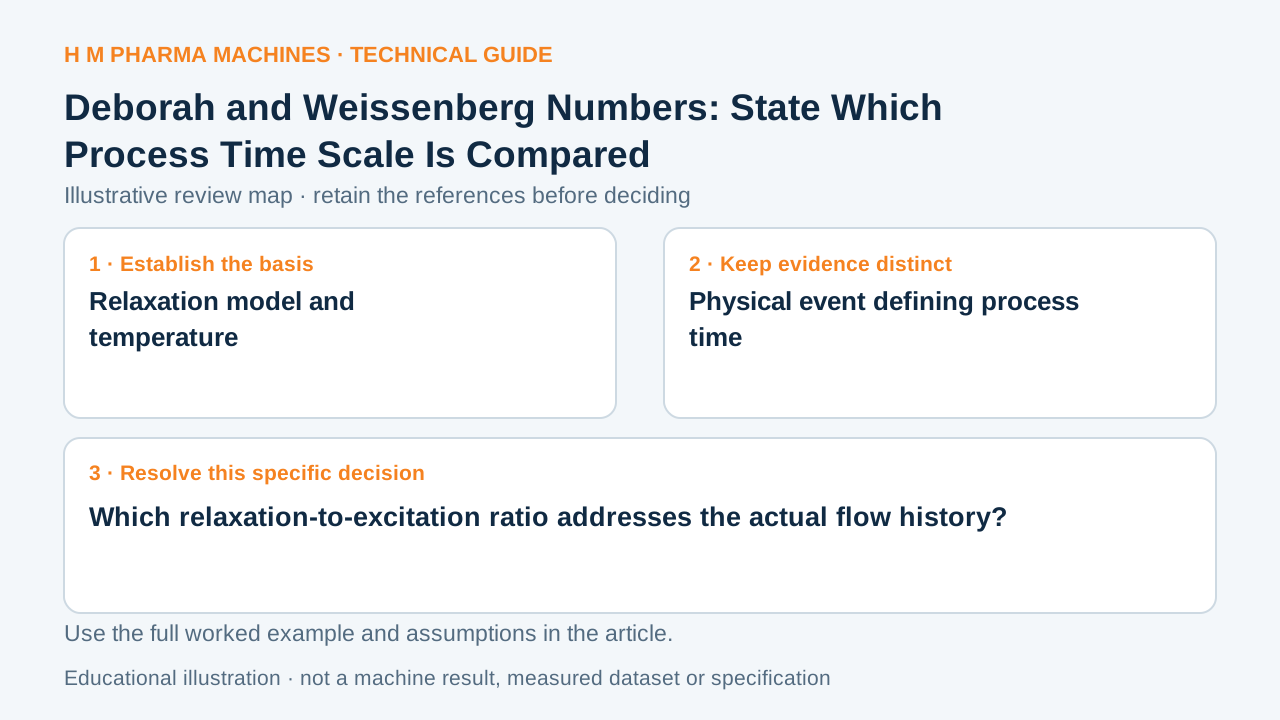
Write the relaxation and excitation timescale definitions before comparing Deborah and Weissenberg values; the names alone do not establish equivalent measures.
Identify the Deformation and Model
The primary viscoelastic-flow paper distinguishes Deborah number λ/t from the kinematic product λγ̇ and from a stress-based Weissenberg definition. A temporal ratio alone does not establish the magnitude of elastic forces. Primary reference: dimensionless definitions and scope.
Review a Hypothetical Comparison
For invented relaxation time λ = 0.5 s, process time t = 2 s and characteristic shear rate 4 per second, Deborah number is 0.25 and the kinematic product is 2. They differ because the selected process time is not the inverse of that rate. The example contains no normal-stress measurement for a stress-based ratio.
Keep the Evidence with the Decision
State what physical event sets the process time: passage, transient forcing or another defined history. Keep the relaxation-time model and temperature beside the calculation. Record whether “Weissenberg” means a kinematic product or an actual stress ratio in the report being compared. Use the same local rate and length/time basis when reviewing two proposed flow models.
Even compatible timescale ratios do not supply every constitutive parameter, elastic modulus or process stability limit. A material with a different stress amplitude can share the same kinematic ratio. The fictional values specify no HM flow condition or acceptable operating region. Their purpose is a definition register that makes incompatible dimensionless quantities visible before they are used to rank formulations or flow paths.
Which relaxation-to-excitation ratio addresses the actual flow history?
This blank worksheet is for your own project. It contains no H M machine trial result.
| Review field | Reference or result | Responsible person |
|---|---|---|
| Relaxation model and temperature | To complete | To complete |
| Physical event defining process time | To complete | To complete |
| Characteristic rate and location | To complete | To complete |
| Kinematic versus stress-based definition | To complete | To complete |
Customer Questions
What Deborah number follows here?
0.25 on the stated process-time basis.
What is the kinematic product?
2; it is not the calculated stress ratio.
Do time ratios alone quantify elastic force magnitude?
No. Additional material/stress evidence matters.
Primary References
These references support the technical principles discussed in this guide. The worked examples and review questions are educational.
Discuss Your Machine Requirement
Share your product, container, required output and the evidence needed for your technical review.
Request a Technical Review