
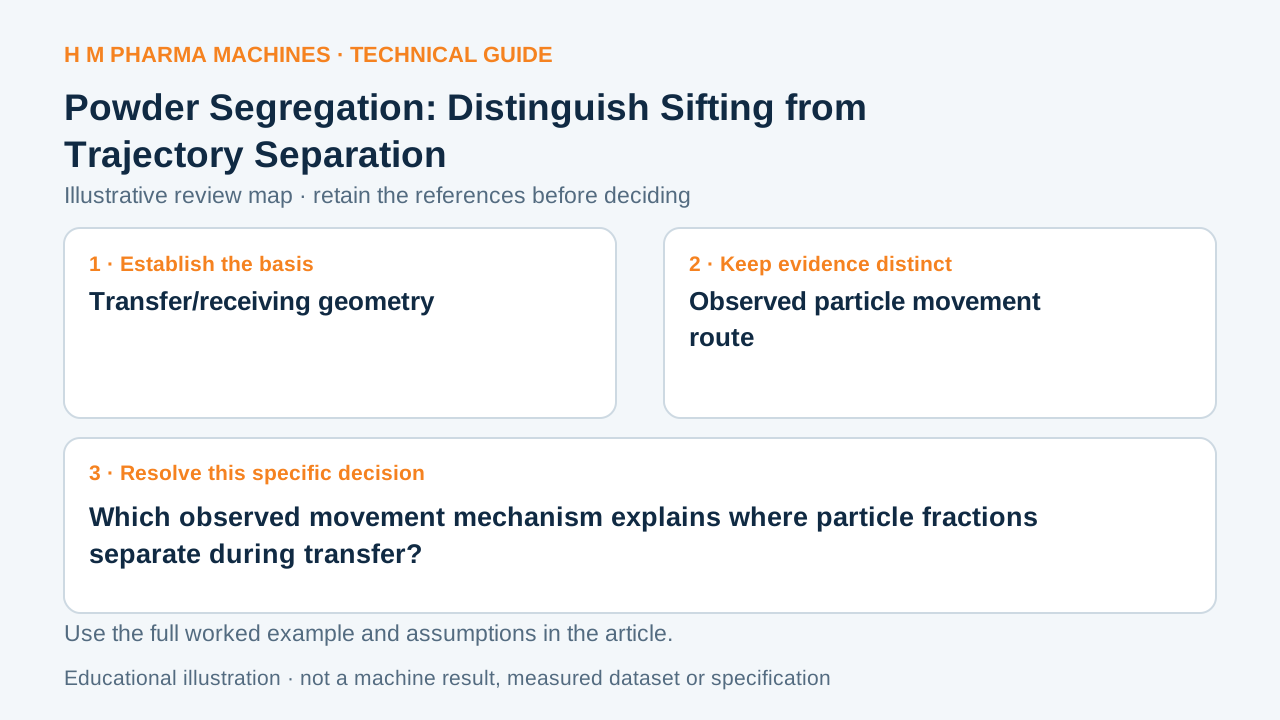
Distinguish particle movement through voids from separation along a free-flight or landing path when investigating where a blend loses uniformity.
Identify the Material Response
Jenike describes fine particles percolating through gaps and other fractions travelling farther during a drop. These movement mechanisms can place fractions in different regions of the receiving material. Primary reference: percolation and transfer paths.
Review a Hypothetical Comparison
Consider two invented observations: small particles move downward through a bed of larger particles during disturbance; elsewhere, fractions land at different distances after a free transfer. The first raises a sifting question and the second a trajectory question. A final composition difference alone would not identify which movement occurred or exclude both acting together.
Keep the Evidence with the Decision
Draw the actual transfer and receiving zones. Record when each fraction is observed moving, and compare locations rather than relying on one convenient surface sample. Preserve the incoming composition, particle-size/density evidence and sampling method. Avoid assuming that every far-travelled fraction is simply the largest: local motion and the material properties determine the actual pattern.
This mechanism review does not prescribe a hopper alteration or a mixing duration. Representative sampling remains necessary, but a sampling plan by itself is not proof of the physical separation route. Use observations to decide which transfer condition needs investigation. The fictional scenarios supply no segregation threshold, supplier case or confirmed HM filling behaviour.
Which observed movement mechanism explains where particle fractions separate during transfer?
This blank worksheet is for your own project. It contains no H M machine trial result.
| Review field | Reference or result | Responsible person |
|---|---|---|
| Transfer/receiving geometry | To complete | To complete |
| Observed particle movement route | To complete | To complete |
| Regional composition and sampling | To complete | To complete |
| Incoming fractions and material evidence | To complete | To complete |
Customer Questions
Does a composition difference identify one mechanism?
No. Observe the movement and relevant regions.
Is sifting the same as a flight trajectory?
No. Their paths and supporting geometry differ.
Can one surface sample represent every region?
Only with an appropriate representative sampling basis.
Primary References
These references support the technical principles discussed in this guide. The worked examples and review questions are educational.
Discuss Your Machine Requirement
Share your product, container, required output and the evidence needed for your technical review.
Request a Technical Review