
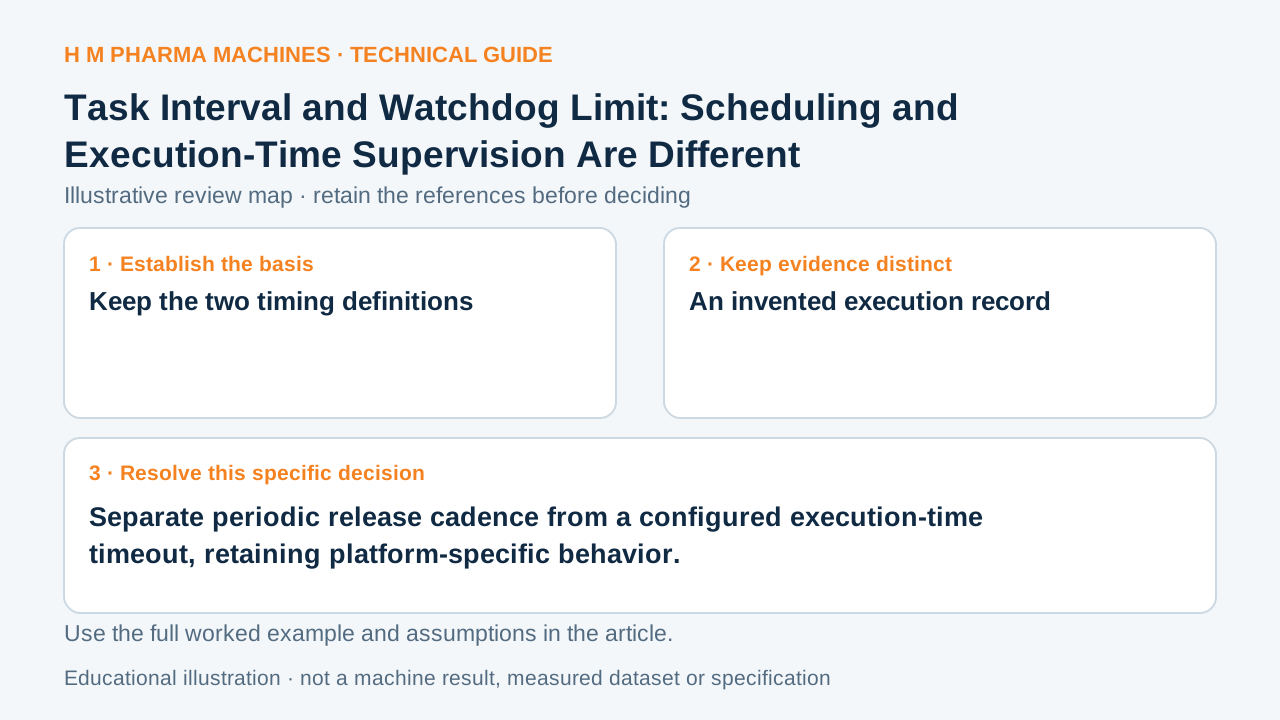
Separate a task’s periodic scheduling interval from the watchdog condition supervising its execution.
Keep the two timing definitions
Schneider describes a task watchdog as execution-time supervision with platform-dependent settings and sensitivity. It is distinct from a configured task cycle interval. Primary reference: task and watchdog configuration.
A periodic interval says when work is scheduled. Execution duration says how long that work takes. The exact controller may also define overrun, jitter and watchdog responses, so these fields should remain attached to its documented behavior rather than treated as one universal timing limit.
An invented execution record
Imagine a fictional task released every 10 ms. Its measured execution durations in three illustrative calls are 2,3 and 12 ms. Against a separately assumed 8 ms execution-time threshold, the third call exceeds that threshold by 4 ms. The 10 ms scheduling interval did not become an 8 ms interval.
Whether and when a real controller raises an exception depends on the actual watchdog rules, including sensitivity and platform behavior. This example uses no installed controller settings, supplies no acceptable CPU loading and recommends no threshold change. It only classifies the reported times.
Prepare separate timing evidence
List configured release interval, observed start times, execution durations and the documented watchdog condition. Keep communication and I/O update histories separate if the application conclusion depends on them.
Ask which timing event an actual fault report identifies. A useful investigation preserves both scheduling and execution evidence, so a long computation is not mislabeled as a changed communication rate or silently resolved by extending an unexplained watchdog setting.
Customer Questions
Is the task interval the watchdog threshold?
They describe different timing fields.
Does one duration predict every platform response?
Retain the actual watchdog and sensitivity rules.
Should the example threshold be installed?
It is a fictional comparison, not an approved setting.
Primary References
These references support the technical principles discussed in this guide. The worked examples and review questions are educational.
Discuss Your Machine Requirement
Share your product, container, required output and the evidence needed for your technical review.
Request a Technical Review