
Write the Discharge Duty Alongside the Holding Duty
A storage tank enquiry often starts with a volume. The useful requirement also explains how the liquid leaves the tank. Identify what the vessel receives, what conditions must be maintained during holding and which operation it supplies next.
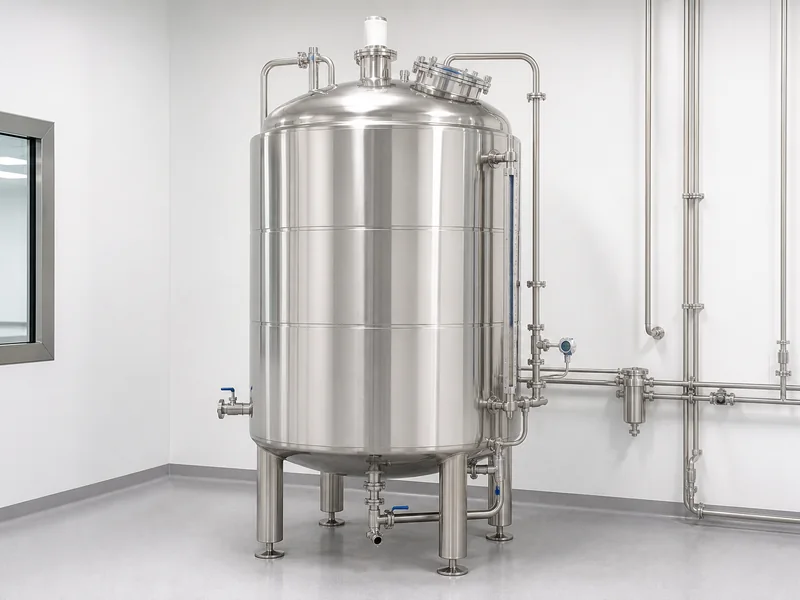
Separate nominal vessel volume from usable working quantity and the intended end-of-batch condition. The same tank volume can lead to different outlet and transfer requirements. H M Pharma Machines lists sanitary receiving and bottom-outlet arrangements for its storage tanks; the selected connections and transfer scope are developed for the approved application.
Review the Outlet on the Actual Drawing
Ask the drawing to identify the outlet position, connection, valve arrangement and surrounding access. A bottom outlet shown on a general product page does not establish the fit of every downstream connection.
Consider the physical route to the next machine and the space needed for the approved connection and cleaning tasks. Note supporting structure, access and interference with nearby equipment. Put unresolved dimensions on the drawing review rather than allowing the installer to discover them after dispatch. The final drawing should represent the ordered tank and its site interfaces.
Match Transfer to Product Condition and Receiving Demand
Describe the product at the time of discharge, including relevant flow behaviour and any holding or conditioning requirement. Explain whether the receiving operation needs intermittent replenishment or a different supply pattern. This helps the parties review the tank and receiver together.
Ask which transfer method, instrumentation and controls are included. Do not assume a pump, recirculation circuit or level function is present because the tank can be connected to one. Record any supply condition required by the receiving filler, and identify which party is responsible for maintaining it.
Trace Every Connection Between Tank and Receiver
List the valves, hoses, fittings and other supplied items along the path. Include buyer-supplied components in the record so that their compatibility and connection duties can be reviewed. Keep product connections distinct from jacket, drain or other service connections.
Agree which drawing controls the route and who supplies supports or line changes. Review access for inspection, removal and the approved cleaning procedure. A complete transfer list prevents a quotation comparison from treating an outlet connection as equivalent to an installed and commissioned transfer system.
Agree an End-of-Batch Observation
If residual product or drainage matters to the purchase, define how it will be reviewed. Record the material, tank arrangement and transfer conditions used. Explain whether the observation concerns the tank alone or the complete path to the receiver.
Keep the result tied to those conditions. Do not convert an observation with one liquid into a universal zero-residue promise. If the demonstration excludes a hose, valve or receiving machine included at the site, note that boundary. The buyer can then identify what remains to be checked on the installed arrangement.
Prepare a Connection and Transfer Worksheet
Use the fields below when reviewing the technical offer. Add a drawing or sample reference wherever an interface could otherwise be ambiguous. These are blank planning fields, not measured performance values.
| Review field | Information to enter |
|---|---|
| Holding and discharge duty | Product, working quantity and next operation |
| Outlet | Drawing revision, valve and connection reference |
| Transfer path | Ordered method, fittings and buyer-supplied items |
| Receiving demand | Required feed condition and responsible party |
| End-of-batch check | Method, scope and identified observation |
| Access | Inspection, removal and cleaning arrangements |
| Open action | Unresolved item, owner and approval stage |
Purchase the Agreed Interface, Not Just the Tank
Request a final offer that separates the vessel, selected conditioning functions, outlet assembly and transfer system. Attach approved drawings and connection schedules. List installation and trial responsibilities as specific items.
If a processing tank feeds storage and storage feeds a bottle filler, review both handoffs. Keep the manuals and agreed test records aligned with the delivered arrangement. A documented interface review helps the buyer understand what the supplier demonstrated, what is included and which site responsibilities still need completion.
Buyer Questions
Does a bottom outlet guarantee zero residual product?
No. Review the actual tank, product and transfer arrangement using an agreed observation method. A general outlet description is not a universal performance result.
Is a transfer pump automatically included with a tank?
No. Identify the transfer method and supplied components in the approved quotation, together with any buyer-supplied items.
Why does the receiving filler matter?
Its required supply condition and replenishment pattern influence the interface. Review the tank discharge and receiver as a connected duty.
Related Equipment and Guides
Primary References
Review these published machine and support pages alongside the approved configuration, actual samples and project documents.
Discuss Your Machine Requirement
Share the machine duty, actual samples, required result and relevant site information with H M Pharma Machines for a technical review.
Request a Technical Review