
In This Guide
- Give each recipe an unambiguous identity
- Separate stroke from motion speed
- Freeze the physical setup before comparing recipes
- Use a change record that explains the decision
- Compare the whole filling sequence
- Release the revision and retain the rejected trials
- Customer Questions
- Product References
- Discuss Your Requirement
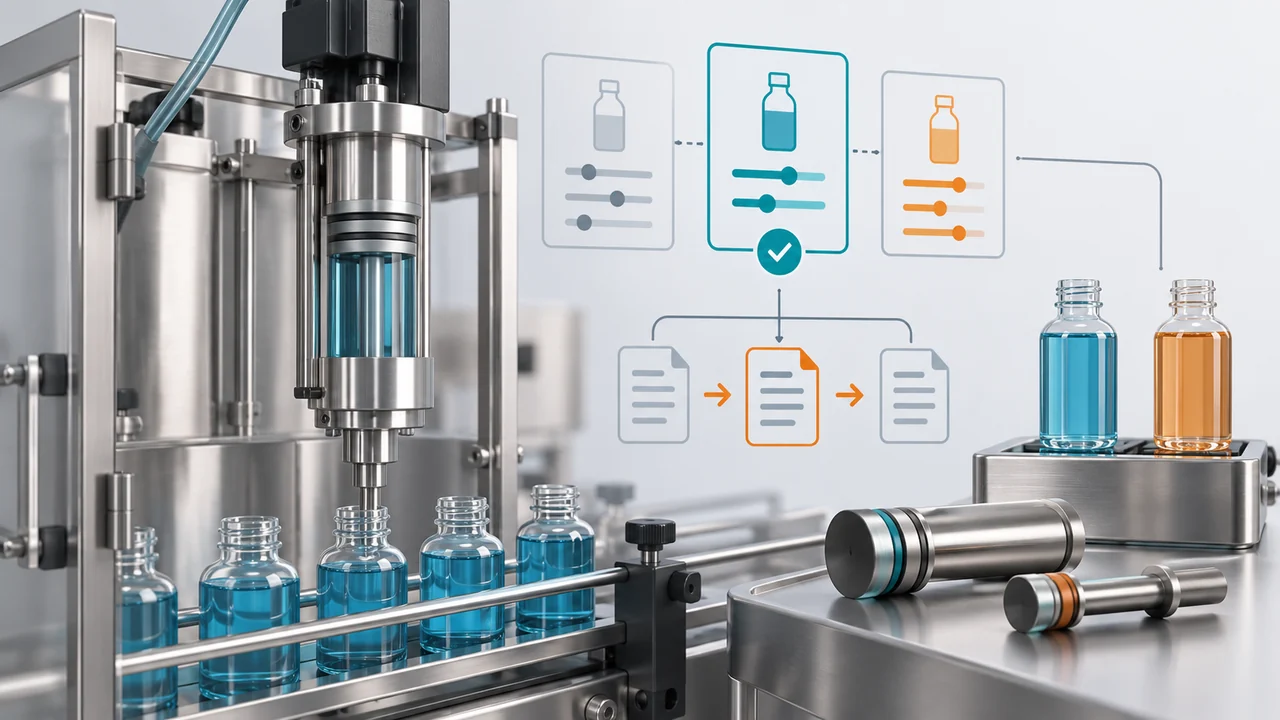
A recipe called “large bottle” is difficult to reproduce when several products, nozzles and container formats share a servo piston liquid filling machine. Two operators may use the same recipe name while working with different stroke or speed settings. The useful record connects the saved parameters to the physical setup and the trial that justified them.
Keep an approved baseline, identify the product and installed format, then record each authorized stroke or speed change separately. Compare dose, intake behavior, nozzle discharge and the complete bottle cycle before accepting a revision. A saved recipe is a configuration record; it does not replace tooling identification or quantity checks.
Give each recipe an unambiguous identity
Start with product identity, required dose, container drawing revision and the intended filling arrangement. Add the nozzle set, piston or cylinder assembly reference and other format parts that affect the cycle. A familiar bottle capacity alone is not enough: the target dose and the neck opening may differ between products using the same bottle.
Use a revision identifier that distinguishes a trial recipe from the released setup. Keep the previous approved version available through the authorized backup process. Record who can edit, review and release recipes rather than allowing a trial name to become a production instruction accidentally.
Separate stroke from motion speed
On a servo piston filler, the controlled piston movement draws and discharges product. Stroke and the motion profile therefore describe different aspects of the cycle. Changing a speed setting to address discharge behavior should not silently change the intended dose movement.
Ask the supplier which screen fields affect travel, intake speed, discharge speed, dwell and nozzle motion on the installed machine. Do not assume parameter names have identical meanings across controllers. Preserve the displayed units and permitted range from the machine documentation when transcribing the record.
Freeze the physical setup before comparing recipes
Record the product condition and feed arrangement before a trial. A different supply level, product temperature or restriction can change the observed intake and discharge, even if the recipe is unchanged. Identify the active heads and retain their individual results instead of combining them into one average.
Confirm that the installed product-contact assembly and nozzle configuration match the baseline. If a physical part must change, treat that as a separate trial revision. Otherwise a better result cannot reliably be attributed to the software setting.
Use a change record that explains the decision
| Record field | Information to preserve |
|---|---|
| Baseline | Recipe identifier, revision and approved physical setup |
| Change | Exact parameter, previous value and trial value with units |
| Reason | Observed intake, foam, discharge or cycle issue |
| Conditions | Product batch, temperature, supply and container identity |
| Results | Quantity checks and bottle observations by head and sequence |
| Disposition | Accept, reject or investigate further, with reviewer |
Attach results to the revision that produced them. A photograph of the HMI is useful supporting evidence, but it should not be the only record if important settings sit on other screens.
Compare the whole filling sequence
Observe whether intake completes consistently, whether discharge splashes or introduces foam, and whether the nozzle withdraws without contaminating the neck. Verify quantity using the agreed method after each relevant change. A visually smoother flow can still deliver an unacceptable dose.
Include normal operation and approved stop-and-restart conditions. Check the bottle as it leaves filling and approaches closure. Do not change multiple motion fields together merely to improve the appearance of one bottle; an interpretable comparison is more useful than an unexplained collection of settings.
Release the revision and retain the rejected trials
Approve a recipe only with its operating conditions, matching parts and acceptance results. Record what an operator should check before loading it, including the correct product, container and nozzle arrangement. Confirm the backup and restoration method with the controls owner.
Retain rejected trial revisions as clearly identified evidence, outside the normal production selection path where possible. Their observations can explain why a previous motion profile was abandoned. When requesting support from a filling machine manufacturer in India, send the baseline, the specific change and the resulting samples together.
Customer Questions
Can one recipe name cover several bottle sizes?
Only if the approved configuration deliberately covers those formats and their physical setups are clearly identified. A broad name alone does not establish compatibility.
Should speed be changed whenever the measured dose is wrong?
First confirm the measurement, product condition and installed setup. The authorized review should distinguish dose movement from intake or discharge speed before changing either.
Does saving a recipe prove it is ready for production?
No. Release requires review of the matching physical configuration, quantity results and complete filling behavior under the agreed conditions.
Product References and Further Details
These pages describe published equipment arrangements. Review the supplied machine, actual materials and agreed operating requirements when applying the guide.
Discuss Your Machine Requirement
Share your product, container or closure samples, required output, process conditions and line layout with H M Pharma Machines for a technical review.
Request a Technical Review