
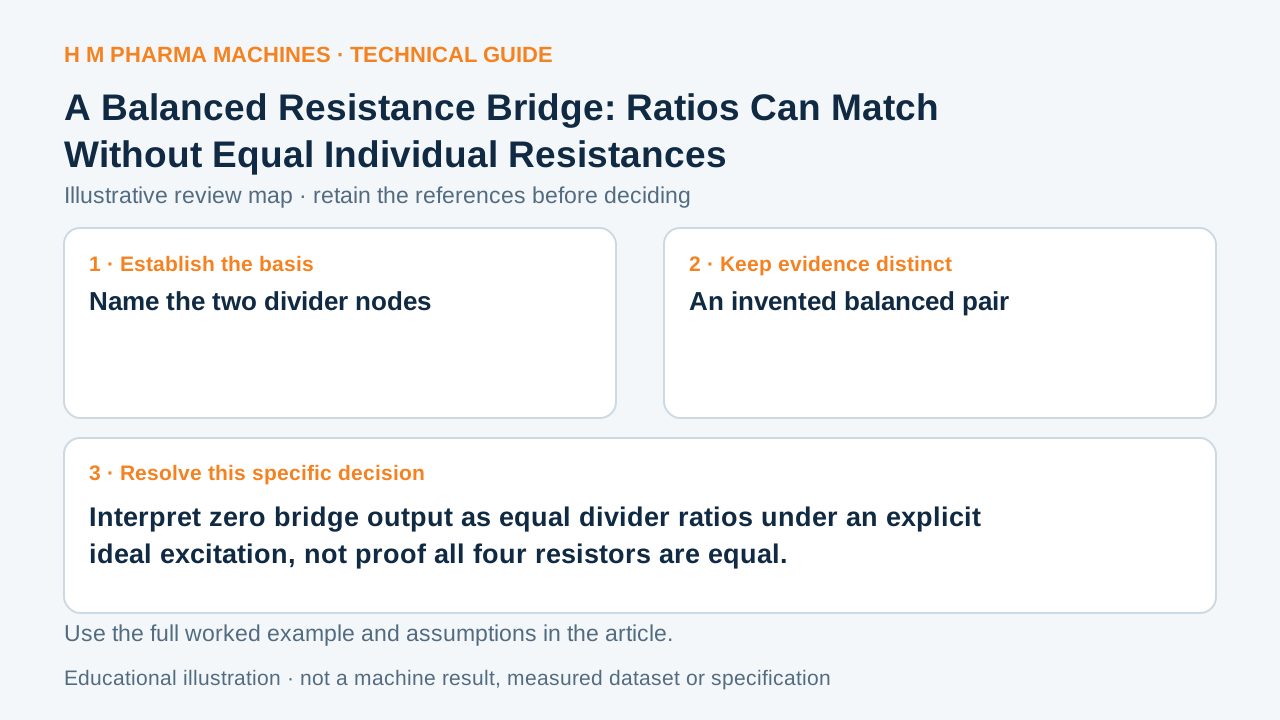
Interpret bridge balance through divider ratios instead of assuming all four resistance values must be identical.
Name the two divider nodes
NI describes a Wheatstone bridge as two voltage dividers whose midpoint difference is the output. Balance occurs when the appropriate resistance ratios match. Primary reference: bridge configuration.
Preserve the chosen top and bottom arm labels. Reversing one ratio silently changes the comparison. A zero midpoint difference under the model says something about relative divider proportions, rather than identifying the absolute value of every arm.
An invented balanced pair
Assume one ideal divider has top resistance 100 Ω and bottom resistance 200 Ω. A second has top 300 Ω and bottom 600 Ω. With the same fictional 6 V excitation, both midpoint voltages are 6×2/3 = 4 V. Their difference is zero although none of the corresponding arms has equal resistance.
If the second bottom arm becomes 630 Ω while its top remains 300 Ω, that midpoint becomes approximately 4.0645 V. The output magnitude is approximately 0.0645 V. Output sign depends on which midpoint the stated measurement subtracts.
Keep balance separate from performance
Create fields for arm names, actual values, excitation, midpoint voltages and subtraction direction. List any source or input-loading assumptions beside the calculation.
An observed zero could also involve instrument resolution, offsets or an actual circuit problem; the ideal balance calculation does not diagnose them. It gives a reviewer a coherent ratio question before interpreting bridge evidence or requesting a sensor-specific assessment.
Customer Questions
Must all four resistances be equal?
Matching divider ratios can also produce ideal balance.
Does zero output identify the arm values?
Several different value sets can share the same ratio.
Is the output sign universal?
Keep the defined midpoint subtraction direction.
Primary References
These references support the technical principles discussed in this guide. The worked examples and review questions are educational.
Discuss Your Machine Requirement
Share your product, container, required output and the evidence needed for your technical review.
Request a Technical Review