
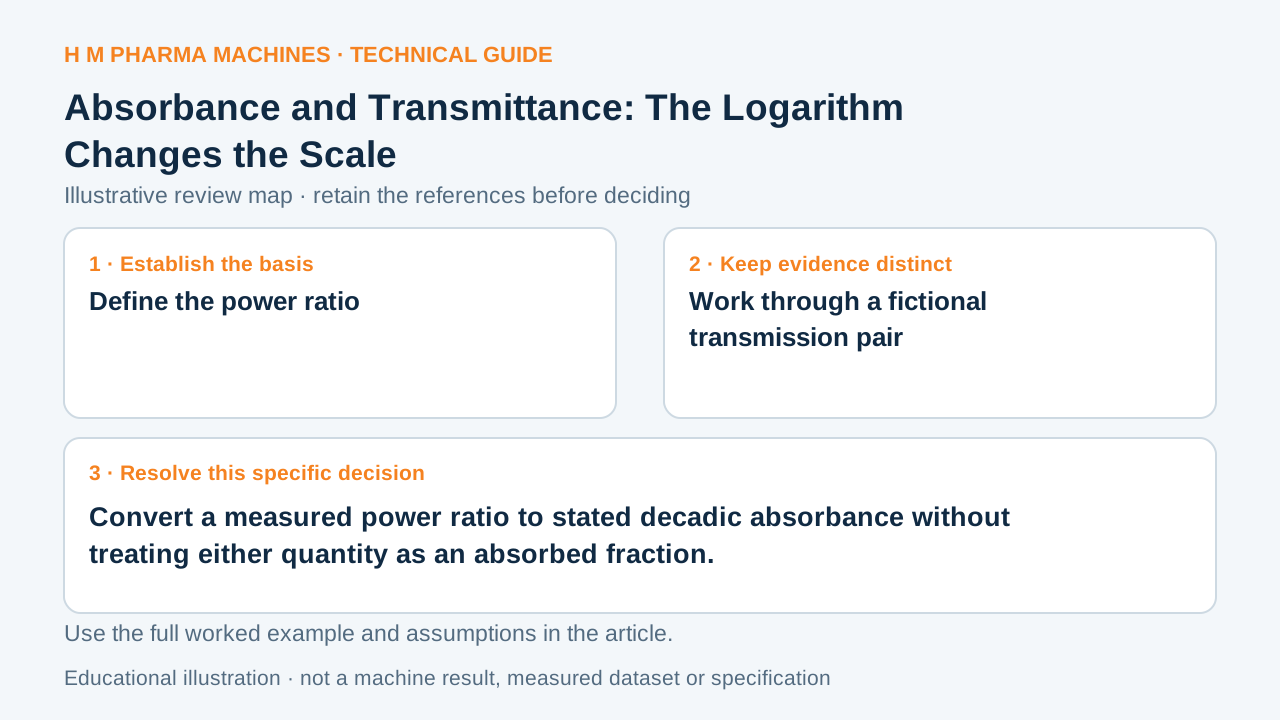
A percentage transmission and an absorbance number describe the same defined power ratio on different scales.
Define the power ratio
Let P0 denote the reference radiant power and P the transmitted power under matching optical conditions. Decadic absorbance is A = log10(P0/P) = -log10(T), where T = P/P0. State the logarithm base when exchanging a result. A logarithm using base e produces a different numerical quantity. Primary reference: IUPAC: absorbance.
This ratio does not automatically isolate absorption from every loss in a practical measurement. The reference and treatment of cell walls, scattering and other contributions matter. Calling A an absorbed percentage loses both the logarithmic definition and the optical conditions.
Work through a fictional transmission pair
Consider an invented worksheet with reference power 100 units and sample power 25 units. T is 0.25, transmission is 25 percent and decadic A is about 0.60206. At sample power 50 units, T becomes 0.5 and A is about 0.30103. Doubling transmitted power halves A in this particular pair; it does not create a general linear scale.
The complement 1 - T is 0.75 for the first row. It is a fractional loss of the defined transmitted beam, not the number 0.60206. Keep separate columns so a reviewer cannot accidentally multiply absorbance by 100 and report an absorption percentage.
Build a ratio-to-log worksheet
Enter P0, P, T, percent transmission, log base and calculated A in separate fields. Recalculate one row directly from the raw powers rather than trusting a display label. Retain the reference identity with the wavelength and cell configuration.
For a second check, reconstruct T = 10^(-A) and compare it with the original ratio. A disagreement identifies an arithmetic or convention problem before anyone interprets sample composition. The invented powers demonstrate notation only and establish no product specification or laboratory acceptance limit.
Customer Questions
Is A = 0.60206 the same as 60.206 percent loss?
No; that row has T = 0.25.
Which logarithm is used here?
Base 10 is explicitly defined.
Does the example identify a chemical?
No; it only converts a ratio.
Primary References
These references support the technical principles discussed in this guide. The worked examples and review questions are educational.
Discuss Your Machine Requirement
Share your product, container, required output and the evidence needed for your technical review.
Request a Technical Review