
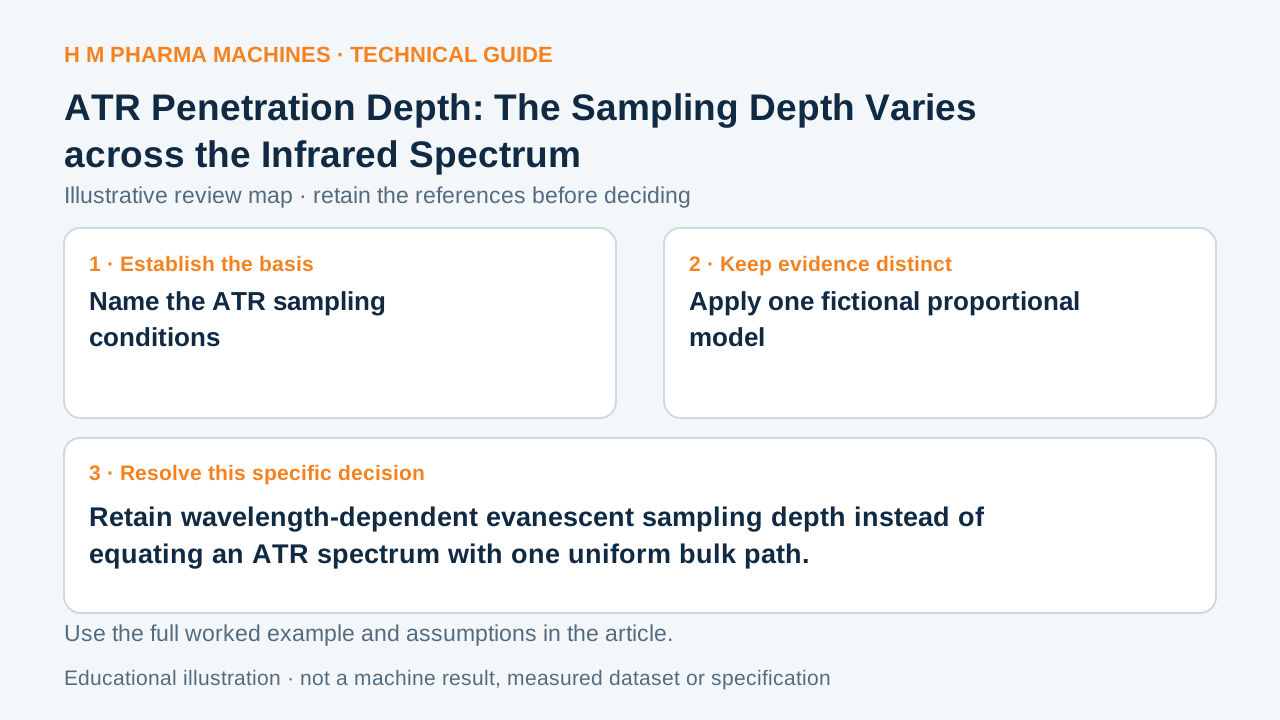
ATR uses an evanescent sampling field whose penetration depth changes with optical conditions and wavelength.
Name the ATR sampling conditions
In attenuated total reflection, penetration depth depends on wavelength, incidence angle and the refractive indices of the prism and sample. Longer wavelengths can give deeper penetration when the other relevant conditions remain fixed. ATR sampling therefore differs from transmission through one constant geometrical bulk path. Primary reference: Shimadzu: ATR penetration depth.
The depth depends on more than a list of spectral coordinates. Contact and the material near the interface also affect the practical observation. Treating every band as if it sampled an identical thickness can conceal which physical comparison is being assumed.
Apply one fictional proportional model
Suppose a hypothetical fixed-angle, fixed-index model assigns penetration depth 1 arbitrary length unit at wavelength 4 micrometres. With every factor other than wavelength held fixed, proportional scaling gives depth 2 at 8 micrometres. The wavelengths correspond to 2500 and 1250 cm^-1.
These depths are invented relative values, not a crystal specification. The fixed-index assumption may fail across a real spectrum. The calculation illustrates why a longer-wavelength band can involve another effective sampling depth even though the physical contact face has not moved.
Prepare an interface comparison worksheet
Record crystal material, angle basis, sample refractive-index information, wavelength and the depth model used. Add the sample-contact condition and whether the material is homogeneous near the interface. Leave unknown physical quantities marked unknown instead of substituting a generic thickness.
When comparing ATR and transmission spectra, inspect the method and applicable correction model before explaining intensity differences as composition changes. Use the worksheet to identify depth assumptions requiring evidence. The original scaling example does not determine an absolute depth, establish surface composition or claim that any HM product includes an ATR instrument.
Customer Questions
Is the invented depth an absolute specification?
No; it only shows relative scaling.
Which factors are held fixed?
Angle and both refractive-index factors.
Is ATR the same as a constant bulk path?
Its sampling field follows other conditions.
Primary References
These references support the technical principles discussed in this guide. The worked examples and review questions are educational.
Discuss Your Machine Requirement
Share your product, container, required output and the evidence needed for your technical review.
Request a Technical Review