
A learning background model can change while the scene feature remains stationary. Its update history belongs to the resulting classification.
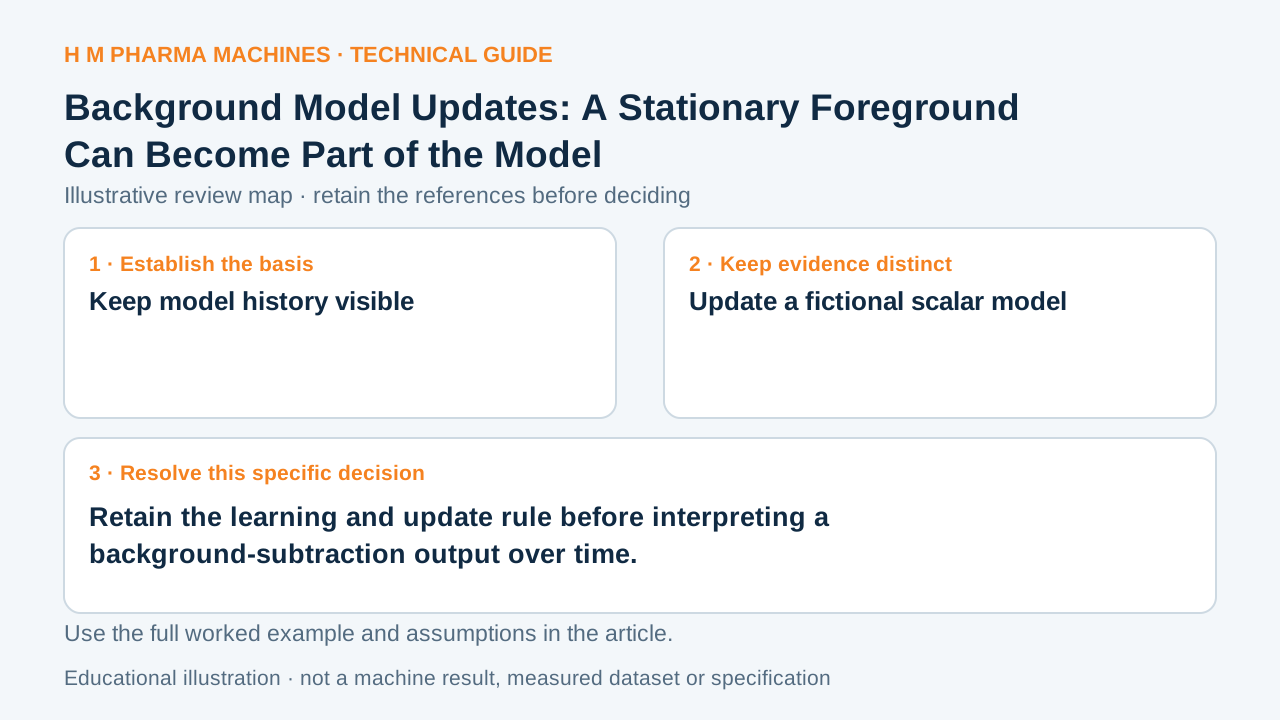
Keep model history visible
Background subtraction compares the current image with a model that can be initialized and updated over time. The update rule and learning behavior influence what the model represents. A stationary foreground's later treatment therefore needs that history instead of being explained solely from its current image value. Primary reference: OpenCV background initialization and model updates.
For an original worksheet, retain the initial model, successive observations and the classification/update order. A learning-rate label does not specify every algorithm's behavior. Keep the documented model separate from a simpler teaching recurrence used to inspect one possible adaptation mechanism.
Update a fictional scalar model
Define a toy recurrence Bnext = 0.5B + 0.5I, starting B = 0 with repeated stationary observation I = 100. Successive models are 50,75 and 87.5. If this invented rule classifies after each update using residual greater than 20, residuals 50,25 and 12.5 give foreground, foreground and background.
The input stayed 100 throughout. This is an expressly fictional scalar model, not the exact MOG2 or KNN implementation or a recommended learning rate. Its result shows why update history and decision order can matter without predicting the behavior of an unspecified camera system.
Review adaptation with the task
Prepare an original timeline of model state, input and residual under the actual documented method. Include the scene feature's stationary interval when that is relevant. If the result changes, inspect learning and update order before claiming that the object disappeared or the acquired feature became unchanged background.
This guide claims no HM background-subtraction capability or universal adaptation setting. Its reader decision is whether model evolution is retained in the explanation. Actual task evaluation must examine the feature and update behavior required by the application rather than adopting the toy classification as an acceptance rule.
Customer Questions
Does the fictional input change?
No. It remains one hundred.
What is the third model state?
Eighty-seven point five.
Is the recurrence a claimed MOG2 default?
No. It is explicitly a teaching model.
Primary References
These references support the technical principles discussed in this guide. The worked examples and review questions are educational.
Discuss Your Machine Requirement
Share your product, container, required output and the evidence needed for your technical review.
Request a Technical Review