
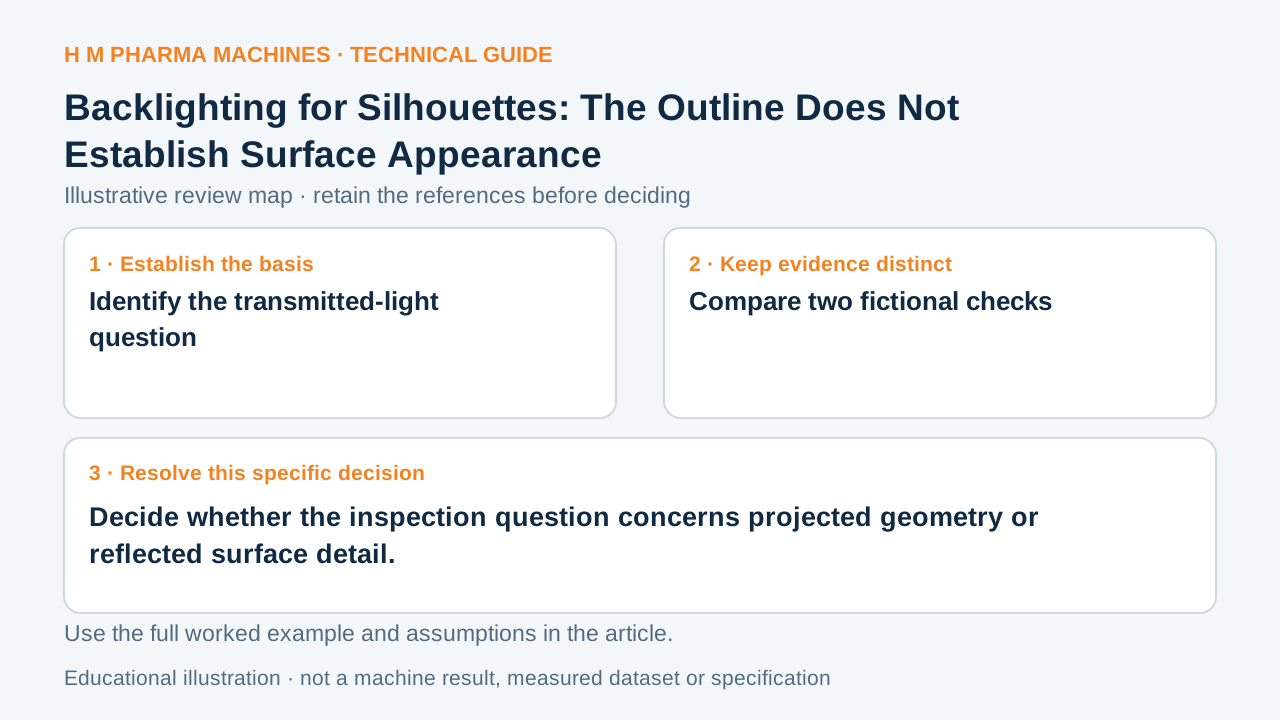
An outline can be clear while a front-surface print remains unobserved. Define what the image must show before accepting a backlight demonstration.
Identify the transmitted-light question
A backlight places illumination behind the object relative to the camera. For an opaque object, its blocked light can create a silhouette with strong edge contrast. That geometry does not directly provide the same evidence as light reflected from the front surface. Primary reference: Edmund Optics: backlight illumination for machine vision.
Separate questions about a projected contour, a transmitted region and front-surface appearance. Transparent or translucent material may transmit and redistribute light, so its image must be interpreted under the actual condition. Do not assume that every dark boundary has the same physical meaning.
Compare two fictional checks
Imagine task A asks whether a cap's projected outer outline contains a missing segment. Task B asks whether a word printed on its front is correct. A hypothetical silhouette showing the complete cap boundary can address A's geometry question while leaving B's surface-print question unresolved.
This example gives no dimensional accuracy, missing-segment threshold or actual detection outcome. It deliberately separates the observations required by the tasks. If the real object transmits light, retain the actual images before deciding which internal or surface features are observable through it.
Mark the required contour and pose
Put the relevant edge or transmitted region on an annotated trial image and record the allowed object orientation. Keep the backlight position, camera viewpoint and exposure state with the evidence. A rotated object can change its projected outline without changing the physical feature being inspected.
Where the task includes both contour and printed appearance, ask how each receives suitable acquisition evidence. One lighting mode need not answer both. Review the original images at the required object positions and state the unresolved question explicitly before treating a visually clean silhouette as a complete packaging-inspection result.
Customer Questions
Does an opaque silhouette show front-surface print?
It generally supplies blocked-light outline evidence rather than that reflected-print observation.
Why retain object pose?
Pose affects the contour projected into the camera view.
Is a clean outline a dimensional specification?
No. Its measurement task requires its own calibration and evidence.
Primary References
These references support the technical principles discussed in this guide. The worked examples and review questions are educational.
Discuss Your Machine Requirement
Share your product, container, required output and the evidence needed for your technical review.
Request a Technical Review