
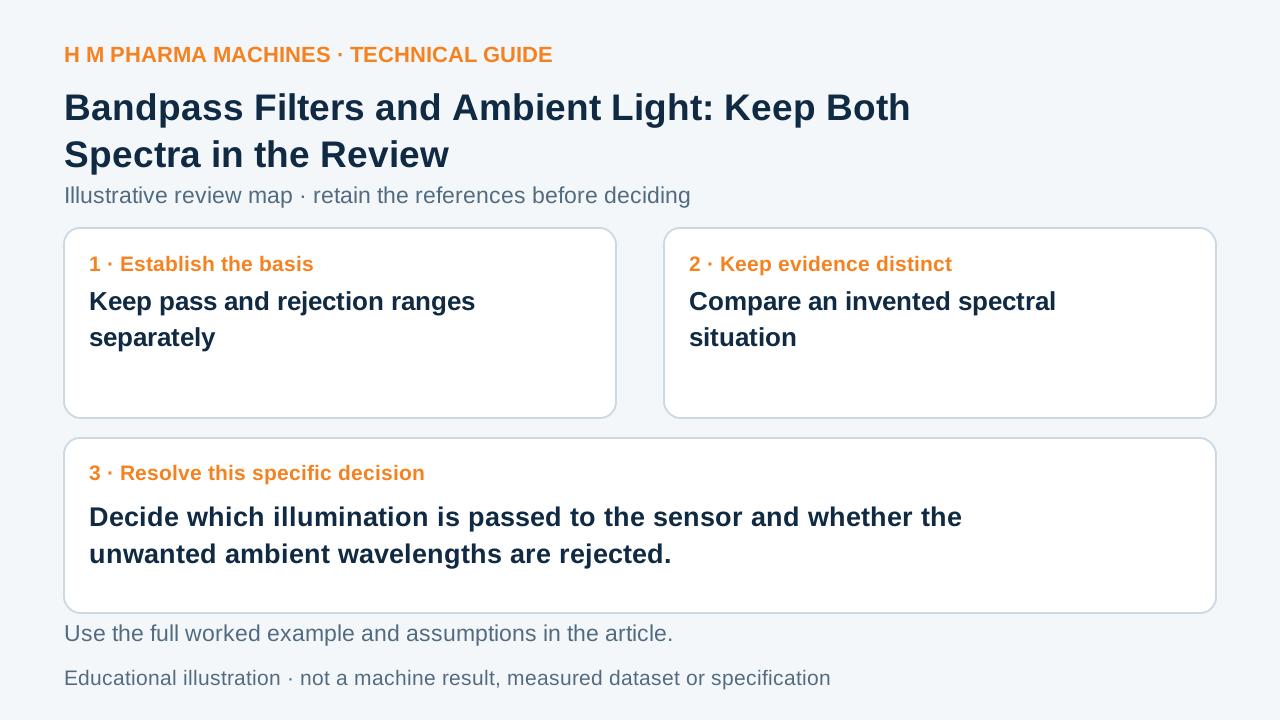
A bandpass filter selects wavelengths. It cannot distinguish a wanted lamp from ambient light when both contribute within the passed band.
Keep pass and rejection ranges separately
A bandpass filter transmits a selected wavelength region while attenuating other regions. Its passband and blocking behaviour describe different parts of the spectrum. A centre-wavelength label alone does not identify the full transmission curve or the rejection of every unwanted contribution. Primary reference: Edmund Optics: bandpass-filter spectral selection.
Record the wanted source spectrum and the ambient spectra that may reach the object and camera. The filter acts on incoming wavelength, rather than source identity. Ambient energy inside the passed band can remain in the image even when out-of-band contributions are strongly reduced.
Compare an invented spectral situation
Suppose a fictional wanted source emits mainly around 630 nm and the selected filter passes an invented 620–640 nm interval. Ambient contribution at 530 nm is outside that interval, while an ambient contribution at 630 nm lies inside it. The latter cannot be rejected merely because it came from a different lamp.
This illustration uses idealized bands and gives no real transmission percentage, optical density or camera sensitivity. It is not a product selection or a claim of complete ambient immunity. Real source widths and filter curves need to replace the fictional intervals in the review.
Review the complete installed path
Request applicable spectral curves and identify the incidence conditions under which they apply. Preserve the filter identity, mounting arrangement and illumination state with the trial images. Compare the task under the ambient conditions expected at the installation rather than testing only in a darkened demonstration area.
If the source or surrounding lighting changes, reopen the spectral overlap check. Record which residual contribution remains and whether the actual decision feature is still supported by the evidence. A reduced background or cleaner screenshot can be encouraging, but it does not establish isolation from all ambient light.
Customer Questions
Can a filter identify which lamp emitted a wavelength?
No. It selects by wavelength, not by source identity.
Does centre wavelength specify all rejection?
No. Retain the transmission and blocking information.
Which ambient conditions should be tested?
Use the relevant installation conditions and keep them with the original images.
Primary References
These references support the technical principles discussed in this guide. The worked examples and review questions are educational.
Discuss Your Machine Requirement
Share your product, container, required output and the evidence needed for your technical review.
Request a Technical Review