
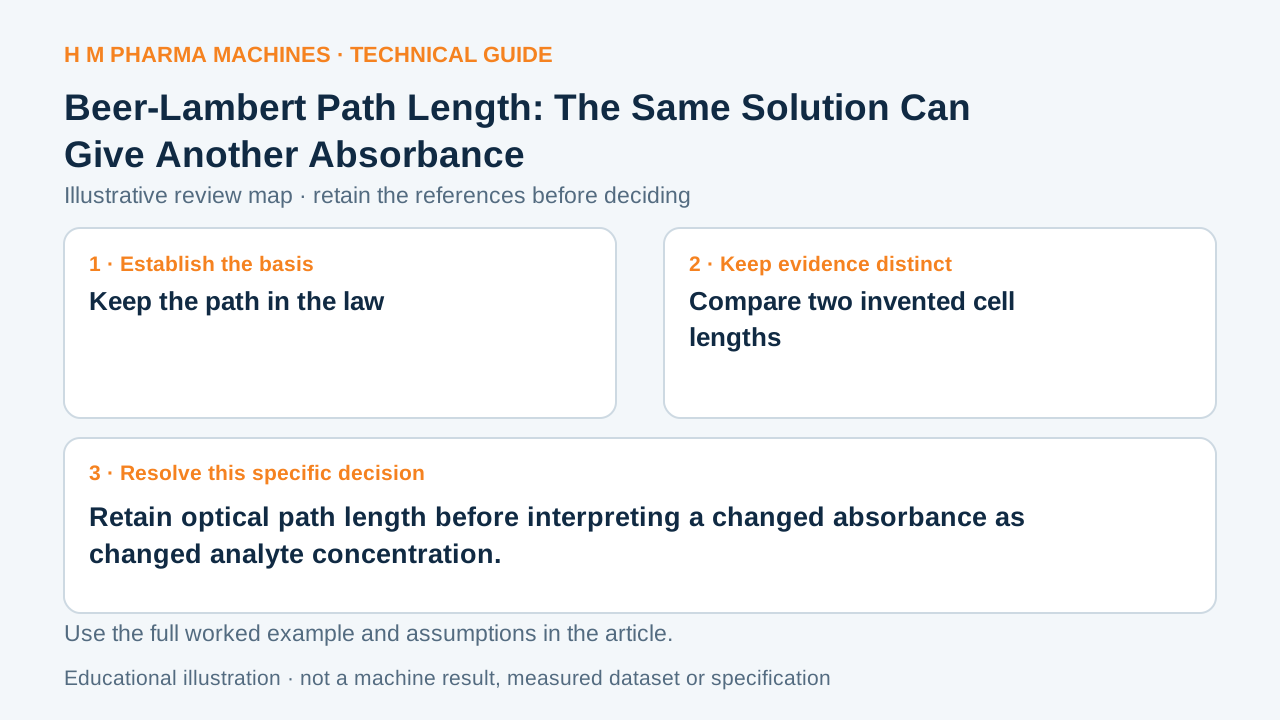
A changed cell path can change absorbance even when the modeled solution concentration stays fixed.
Keep the path in the law
The Beer-Lambert relationship writes decadic absorbance as A = epsilon c l. The absorption coefficient, concentration and optical path must use compatible units. Its ideal statement concerns collimated monochromatic radiation in a homogeneous isotropic medium; the spectral bandwidth and behavior of the real sample require attention. Primary reference: IUPAC: Beer-Lambert law.
When epsilon and c remain fixed in that model, A is proportional to l. A larger reading therefore need not mean that more solute was added. Comparing results from different cells without their path lengths leaves a physical input out of the interpretation.
Compare two invented cell lengths
In a fictional calculation, set epsilon to 100 L/(mol cm), c to 0.002 mol/L and l to 1 cm. A is 0.2. Change only l to 2 cm and A becomes 0.4. The concentration is identical in both rows by definition, while the modeled transmitted fractions are approximately 0.6310 and 0.3981.
Recovering c from the second row with a mistaken 1 cm path gives 0.004 mol/L, twice the stipulated value. This discrepancy comes from the input convention, not demonstrated chemistry. It also shows why a transmission change should not be interpreted by an unqualified proportional percentage rule.
Review cell and coefficient fields
Record cell identity, actual optical path, path unit, wavelength, coefficient basis and concentration unit. Write the multiplication with units once: L/(mol cm) times mol/L times cm cancels to a dimensionless absorbance.
Before comparing two reported concentrations, inspect whether their methods used equivalent coefficients and optical conditions. If the sample fails the stated model, dividing by path does not repair it. The worksheet is an original ideal example rather than a validated assay or a claim about any supplied instrument.
Customer Questions
Why does the second A double?
The fictional path doubles.
Did the solution concentration double?
It remains 0.002 mol/L.
Is path correction enough for every sample?
No; the model assumptions still matter.
Primary References
These references support the technical principles discussed in this guide. The worked examples and review questions are educational.
Discuss Your Machine Requirement
Share your product, container, required output and the evidence needed for your technical review.
Request a Technical Review