
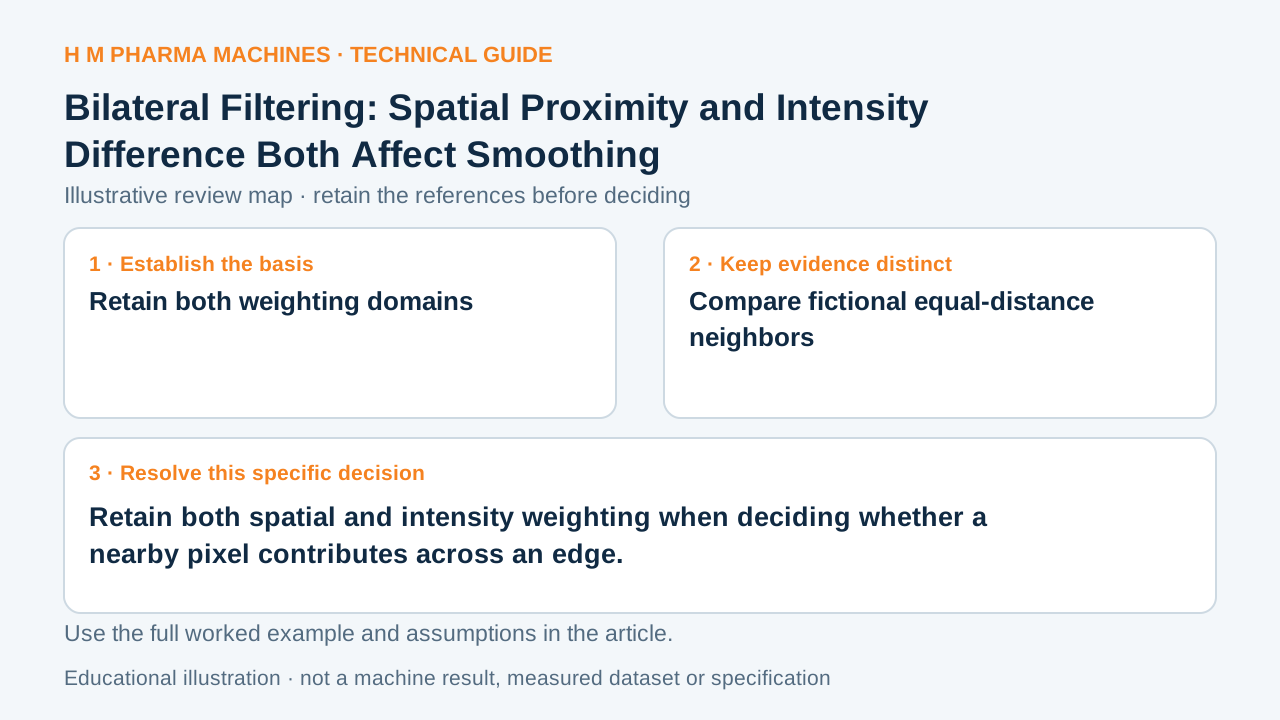
A nearby pixel need not contribute strongly to bilateral smoothing if its intensity is very different. The two weighting domains need separate parameters.
Retain both weighting domains
Bilateral filtering combines spatial closeness with intensity or color similarity in a normalized neighborhood average. Unlike a fixed spatial-only kernel, its range weights depend on the input values. The choice of intensity-distance scale therefore changes how nearby pixels contribute across a value boundary. Primary reference: Tomasi and Manduchi bilateral filtering formulation.
For an original worksheet, keep spatial distance, value difference and their scales in separate fields. Do not equate a small spatial gap with high intensity similarity. Also state whether the model uses scalar grayscale differences or another expressly defined multichannel distance.
Compare fictional equal-distance neighbors
Consider two hypothetical neighbors at the same spatial distance from a center value 0. One has value 0 and the other 100. With a defined Gaussian range scale 20, their range-weight factors are 1 and exp(−100²/(2 ×20²)) = exp(−12.5), about 0.00000373.
Their equal spatial factor does not remove this large difference in range contribution. The complete output still requires normalization across the whole chosen neighborhood, including the center and other samples. This original weight comparison is not an exact output from a deployed image-processing system.
Review the parameters and input
Prepare a trial with the actual input patch and calculated spatial and range weights. Retain the normalization denominator alongside the weighted sum. If intensity units or channel distance change, revisit the range scale rather than copying its numerical value unchanged.
No scale in this guide is a camera calibration or an HM inspection setting. Bilateral processing does not establish the physical cause of an intensity edge or guarantee preservation of every required feature. Its reader decision is whether both distance domains were included in the smoothing definition.
Customer Questions
Do equally close pixels receive equal bilateral weights?
Not necessarily; their intensity differences can change the range factor.
What is the large-difference range factor in the example?
Approximately 0.00000373 before full neighborhood normalization.
Does that factor alone give the output intensity?
No. All selected contributions and normalization are still needed.
Primary References
These references support the technical principles discussed in this guide. The worked examples and review questions are educational.
Discuss Your Machine Requirement
Share your product, container, required output and the evidence needed for your technical review.
Request a Technical Review