
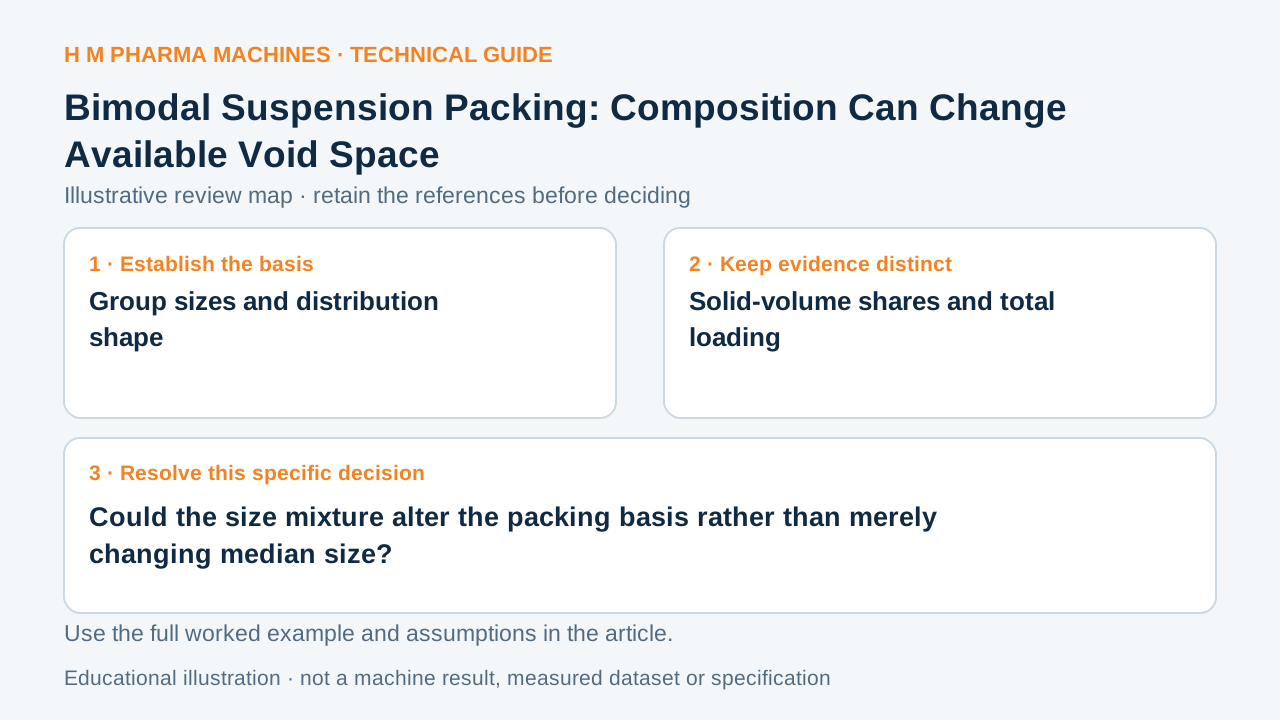
Review the size-mixture composition when changing a dense suspension; a median size alone leaves the packing relationship unresolved.
Identify the Deformation and Model
The primary bidisperse-suspension paper links size-distribution changes to maximum flowable packing and rheology within its noncolloidal simulation setting. This is a mechanism to assess, not a universal optimum mixture ratio. Primary reference: size mixture and packing.
Review a Hypothetical Comparison
Imagine two fictional size mixtures both occupy 0.40 L solid in a 1 L mixture. The first assigns 0.30 L to larger particles and 0.10 L to smaller ones; the second assigns 0.20 L to each group. Total solid fraction is unchanged, while the larger-particle share changes from 75 to 50 percent. That arithmetic alone does not calculate a packing maximum.
Keep the Evidence with the Decision
Retain size ratio, solid-volume shares and particle shape rather than only the combined median. Ask whether smaller particles enter available void space under the actual interactions and flow conditions. Compare formulation evidence at a common total loading and continuous-liquid state. Distinguish a possible packing explanation from a measured change in viscosity or stability.
Real distributions, contact interactions and particle associations can change the outcome, so a two-size sketch does not establish an optimum or guarantee reduced viscosity. The invented composition supplies no material recipe, vendor recommended mix or HM performance. The worksheet should identify which size-distribution information is needed to evaluate packing without changing several other formulation variables unnoticed.
Could the size mixture alter the packing basis rather than merely changing median size?
This blank worksheet is for your own project. It contains no H M machine trial result.
| Review field | Reference or result | Responsible person |
|---|---|---|
| Group sizes and distribution shape | To complete | To complete |
| Solid-volume shares and total loading | To complete | To complete |
| Interactions/shape and void-space hypothesis | To complete | To complete |
| Common-condition material comparisons | To complete | To complete |
Customer Questions
Did total solid loading change between the examples?
No. It remains 0.40 by volume.
What changed in the larger-particle share?
It changed from 75 to 50 percent of solids.
Does that arithmetic identify an optimum mixture?
No. Packing and rheology require evidence.
Primary References
These references support the technical principles discussed in this guide. The worked examples and review questions are educational.
Discuss Your Machine Requirement
Share your product, container, required output and the evidence needed for your technical review.
Request a Technical Review