
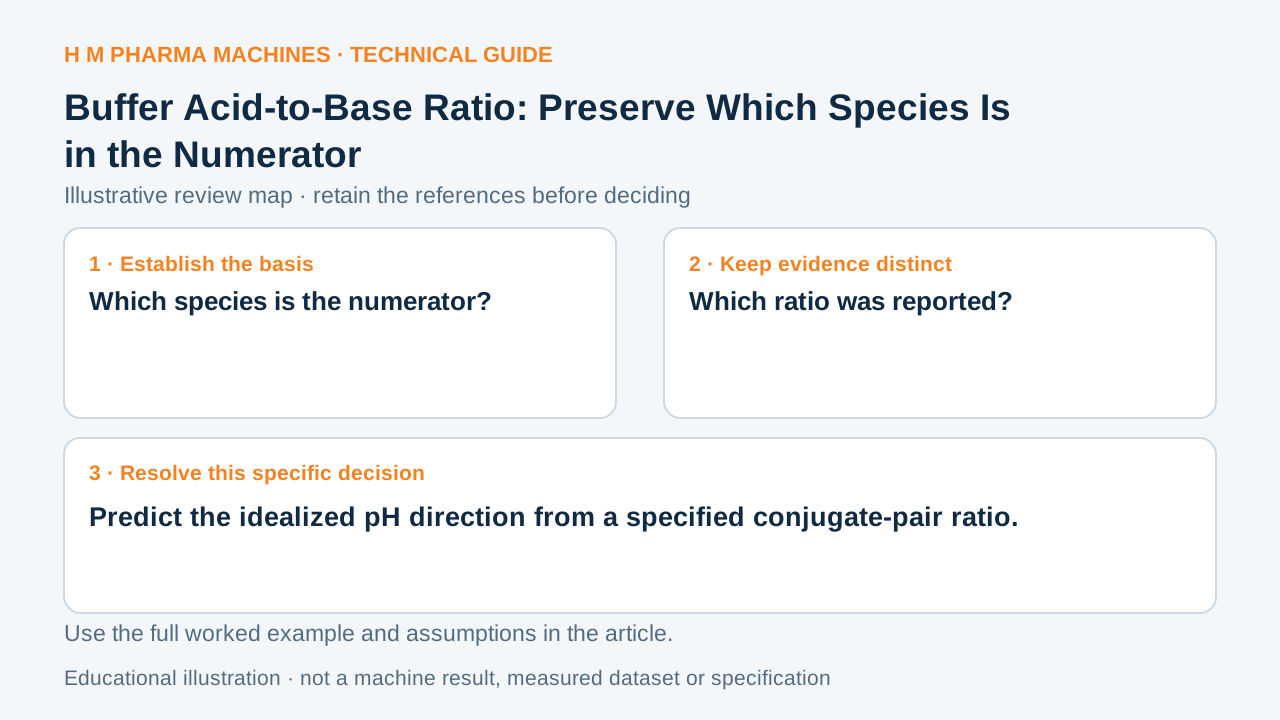
A conjugate acid/base ratio enters a logarithmic pH relationship in a specified direction. Reversing its numerator changes the predicted side of the pKa.
Keep base above acid in the ratio
For a specified weak acid and conjugate base under the stated idealized concentration approximation, the Henderson–Hasselbalch relationship is pH = pKa + log₁₀([Base]/[Acid]). The numerator is the conjugate base; reversing it changes the logarithm’s sign. Actual activity effects require separate consideration. Primary reference.
Compare two constructed ratios
Assign an invented pKa of 5.00 and an idealized base-to-acid ratio of 4.00. The model pH is 5.00 + log₁₀(4.00) ≈ 5.602. With the reciprocal ratio 0.250, the model gives approximately 4.398.
The two results lie the same logarithmic distance on opposite sides of the assigned pKa. An equal ratio of one gives the assigned pKa in this model. No real buffer ingredients, concentration, temperature constant or approved pH target are supplied by these constructed ratios.
Retain the approximation boundary
Prepare an original ratio calculation that identifies both species before substituting numbers. Preserve whether the values are activities or concentrations, and what approximation permits the latter. A reported acid-to-base ratio can still be used, but its reciprocal is needed in the displayed base-to-acid formula.
This article checks the direction of an equilibrium calculation rather than buffer capacity under a later chemical addition. Equal ratios need not imply equal available inventories. Keep the ratio interpretation with its method assumptions and retain any actual measurement independently of this teaching model.
Solution review worksheet
This blank worksheet is for your own project. It contains no H M machine trial result.
| Question | Record to retain |
|---|---|
| Which species is the numerator? | Conjugate base |
| Which ratio was reported? | Base/acid or acid/base, explicitly labelled |
| Which convention is applied? | Activities or a stated concentration approximation |
Customer Questions
What is the fictional pH at base/acid = 4?
Approximately 5.602.
What happens when that ratio is inverted?
The fictional pH becomes approximately 4.398.
Does the ratio determine finite buffer capacity?
No. The available inventories also matter.
Primary References
These references support the technical principles discussed in this guide. The worked examples and review questions are educational.
Discuss Your Machine Requirement
Share your product, container, required output and the evidence needed for your technical review.
Request a Technical Review