
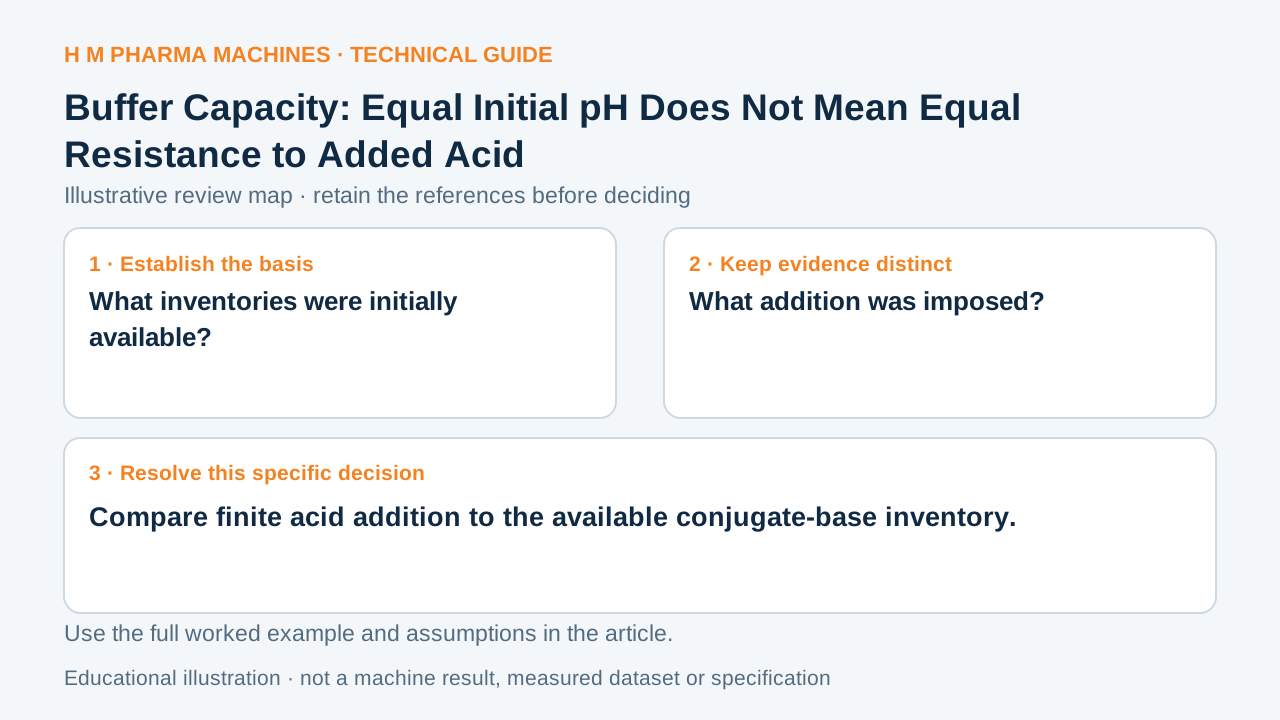
Equal initial buffer ratios can conceal different available inventories. A finite acid addition changes a small inventory much more than a larger one in the same teaching model.
Separate ratio from available amount
Buffer response depends on the available weak-acid and conjugate-base amounts, not only their initial ratio. In a simplified acid-addition balance, added strong acid consumes conjugate base and forms conjugate acid. The ratio after that balance differs from the initial ratio. Primary reference.
Apply one hypothetical acid addition
Construct buffer A with 10 mmol acid and 10 mmol base, and buffer B with 1 mmol of each. Both initially have base/acid = 1. Add an invented 0.50 mmol hydrogen-equivalent amount to each, assuming complete consumption by the base and the stated ideal ratio model.
A then contains 10.5 mmol acid and 9.5 mmol base; log₁₀(9.5/10.5) ≈ −0.0435. B contains 1.5 mmol acid and 0.5 mmol base; log₁₀(0.5/1.5) ≈ −0.4771. These are the respective modeled pH shifts relative to the unchanged assigned pKa, rather than universal buffer specifications.
Record the remaining conjugate pair
Create an original before-and-after inventory table, keeping the added reactive amount and the remaining species visible. The simplified ratio uses the same final-volume denominator for both species within each solution. It does not assume that the two buffers have equal total amounts or equal concentrations.
This finite-addition comparison is not a formal measurement of differential buffer capacity or a preparation recommendation. Other equilibria and activity changes can affect a real result. Its decision is whether an initial pH or ratio has hidden the quantity available to absorb the proposed chemical perturbation.
Solution review worksheet
This blank worksheet is for your own project. It contains no H M machine trial result.
| Question | Record to retain |
|---|---|
| What inventories were initially available? | Acid and conjugate-base amounts |
| What addition was imposed? | Reactive hydrogen-equivalent amount |
| What remains after the model balance? | Final species amounts and ratio |
Customer Questions
What is A’s fictional model pH shift?
Approximately −0.0435.
What is B’s fictional model pH shift?
Approximately −0.4771.
Is this a measured differential buffer capacity?
No. It is a defined finite-addition example.
Primary References
These references support the technical principles discussed in this guide. The worked examples and review questions are educational.
Discuss Your Machine Requirement
Share your product, container, required output and the evidence needed for your technical review.
Request a Technical Review