
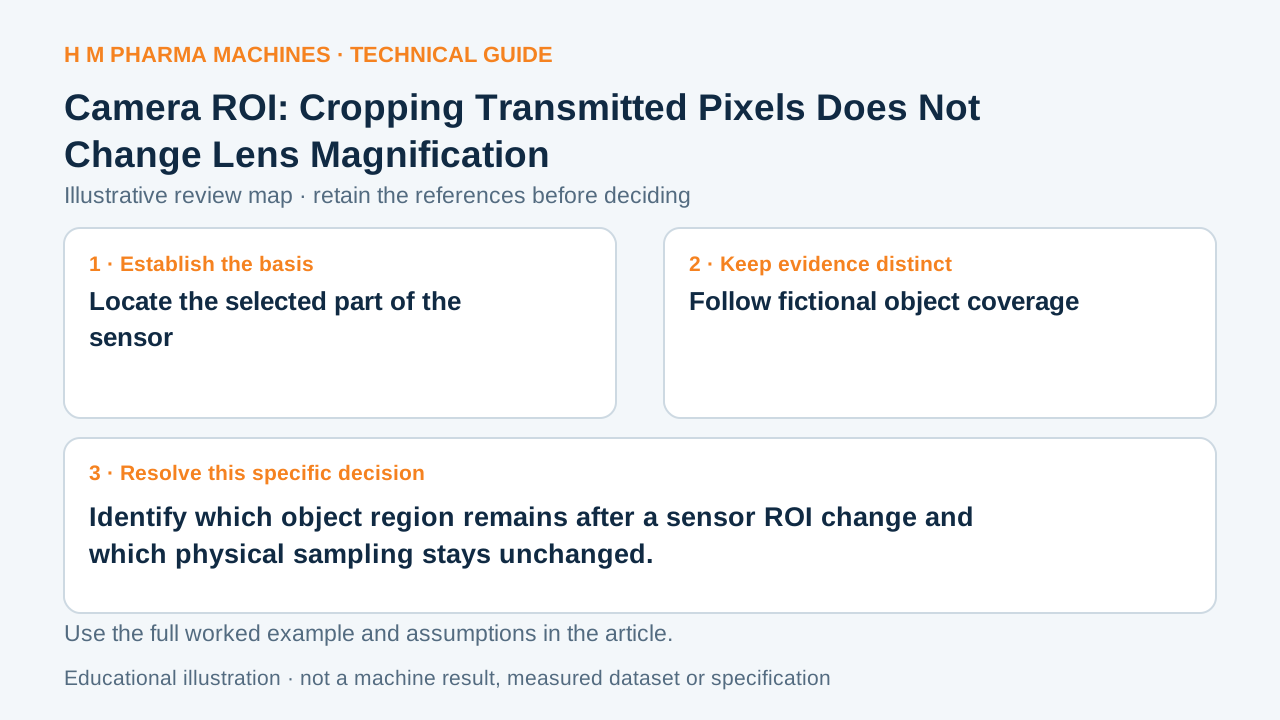
A smaller transmitted image can be a crop rather than a new magnification. Keep the selected sensor region and its offsets with the image dimensions.
Locate the selected part of the sensor
An image ROI selects a part of the sensor array for acquisition and transmission. Its size and offset identify the retained region. Changing that selection by itself does not change the lens or its optical magnification. Primary reference: Basler: image region of interest.
Distinguish a sensor ROI from a crop performed on a stored image and from an ROI used only by an automatic adjustment function. They can produce similar-looking rectangles while affecting different operations. Name the operation instead of describing every rectangle as the camera ROI.
Follow fictional object coverage
Imagine a 2,000-column image covering 100 mm with an assumed uniform local scale. Selecting the central 1,000 original columns retains approximately 50 mm, still sampled at 0.05 mm per original column. It does not produce 1,000 new samples across the original 100 mm view.
The offset determines which half of the object coverage remains. This example assumes unchanged optics and no binning or resampling. It is not a real camera configuration, a frame-rate prediction or proof that a required feature will stay inside the selected region.
Keep feature position with the crop
Mark the expected feature envelope on the full reference image before reducing the region. Preserve allowed object movement and the actual ROI coordinates. A crop that fits one centred sample may omit a shifted or rotated feature that is part of the stated task.
Recheck downstream software that interprets coordinates after the change. Determine whether it reports positions relative to the ROI or the full sensor. If additional processing changes the grid, document it separately. Review the task coverage and coordinate meaning before accepting reduced output dimensions as an equivalent inspection record.
Customer Questions
Does a smaller ROI change optical magnification?
Not by itself; it selects less of the existing sensor region.
What identifies the retained area?
Keep the ROI dimensions and offsets with the reference image.
Why check software coordinates?
Their origin may refer to the ROI or to the original full sensor.
Primary References
These references support the technical principles discussed in this guide. The worked examples and review questions are educational.
Discuss Your Machine Requirement
Share your product, container, required output and the evidence needed for your technical review.
Request a Technical Review