
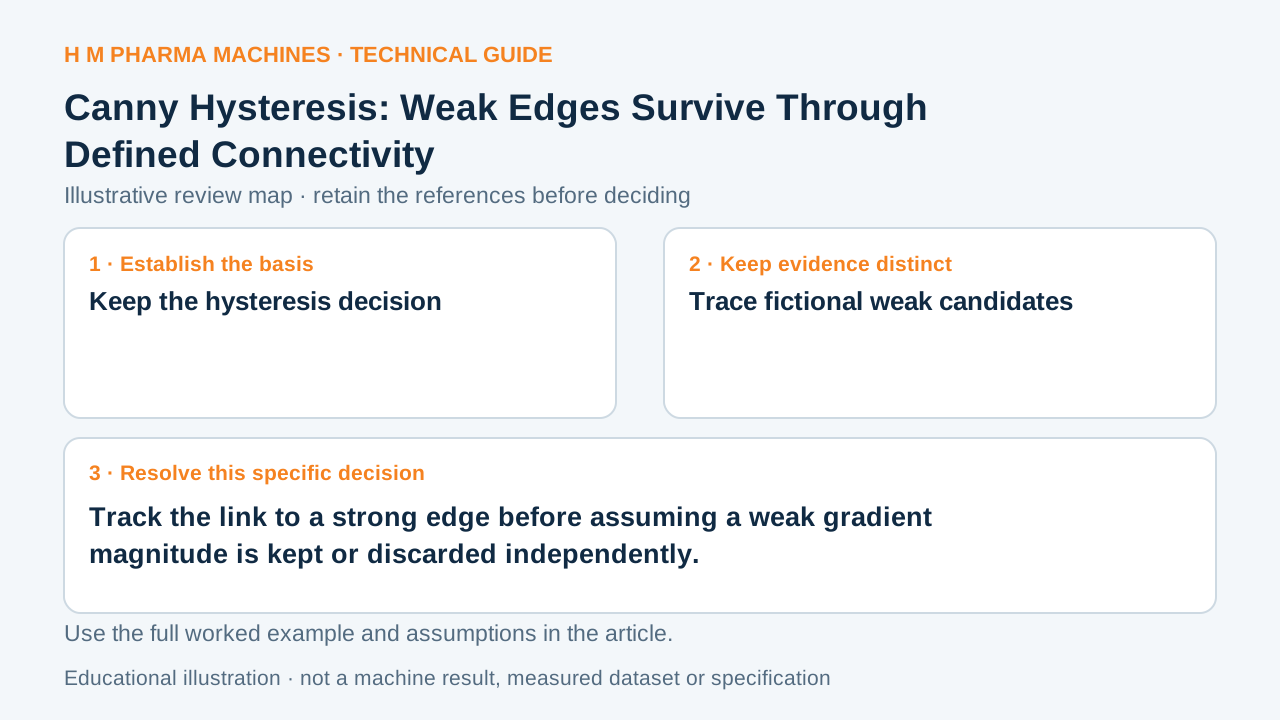
Two weak edge candidates with the same magnitude can receive different final treatment when only one connects to a strong edge.
Keep the hysteresis decision
Canny hysteresis uses lower and upper gradient thresholds after earlier edge-processing stages. A candidate between those thresholds is retained through connection to strong edge evidence rather than solely through its individual magnitude. Connectivity therefore contributes to the final edge support alongside the selected thresholds. Primary reference: OpenCV Canny hysteresis connectivity.
For an original worksheet, retain the gradient candidates entering hysteresis and their connections. Do not describe hysteresis as a single global cutoff. Also distinguish gradient magnitude from original image intensity so the threshold's quantity remains explicit in any later review.
Trace fictional weak candidates
In an invented hysteresis-only graph, set a lower threshold of 40 and an upper threshold of 80. Candidate A has magnitude 100. Candidate B has magnitude 60 and is connected to A; candidate C also has magnitude 60 but belongs to an isolated branch with no strong candidate.
Under the defined rule, A is strong, B is retained through its connection, and C is discarded. The graph assumes earlier stages have already supplied these candidates. It is not an exact result for a complete Canny call on an unspecified image, nor a recommended inspection threshold.
Inspect the connection evidence
Prepare an original candidate map labeling magnitudes and the paths to strong evidence. If a weak location is missing in the final edge map, inspect both its magnitude and its connection. Equal weak magnitudes do not require equal final outcomes when their retained paths differ.
This guide claims no HM edge-classification capability. Its decision is whether connectivity was preserved in the explanation of the final edge map. A kept edge remains a processing result; its physical meaning and application acceptance need evidence beyond this teaching graph.
Customer Questions
Do B and C have equal fictional magnitudes?
Yes, sixty.
Why is B retained in the defined graph?
It connects to the strong candidate A.
Is this a complete detector-output prediction?
No. It isolates the hysteresis-stage rule.
Primary References
These references support the technical principles discussed in this guide. The worked examples and review questions are educational.
Discuss Your Machine Requirement
Share your product, container, required output and the evidence needed for your technical review.
Request a Technical Review