
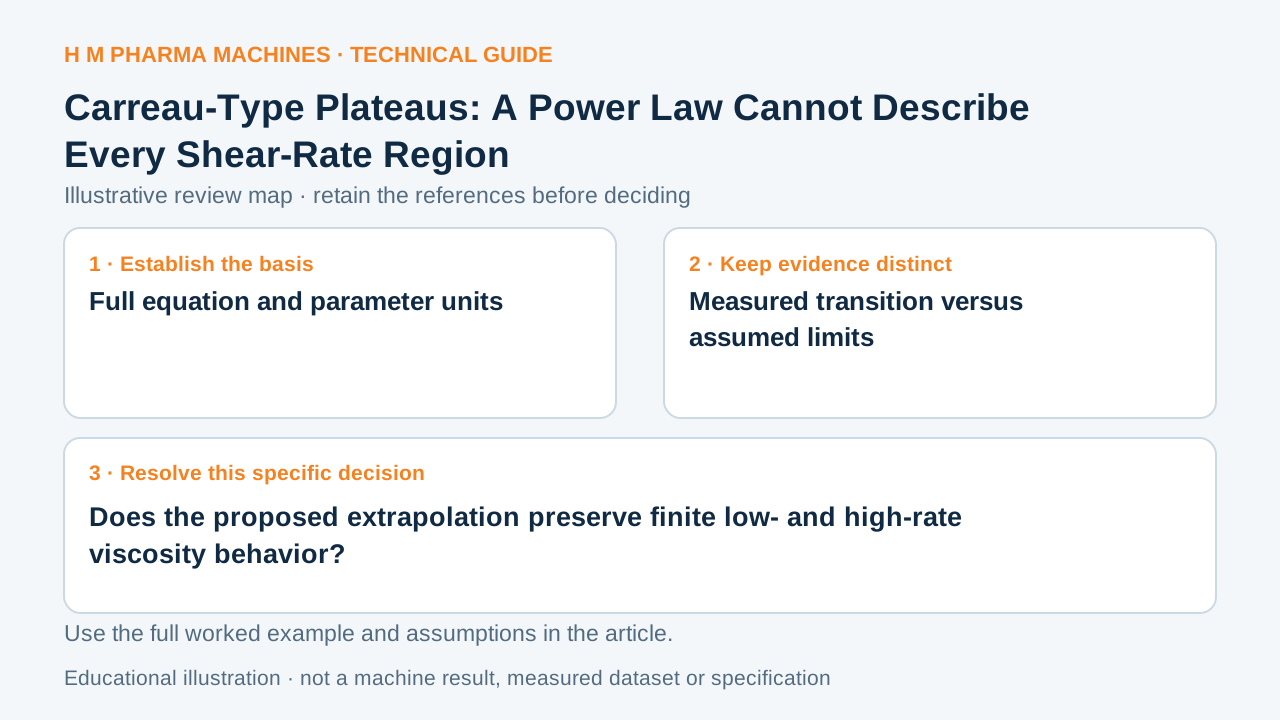
Ask what finite rate limits the chosen model represents before extrapolating a mid-range power-law fit far beyond its measured interval.
Identify the Deformation and Model
COMSOL describes a Carreau viscosity model with low-rate and high-rate viscosity limits and a transition governed by rate-dependent parameters. Those limits differ from an unrestricted mid-range power law. Primary reference: Carreau model boundaries.
Review a Hypothetical Comparison
Suppose a hypothetical fit explicitly assigns low-rate viscosity 10 Pa·s and high-rate viscosity 1 Pa·s. Its limiting viscosity ratio is ten. Those assigned plateaus are model parameters, not proof that measurements reached either region; many transition curves can share these same limits while differing substantially at an intermediate rate.
Keep the Evidence with the Decision
Mark measured points, transition region and extrapolated limits separately on the review plot. Retain the complete Carreau-type equation because added shape parameters or alternative conventions change its interpretation. Ask whether the dataset contains evidence for both plateaus or whether one was merely assumed during fitting. Compare models at the actual proposed rates rather than judging only their fit inside one narrow interval.
Neither finite limits nor an appealing smooth curve establish accuracy outside the supporting material conditions. The invented parameters specify no HM formulation, nozzle rate or permitted viscosity. The decision is whether the proposed extrapolation has a documented asymptotic basis and sufficient evidence, rather than using a middle-section trend as if it described every possible rate.
Does the proposed extrapolation preserve finite low- and high-rate viscosity behavior?
This blank worksheet is for your own project. It contains no H M machine trial result.
| Review field | Reference or result | Responsible person |
|---|---|---|
| Full equation and parameter units | To complete | To complete |
| Measured transition versus assumed limits | To complete | To complete |
| Evidence for each plateau | To complete | To complete |
| Predictions at proposed process rates | To complete | To complete |
Customer Questions
What ratio follows from the assigned plateaus?
Ten, on the stated limiting-viscosity basis.
Does a fitted plateau prove it was measured?
No. It may be an assumption.
Do equal limits determine the full transition curve?
No. Transition parameters also matter.
Primary References
These references support the technical principles discussed in this guide. The worked examples and review questions are educational.
Discuss Your Machine Requirement
Share your product, container, required output and the evidence needed for your technical review.
Request a Technical Review