
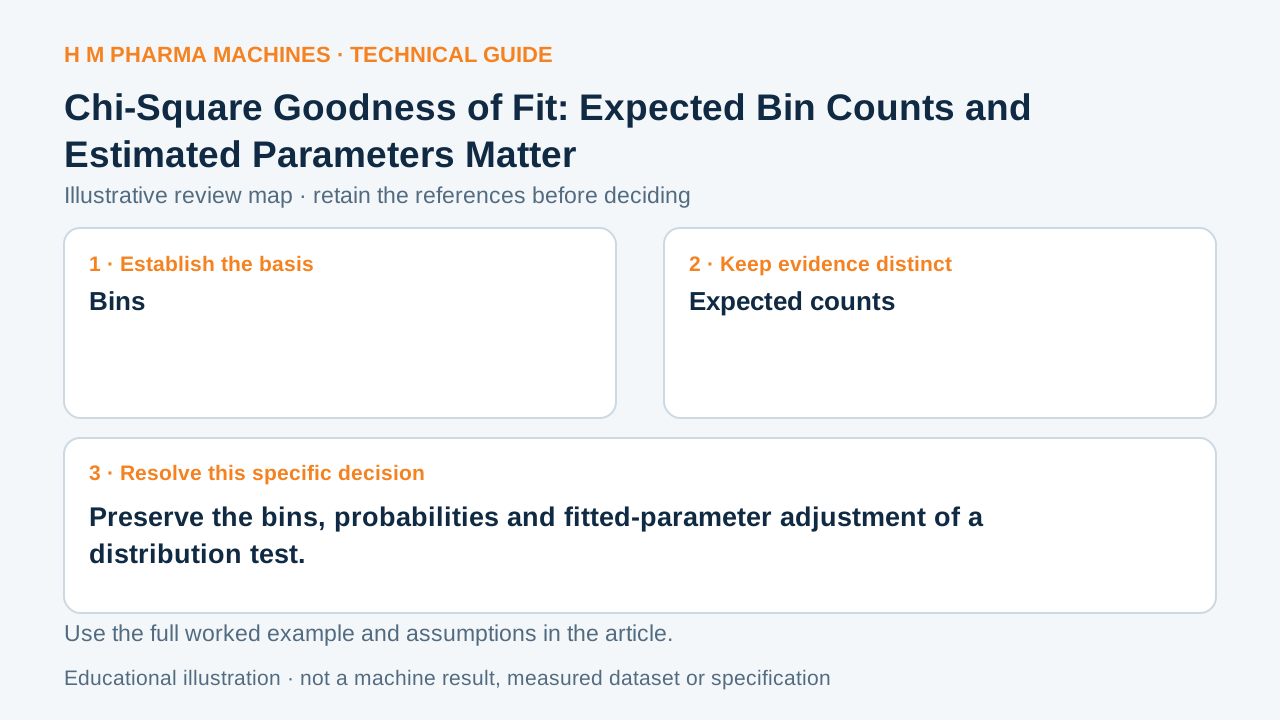
A binned goodness-of-fit test needs declared bin boundaries, model probabilities and parameter-estimation treatment. A frequency table alone does not identify the test.
The statistical question
Chi-square goodness of fit compares observed bin counts with expected counts from the proposed probability model. The bins affect the statistic. Its reference degrees of freedom account for the count constraint and estimated parameters, and the approximation needs adequate expected frequencies. Record the applicable estimation procedure; changing bins or fitting parameters can change the reference calculation.
An illustrative review example
For a fictional fully specified four-bin model with 100 independent observations and probability 0.25 per bin, every expected count is 25. Observed counts of 20,30,25 and 25 give a chi-square sum of 25/25 plus 25/25 plus zero plus zero, or two. With no parameters fitted and the stated model assumptions, the usual reference has three degrees of freedom. This is an arithmetic illustration without a significance decision.
Prepare the evidence for discussion
Save the bin endpoints, boundary assignment convention, observed counts and expected probabilities. Tell the analyst how any model parameters were estimated, including whether their method fits the grouped counts. Ask how sparse expected cells should be treated before reading a result. When comparing two trial reports, reconcile their bin definitions first; a difference in a goodness-of-fit statistic may arise from analysis choices rather than new machine behavior.
Expected counts need the model and bins
This blank worksheet is for your own project. It contains no H M machine trial result.
| Question to resolve | Evidence to retain |
|---|---|
| Bins | Endpoints and boundary convention |
| Expected counts | Model probabilities times sample size |
| Parameters | Fixed or fitted and method |
| Approximation | Degrees of freedom and sparse cells |
Customer Questions
Do bin boundaries affect the statistic?
Yes. They determine the observed grouping and model probability assigned to each cell.
Why record fitted parameters?
Their estimation changes the applicable reference calculation and degrees of freedom.
Does the four-bin example approve a test plan?
No. It illustrates count arithmetic under a fully specified hypothetical model.
Primary References
These references support the technical principles discussed in this guide. The worked examples and review questions are educational.
Discuss Your Machine Requirement
Share your product, container, required output and the evidence needed for your technical review.
Request a Technical Review