
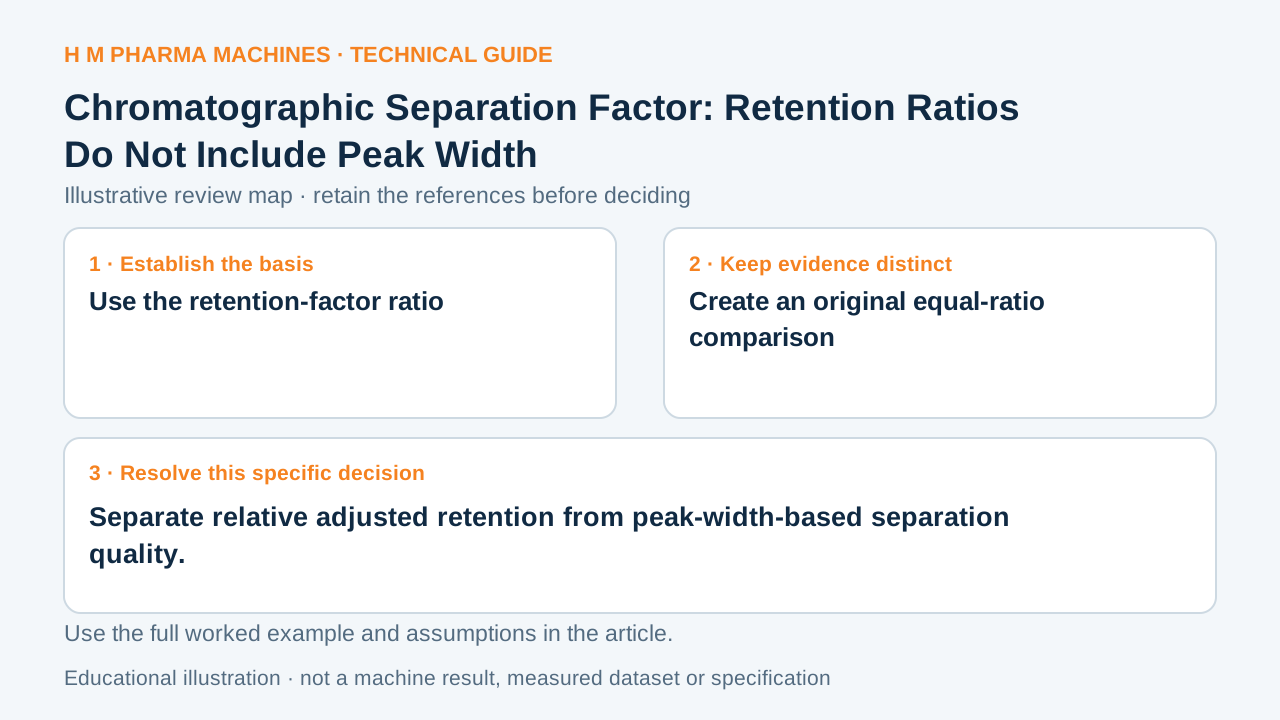
A ratio of two retention factors describes their relative retention, while peak widths answer another question.
Use the retention-factor ratio
For two ordered chromatographic components, separation factor alpha is the ratio k2/k1, with the more retained component in the numerator. IUPAC uses separation factor for this defined quantity and discourages calling it a selectivity factor in this context. The relevant components and method conditions must be specified. Primary reference: IUPAC: separation factor in column chromatography.
No peak-width term appears in this ratio. A separation factor can therefore be the same for two observations with very different peak overlap. It should not be relabeled a measured peak-resolution value merely because both quantities concern separation.
Create an original equal-ratio comparison
Suppose two fictional isocratic components have k1 = 2 and k2 = 3, so alpha is 1.5. At tM = 1 minute their total retention times are 3 and 4 minutes. Worksheet A assigns baseline widths 0.4 and 0.4 minute; worksheet B assigns 1.5 and 1.5 minutes at the same centers.
Both rows retain alpha = 1.5 because neither k changes. Using the stated baseline-width resolution expression, A gives 2.5 and B gives about 0.6667. These independently chosen shapes demonstrate that retention ratio alone does not carry peak-width information. They are not predictions of a column.
Keep the reported quantities separate
Put k1, k2, the ordering convention and alpha into a retention section. Give observed peak widths, their definition and any calculated resolution separate fields. Use the same time basis for comparisons and do not infer a width from alpha without another supported model.
The review question is whether a retention-factor ratio has been asked to answer a peak-overlap question it cannot answer alone. Real separation decisions require the chromatogram and applicable criteria. No universal acceptable alpha, resolution limit, operating recipe or equipment performance is asserted by this invented comparison.
Customer Questions
What sets alpha in this example?
The two stipulated retention factors.
Does alpha contain a peak width?
Its defined ratio does not.
Why do the two calculated resolutions differ?
Their fictional baseline widths differ.
Primary References
These references support the technical principles discussed in this guide. The worked examples and review questions are educational.
Discuss Your Machine Requirement
Share your product, container, required output and the evidence needed for your technical review.
Request a Technical Review