
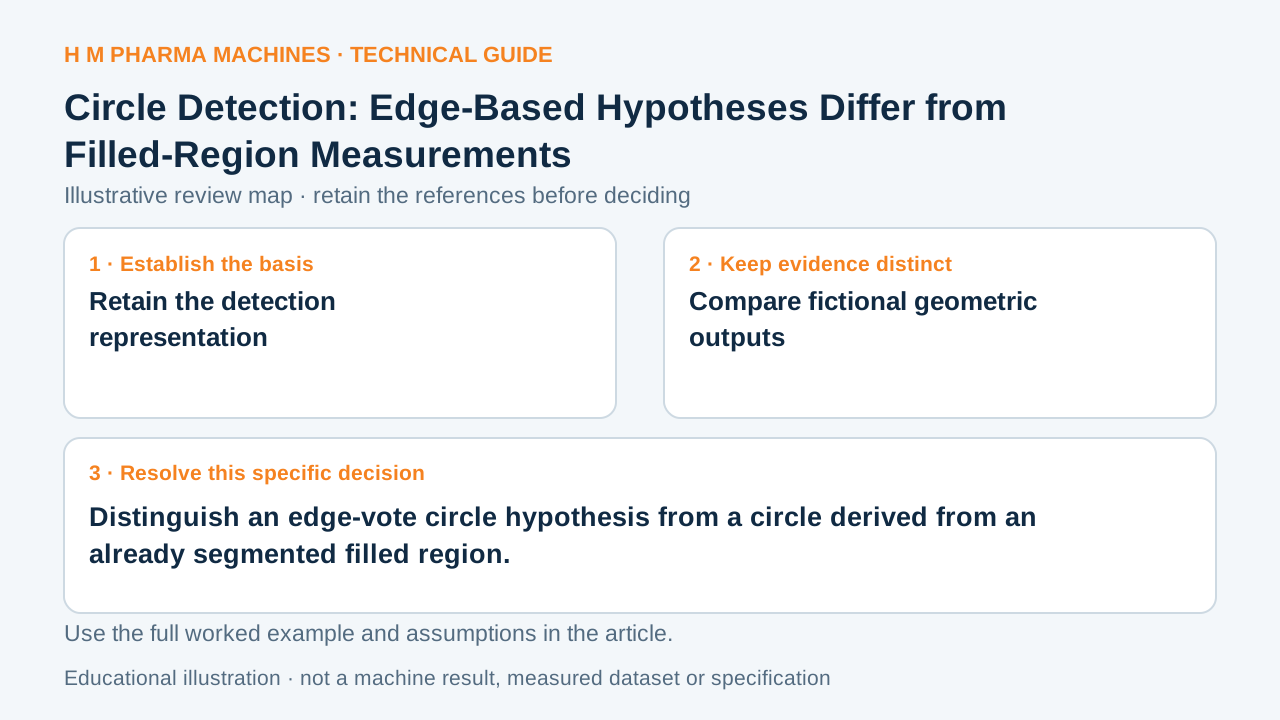
A circle detection output need not be a filled foreground region. Its radius and a segmentation's area describe different representations.
Retain the detection representation
Gradient-based Hough circle detection uses image-edge information to generate circle-center and radius hypotheses. A segmentation-based area measurement instead uses a selected foreground region. These outputs need their input evidence and definitions kept separate before a circle radius is converted into an assumed filled area. Primary reference: OpenCV gradient-based circle detection.
For an original worksheet, retain the detected circle overlay and the segmentation mask in separate fields. Record whether foreground actually fills the proposed circle. A useful geometric hypothesis does not itself certify which pixels belong to the material or feature being counted.
Compare fictional geometric outputs
Suppose a teaching record contains a circle hypothesis with radius 10. A separate invented continuous segmentation is an annulus with inner radius 9 and outer radius 11. Its occupied area is π(11² − 9²) = 40π, while the radius-ten filled disk would have area 100π.
The two areas answer different questions. The example does not claim that the Hough detector must return radius 10 from that annulus; its separate outputs are deliberately hypothetical. The radius alone does not establish filled foreground area or the physical material quantity in an image.
Keep representation comparisons explicit
Prepare an original overlay showing the proposed circumference and actual segmented support. If an area value is derived from a circle formula, label it as the assumed disk geometry. Keep the segmentation-based area alongside it so a missing interior is not silently counted as filled foreground.
This guide offers no HM circle-detection guarantee or roundness criterion. Its reader decision is whether an edge-derived geometric hypothesis has been mistaken for a measured filled region. Input selection, radius limits and the segmentation meaning require their own evaluation for any actual application.
Customer Questions
What is the fictional annulus area?
Forty pi square coordinate units.
What is the assumed radius-ten disk area?
One hundred pi square coordinate units.
Is radius ten a claimed detector output from the annulus?
No. The two teaching outputs are expressly hypothetical.
Primary References
These references support the technical principles discussed in this guide. The worked examples and review questions are educational.
Discuss Your Machine Requirement
Share your product, container, required output and the evidence needed for your technical review.
Request a Technical Review