
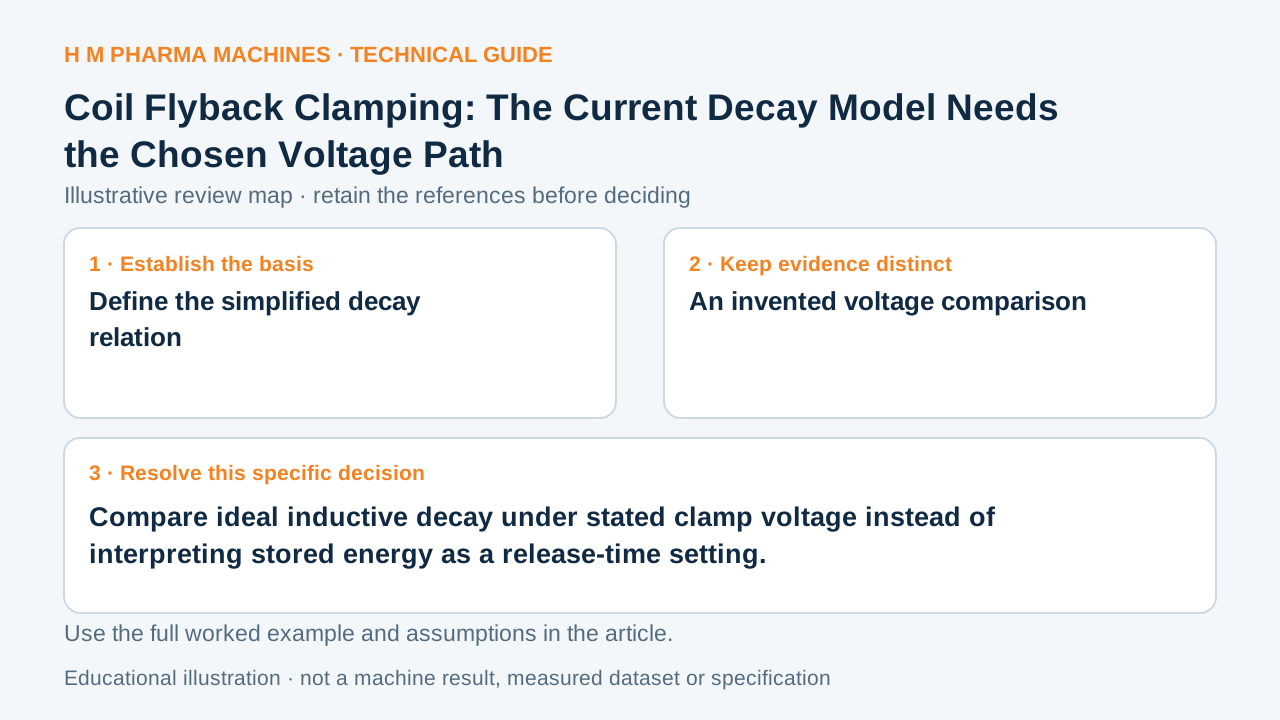
Retain the voltage opposing coil current when comparing an ideal current-decay time.
Define the simplified decay relation
TI explains freewheeling and clamping as different current-decay paths. Neglecting resistance in a constant-inductance approximation gives a decay interval magnitude LΔI/V across the inductance. Primary reference: passive clamping, section 3.2.2.
Keep V as the opposing voltage in that stated model, rather than an arbitrary supply or device-pin voltage. The actual winding resistance, moving armature and path behavior can change the current history. Electrical decay and completed mechanical release remain separate observations.
An invented voltage comparison
Assume fictional L =0.10 H and a current change of 0.20 A under a constant opposing 10 V. The ideal interval is 0.10×0.20/10 =0.002 s. With the same L and current change but 20 V, it becomes 0.001 s.
These cases compare only the defined inductive model. They do not recommend increasing a clamp voltage: actual switching elements, insulation and suppression components have relevant limits, and the mechanical load needs its own assessment. No HM coil or control setting is represented.
Preserve electrical and motion records
List inductance condition, initial current, opposing voltage path and the approximations used. Record separately how actual current and physical release were observed.
Ask which evidence connects the electrical decay to the required application event. This provides a clear review question when two apparently similar coil circuits have different timing, without diagnosing an actual delay from one equation alone.
Customer Questions
Is supply voltage always V in this model?
Use the actual opposing voltage across the inductance.
Does electrical current reaching zero prove completed release?
Mechanical motion requires its separate evidence.
Does larger modeled V shorten the interval?
Under the explicit fixed-input approximation, yes.
Primary References
These references support the technical principles discussed in this guide. The worked examples and review questions are educational.
Discuss Your Machine Requirement
Share your product, container, required output and the evidence needed for your technical review.
Request a Technical Review