
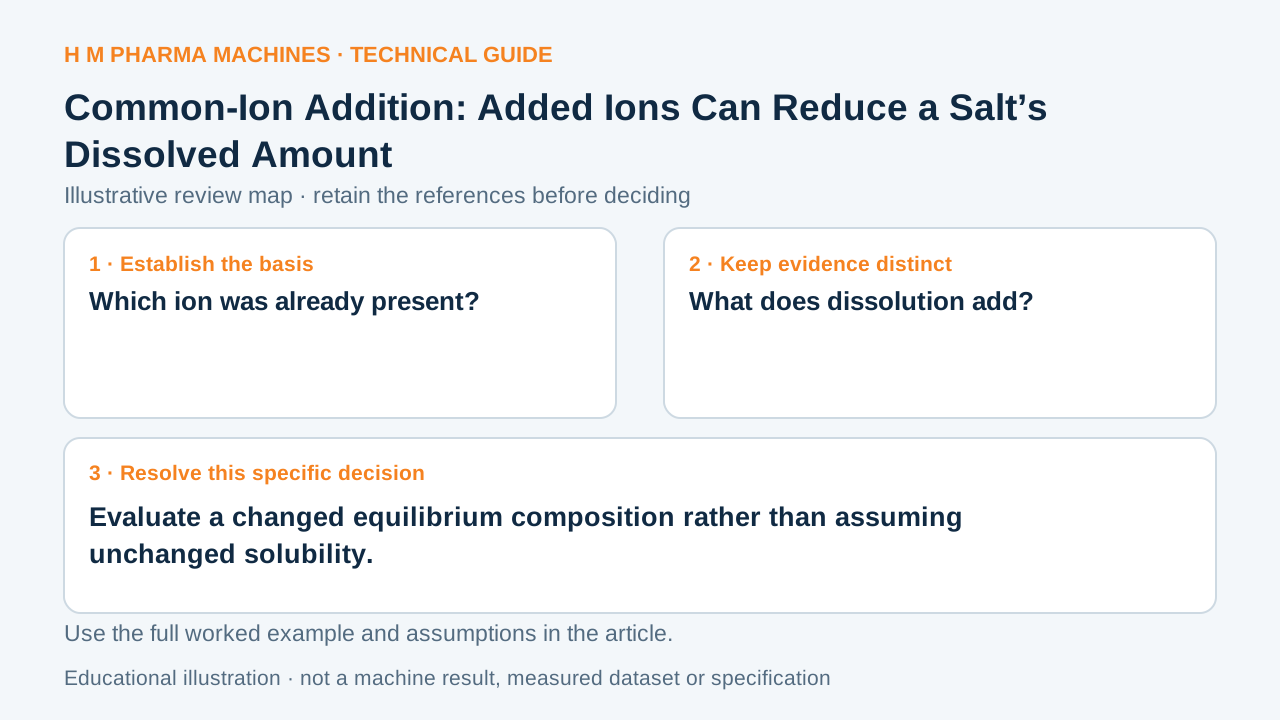
An ion already present in solution can change how much of a salt dissolves. The equilibrium balance must include that background amount before a solubility is inferred.
Include the background ion in the balance
A common ion is also produced by the specified salt’s dissolution. Within a simple solubility equilibrium, its added background shifts the dissolved amount required to satisfy the equilibrium product. The calculation depends on the salt stoichiometry and the applicable activity or concentration model. Primary reference.
Compare constructed water and common-ion states
Use a fictional ideal concentration model for MX(s) ⇌ M⁺ + X⁻ with Ksp = 10⁻⁸. In initially pure water, equal dissolved concentrations s give s² = Ksp, or s = 10⁻⁴ mol/L. In a separate state containing 0.0100 mol/L background X⁻, the balance becomes s(0.0100 + s) = 10⁻⁸.
Neglecting s next to 0.0100 gives s ≈ 10⁻⁶ mol/L. The positive quadratic root is about 9.999 × 10⁻⁷ mol/L, consistent with that explicitly small-increment approximation. The roughly hundred-fold reduction belongs only to these invented constants and the stated two-ion model.
Keep the approximation visible
Create an original balance showing background ion, newly dissolved salt and final free-ion concentrations in different columns. Do not place the salt’s total formula-unit amount directly into a free-ion expression when additional equilibria are unresolved. Temperature and other solution conditions remain part of the reference.
This example sets no real solubility, deposit-removal recipe or process-water limit. Its decision is whether the composition model accounts for the pre-existing ion inventory. A correct small-increment approximation does not by itself validate the same simple equilibrium model for an actual liquid.
Solution review worksheet
This blank worksheet is for your own project. It contains no H M machine trial result.
| Question | Record to retain |
|---|---|
| Which ion was already present? | Background free-ion concentration |
| What does dissolution add? | Stoichiometric ion increments |
| What approximation was used? | Dissolved increment small relative to the background |
Customer Questions
What is the fictional pure-water solubility?
10⁻⁴ mol/L.
What is the approximate common-ion result?
10⁻⁶ mol/L.
Does the model establish an actual cleaning recipe?
No.
Primary References
These references support the technical principles discussed in this guide. The worked examples and review questions are educational.
Discuss Your Machine Requirement
Share your product, container, required output and the evidence needed for your technical review.
Request a Technical Review