
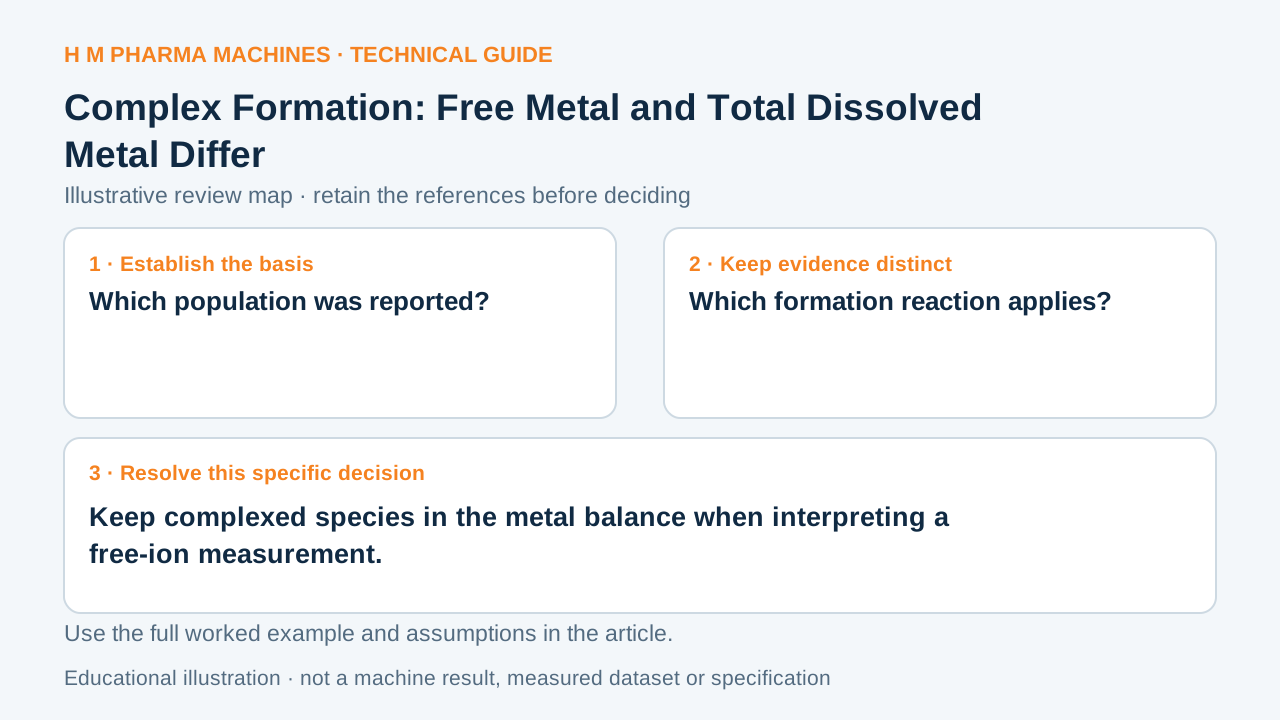
An analytical total-metal result and a free-metal-ion value describe different inventories when complexes are present. Their relationship needs the species balance, not a changed unit label.
Define the formation equilibrium and total
A formation constant belongs to a specified complex-formation equilibrium. Stepwise and cumulative constants describe different reactions. For a single complex ML, the total dissolved metal includes both the free metal species M and the metal assigned to ML on the stated amount basis. Primary reference.
Calculate a fictional one-complex model
Construct an ideal concentration model M + L ⇌ ML, with formation coefficient β = 10,000 L/mol. Specify free ligand [L] = 0.0100 mol/L as a controlled input and total metal 0.00100 mol/L. Then [ML]/[M] = β[L] = 100, and the metal balance is total = [M](1 + 100).
The resulting free metal is approximately 9.901 × 10⁻⁶ mol/L; complexed metal is approximately 0.0009901 mol/L. The supplied free-ligand value is not an initial total-ligand charge. If only the latter were known, ligand depletion would need its own balance before using the ratio.
Preserve what the measurement represents
Prepare an original interpretation record identifying the measured metal population, included complexes and the applicable equilibrium convention. Preserve the analytical method’s meaning of total rather than assuming that every dissolved-metal result measures free ions. Additional complexes or precipitates can change the balance.
These invented inputs do not identify a chelator, prescribe metal removal or establish pharmaceutical impurity acceptance. The reader decision is whether a free-ion result can be reconciled with a total inventory under the explicit species model. Keep the actual method scope alongside any calculated partition.
Solution review worksheet
This blank worksheet is for your own project. It contains no H M machine trial result.
| Question | Record to retain |
|---|---|
| Which population was reported? | Free species or defined total dissolved metal |
| Which formation reaction applies? | Named complex and corresponding constant |
| How is ligand specified? | Free-ligand input or a separate total-ligand balance |
Customer Questions
What is the fictional free-metal concentration?
Approximately 9.901 × 10⁻⁶ mol/L.
What ratio follows from the given free ligand?
100 complexed metal units per free-metal unit.
Can initial total ligand silently replace free ligand?
No.
Primary References
These references support the technical principles discussed in this guide. The worked examples and review questions are educational.
Discuss Your Machine Requirement
Share your product, container, required output and the evidence needed for your technical review.
Request a Technical Review