
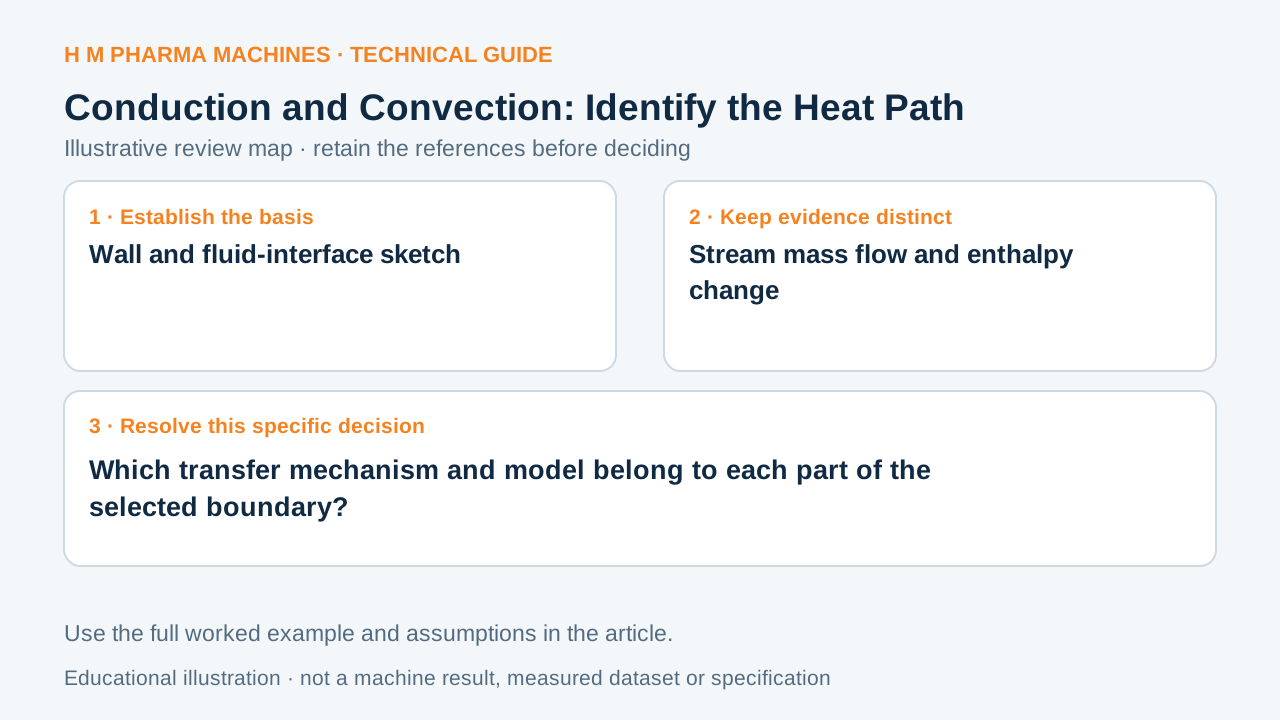
Wall conduction, fluid-side convection and a stream enthalpy change can describe the same transferred power. Do not add them as independent duties.
Define the Thermal Model
Conduction transfers energy through the stationary wall; convection connects that surface with moving fluid. Spirax Sarco’s heat-transfer lesson distinguishes these mechanisms in a combined transfer path. A bulk stream’s energy gain is a balance on that stream, rather than an extra heater in addition to the wall transfer.
Compare a Hypothetical Case
Imagine an invented steady exchanger transfers 600 W through its wall. Its cold stream is 0.1 kg/s with assumed cₚ = 3 kJ/(kg·K), so a 2 K rise also accounts for 600 W. A compatible fluid-side model h = 500 W/(m²K), A = 0.2 m² and surface-to-bulk gap 6 K gives 600 W. Adding the three descriptions to report 1,800 W counts one path three times.
Complete the Engineering Review
Draw a control boundary around each reported quantity. Label whether a calculation describes a wall, an interface or a complete stream. Check that steady energy-flow descriptions agree within the stated loss and storage assumptions. Use mismatches to inspect the model or data; do not resolve them by summing every available equation.
For a processing-tank utility review, provide the actual flow and surface arrangement. This guide maps energy boundaries and avoids double counting. It does not estimate overall U, choose circulation speed or establish that a batch has reached uniform temperature.
Which transfer mechanism and model belong to each part of the selected boundary?
This blank worksheet is for your own project. It contains no H M machine trial result.
| Review field | Reference or result | Responsible person |
|---|---|---|
| Wall and fluid-interface sketch | To complete | To complete |
| Stream mass flow and enthalpy change | To complete | To complete |
| Reported power and control boundary | To complete | To complete |
| Loss, storage and double-count check | To complete | To complete |
Customer Questions
Should wall and stream duties be added?
They can describe the same energy path.
Does a disagreement prove extra heat?
Check losses, storage and model inputs.
Is convection only a bulk energy balance?
It also describes transfer at a surface-fluid interface.
Related Equipment References
Review the actual offered equipment and application separately from this educational example.
Primary References
These references support the technical principles discussed in this guide. The worked examples and review questions are educational.
Discuss Your Machine Requirement
Share your product, container, required output and the evidence needed for your technical review.
Request a Technical Review