
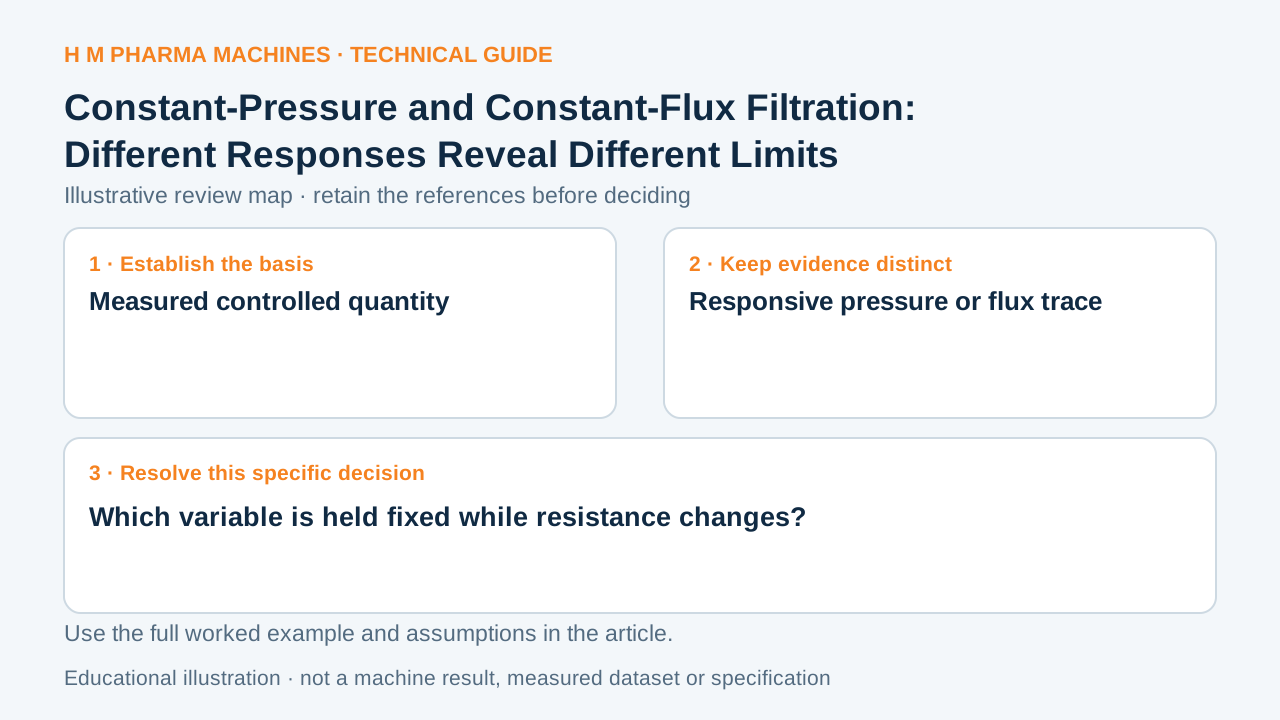
Changing resistance appears as different measured responses when a filtration review holds pressure or flux fixed.
Define the Interface or Transport Basis
Jami and colleagues' primary comparison of constant-rate and constant-pressure filtration, abstract describes rising pressure in one mode and declining flux in the other as resistance develops. Preserve the controlled variable when interpreting a trace rather than comparing unlike runs as if their control conditions matched.
Review a Hypothetical Comparison
Imagine two invented controllers acting on the same assumed resistance change, with viscosity fixed. In trial A, pressure difference stays at 80 kPa while flux changes from 0.0004 to 0.0002 m/s. In trial B, flux stays at 0.0004 m/s while pressure changes from 80 to 160 kPa. Each is consistent with doubled modeled resistance. The important distinction is which required response the controller holds and which response the process is allowed to change.
Keep the Evidence with the Decision
Write the measured controlled quantity and the responsive quantity above every plotted trace. Keep actual controller behavior separate from its requested setpoint: saturation or a pump limitation can prevent the intended mode. Record when the assumed fixed variable drifts and evaluate the measured pressure and flux together before classifying the result.
These are synthetic control comparisons, not the cited study's test conditions or a suggested backwashing schedule. The mode alone does not identify the deposit mechanism or a universal stopping threshold.
Which variable is held fixed while resistance changes?
This blank worksheet is for your own project. It contains no H M machine trial result.
| Review field | Reference or result | Responsible person |
|---|---|---|
| Measured controlled quantity | To complete | To complete |
| Responsive pressure or flux trace | To complete | To complete |
| Actuator/controller capability evidence | To complete | To complete |
| Intervals where the intended mode is lost | To complete | To complete |
Customer Questions
Does a constant setpoint prove a constant measured variable?
No. Check actual readings and actuator limitations.
Can lower flux and higher pressure both indicate resistance growth?
Yes, under different stated control modes; retain the full conditions.
Does the mode identify the fouling cause?
No. It describes the controlled response, not the complete physical mechanism.
Primary References
These references support the technical principles discussed in this guide. The worked examples and review questions are educational.
Discuss Your Machine Requirement
Share your product, container, required output and the evidence needed for your technical review.
Request a Technical Review