
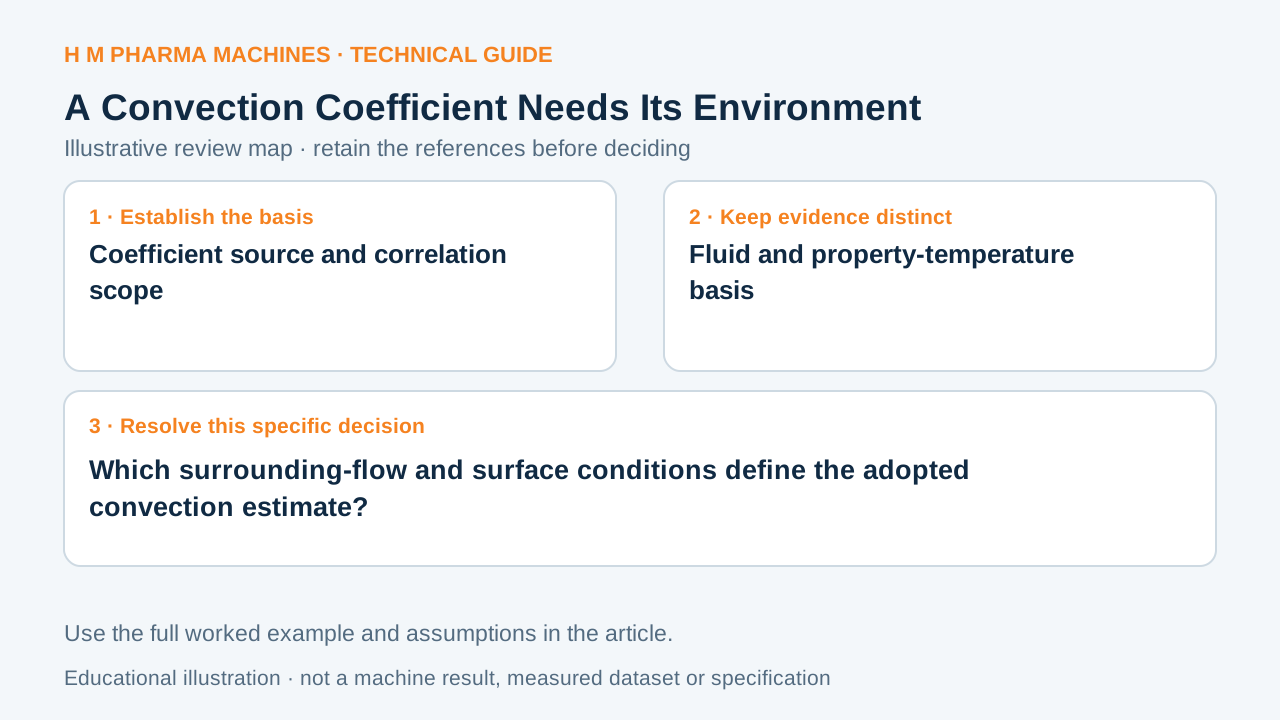
A convection coefficient belongs to a fluid, flow and geometry condition. It should not travel unchanged between unrelated environments.
Define the Thermal Model
A convection model writes heat flux as h times the surface-to-bulk fluid temperature difference. COMSOL’s correlation discussion identifies fluid properties, temperature, flow and geometry among the inputs to h. Treat a coefficient as a documented model result rather than a constant property of stainless steel.
Compare a Hypothetical Case
For an invented surface of 2 m² and a 20 K difference, assuming h = 15 W/(m²K) gives 600 W. Assuming h = 30 gives 1,200 W. This sensitivity comparison does not assert that a particular fan doubles h. It shows why two proposals using different environmental assumptions can disagree before their geometry changes.
Complete the Engineering Review
Attach the coefficient source and its geometry to the estimate. State natural or forced convection, relevant flow conditions and the property temperature basis. Check that the selected correlation’s characteristic length and applicability match the surface. When conditions are uncertain, show a justified sensitivity range instead of concealing one unexplained number.
Use a storage-tank enquiry with the intended installation conditions. The example provides no actual tank-loss rating. Radiation, supports and evaporation can remain separate heat-loss paths; changing h alone does not account for every environmental effect.
Which surrounding-flow and surface conditions define the adopted convection estimate?
This blank worksheet is for your own project. It contains no H M machine trial result.
| Review field | Reference or result | Responsible person |
|---|---|---|
| Coefficient source and correlation scope | To complete | To complete |
| Fluid and property-temperature basis | To complete | To complete |
| Surface geometry and characteristic length | To complete | To complete |
| Natural or forced flow conditions | To complete | To complete |
Customer Questions
Is h a metal property?
It describes a boundary transfer condition.
Can a fan speed specify h alone?
Geometry and fluid conditions also matter.
Does h include all heat losses?
Other transfer paths may be separate.
Related Equipment References
Review the actual offered equipment and application separately from this educational example.
Primary References
These references support the technical principles discussed in this guide. The worked examples and review questions are educational.
Discuss Your Machine Requirement
Share your product, container, required output and the evidence needed for your technical review.
Request a Technical Review