
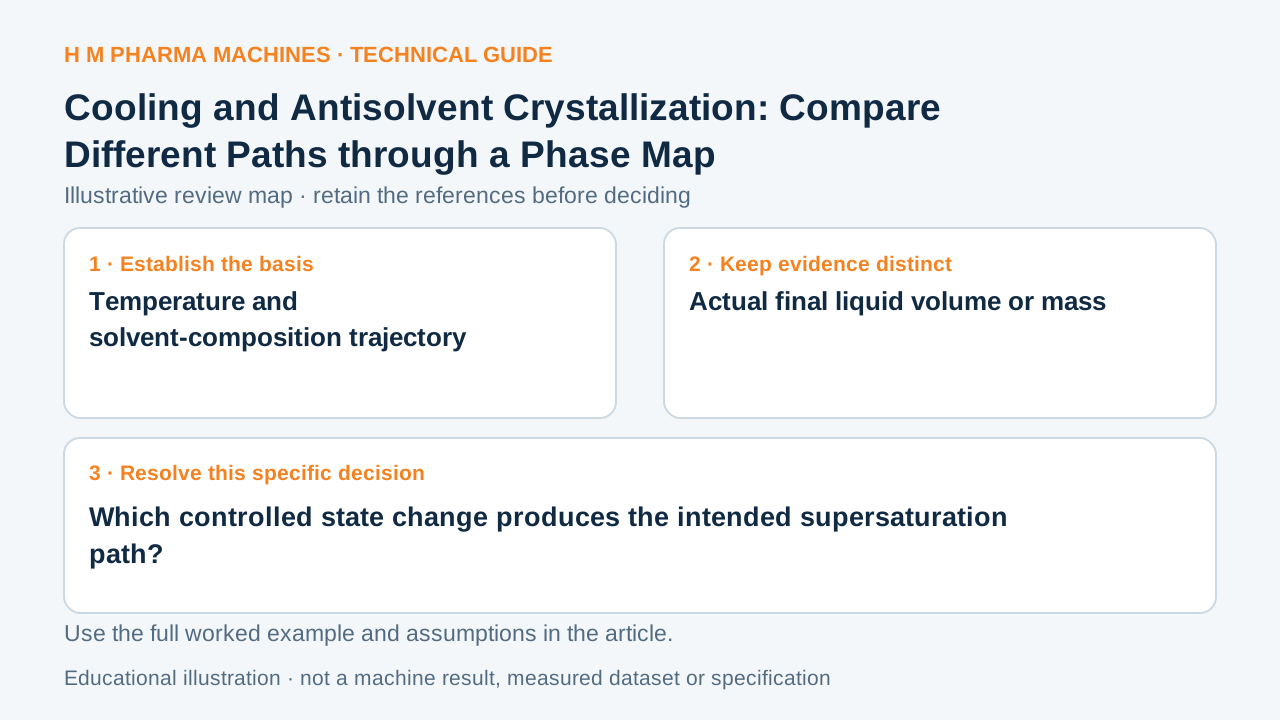
Treat cooling and antisolvent addition as different paths through temperature and solvent-composition space.
Define the Phase or Process Boundary
METTLER TOLEDO's recrystallization method discussion describes cooling a suitable system to lower solubility and changing solvent composition through antisolvent addition. The same endpoint supersaturation ratio can arise through different inventory and state changes.
Review a Hypothetical Comparison
Assume an invented solution initially has C=0.18 and C*=0.20 on one specified concentration basis, so S=0.90. A cooling path leaves the assigned concentration at 0.18 while solubility becomes 0.15, giving S=1.20. An alternative solvent-addition path has a separately established final volume 1.5 times the initial volume: its concentration becomes 0.12 while mixture solubility is assigned 0.10, also giving S=1.20. The final volume is supplied, not inferred by assuming additive solvent volumes.
Keep the Evidence with the Decision
Plot the actual path using both temperature and solvent composition. Track dilution separately from the solubility change. Keep mixing/contact history and final inventory with the endpoint. Equal S values do not prove equal local excursions, crystal form, kinetics or downstream solvent load.
All quantities are fictional and no real solvent is recommended. Actual solubility surfaces, stability and mixing evidence must support any process choice.
Which controlled state change produces the intended supersaturation path?
This blank worksheet is for your own project. It contains no H M machine trial result.
| Review field | Reference or result | Responsible person |
|---|---|---|
| Temperature and solvent-composition trajectory | To complete | To complete |
| Actual final liquid volume or mass | To complete | To complete |
| Concentration and mixture-solubility changes | To complete | To complete |
| Local history and downstream solvent inventory | To complete | To complete |
Customer Questions
Does antisolvent addition only change solubility?
It also changes the liquid inventory and concentration basis.
Can equal final S prove equal processing history?
No. The routes and local states can differ.
Can final mixed volume be assumed additive?
Use an applicable model or measured inventory; here it is explicitly supplied.
Primary References
These references support the technical principles discussed in this guide. The worked examples and review questions are educational.
Discuss Your Machine Requirement
Share your product, container, required output and the evidence needed for your technical review.
Request a Technical Review