
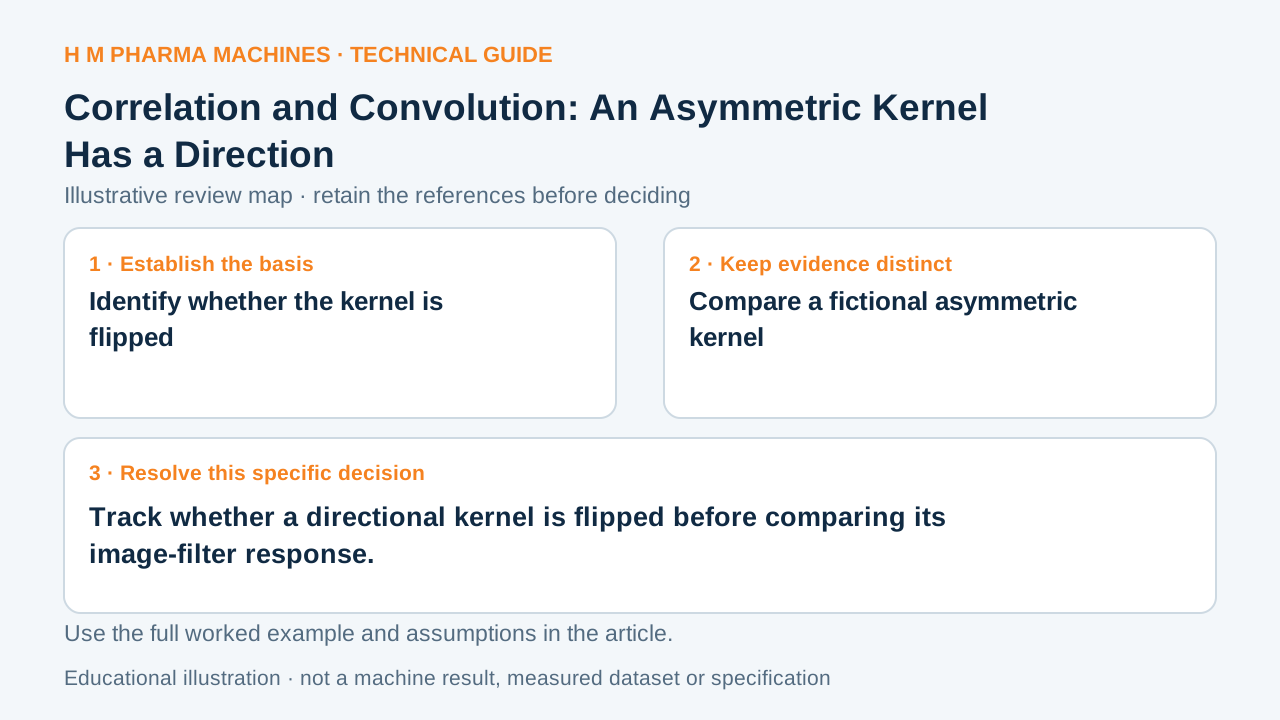
An asymmetric kernel changes meaning when it is flipped. Name the operation instead of treating every neighborhood filter as the same directional calculation.
Identify whether the kernel is flipped
Correlation applies neighborhood coefficients in their specified orientation, while convolution reverses the relevant kernel directions. For a symmetric kernel the reversal can leave coefficients unchanged; for an asymmetric kernel it can change the response. The operation convention must therefore accompany a directional coefficient array. Primary reference: MathWorks correlation and convolution filter options.
For an original worksheet, mark the coefficient order and the corresponding input sample order. Keep the output location and kernel reference explicit. An algorithm name containing filter does not by itself establish whether a particular software call uses correlation or convolution.
Compare a fictional asymmetric kernel
Take an invented three-sample neighborhood [10,20,30] and coefficients [1,2,4]. The stated correlation sum is 1 ×10 +2 ×20 +4 ×30 =170. Reversing the coefficients for the corresponding convolution calculation gives 4 ×10 +2 ×20 +1 ×30 =110.
The input samples did not move between calculations; the coefficient orientation changed. These are unnormalized floating sums at the defined location, not eight-bit stored outputs. Clipping, offsets or normalization would need their own explicit terms before those sums became image values.
Review direction before interpreting a feature
Prepare a trial with a deliberately asymmetric coefficient array so a reversal is visible numerically. Compare the documented operation and result rather than testing only symmetric smoothing kernels, which can conceal this distinction. Retain the numerical type and any later storage conversion.
This guide establishes no physical edge direction, HM camera function or preferred filter. Its decision is whether the same directional operation was actually compared. A difference caused by coefficient reversal should not be reported as a changed object or a shifted acquisition without further evidence.
Customer Questions
Does kernel reversal always change the coefficients?
No. A symmetric kernel can remain unchanged.
What are the two fictional sums?
170 for the stated correlation and 110 after the coefficient reversal.
Are those eight-bit stored pixel values?
No. They are defined floating sums before storage conversion.
Primary References
These references support the technical principles discussed in this guide. The worked examples and review questions are educational.
Discuss Your Machine Requirement
Share your product, container, required output and the evidence needed for your technical review.
Request a Technical Review