
Countersink diameter depends on angle and cone depth.
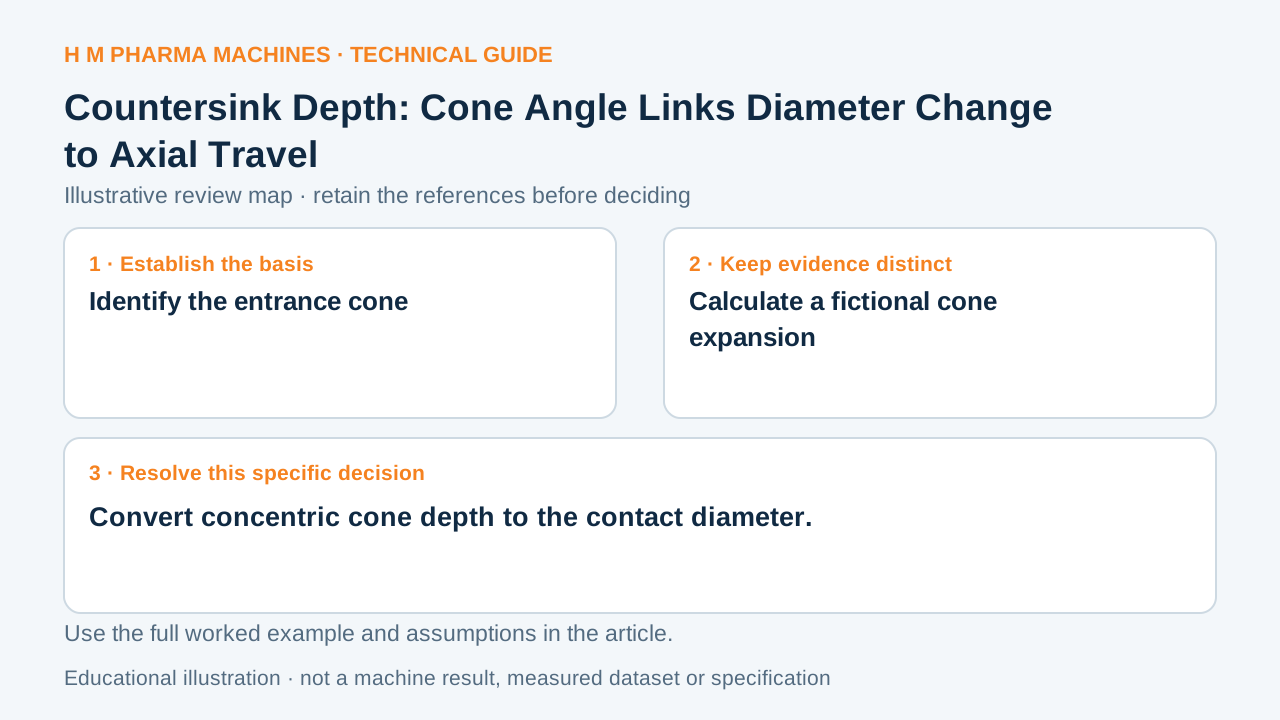
Identify the entrance cone
Harvey distinguishes countersinking from other uses of a chamfer mill. For a defined conical entrance, angle and axial penetration determine its geometry. Primary reference: Harvey technical explanation.
Calculate a fictional cone expansion
Assume an existing circular hole diameter of 6 mm and an ideal countersink extending 1 mm axially from that entrance. With a 90° included cone angle, the half-angle is 45°, giving radial expansion 1·tan45°=1 mm. The resulting entrance diameter is 8 mm.
With a 60° included angle at the same axial depth, radial expansion is about 0.577 mm and diameter about 7.155 mm. These are original ideal-cone constructions, not tool settings, standard fastener seats or claimed finished dimensions. Actual cutter truncation and contact start must be identified.
Keep the angle and datum with the dimension
Draw the original hole rim, cone start, included angle and final diameter on the section. Distinguish included angle from half-angle and axial depth from sloped cone length. Keep any datum offset separate from geometric penetration.
Compare the actual mating requirement and tool form before selecting a depth. Matching diameter alone does not establish an appropriate fastener seat or contact surface. This worksheet identifies the missing angle or depth reference in an entrance-feature description without selecting a cutter or transferring the hypothetical values into a machining program.
Customer Questions
Diameter at ninety degrees?
Eight millimeters.
At sixty degrees?
About 7.155 millimeters.
Can sloped length replace axial depth silently?
The geometric definitions differ.
Primary References
These references support the technical principles discussed in this guide. The worked examples and review questions are educational.
Discuss Your Machine Requirement
Share your product, container, required output and the evidence needed for your technical review.
Request a Technical Review