
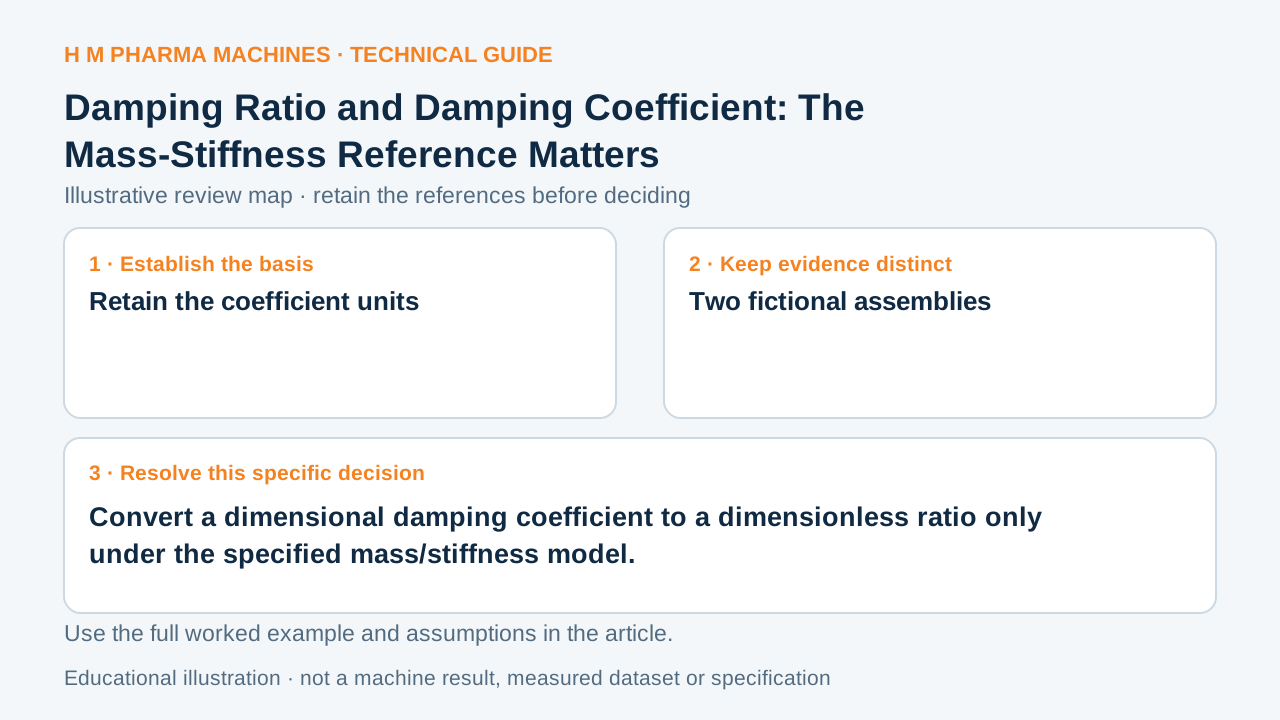
Normalize a damping coefficient only against the stated mass and stiffness model.
Retain the coefficient units
A linear viscous oscillator uses a damping force proportional to velocity. Its critical coefficient is 2√(mk); dividing the coefficient b by this value defines the damping ratio ζ. Primary reference: damped oscillator model.
The coefficient has units of N·s/m for translational motion, whereas ζ is dimensionless. Comparing two coefficients without their mass and stiffness references can hide different normalized behavior. Frictional or nonlinear damping requires its own model.
Two fictional assemblies
Suppose assembly A has m = 4 kg, k = 4,000 N/m and b = 40 N·s/m. Its critical coefficient is approximately 252.98 N·s/m, so ζ is approximately 0.158. Assembly B doubles both mass and stiffness while retaining b = 40; its critical coefficient doubles to approximately 505.96 and ζ becomes approximately 0.079.
The same dimensional coefficient therefore gives a different ratio. The undamped natural frequency remains unchanged because k/m is unchanged. This comparison separates normalization from frequency and does not establish actual decay, damping hardware suitability or an acceptable machine response.
Keep the assessment conditional
Create columns for the motion coordinate, b, m, k and the resulting ratio. Ask whether the coefficient was derived under the same amplitude, temperature and velocity conditions as the intended model. Do not combine a rotational coefficient with translational mass without an explicit transformation.
A proposed damping change should be reviewed against the relevant response requirement and verified model. Keep free-decay evidence separate from forced-response observations. This guide explains a normalization operation; it supplies no installed component coefficient or universal acceptable damping ratio.
Customer Questions
Is ζ measured in N·s/m?
The ratio is dimensionless; the coefficient retains its units.
Can equal coefficients imply different ratios?
Different mass-stiffness references can change the normalization.
Does this cover every damper?
The calculation assumes the stated linear viscous model.
Primary References
These references support the technical principles discussed in this guide. The worked examples and review questions are educational.
Discuss Your Machine Requirement
Share your product, container, required output and the evidence needed for your technical review.
Request a Technical Review