
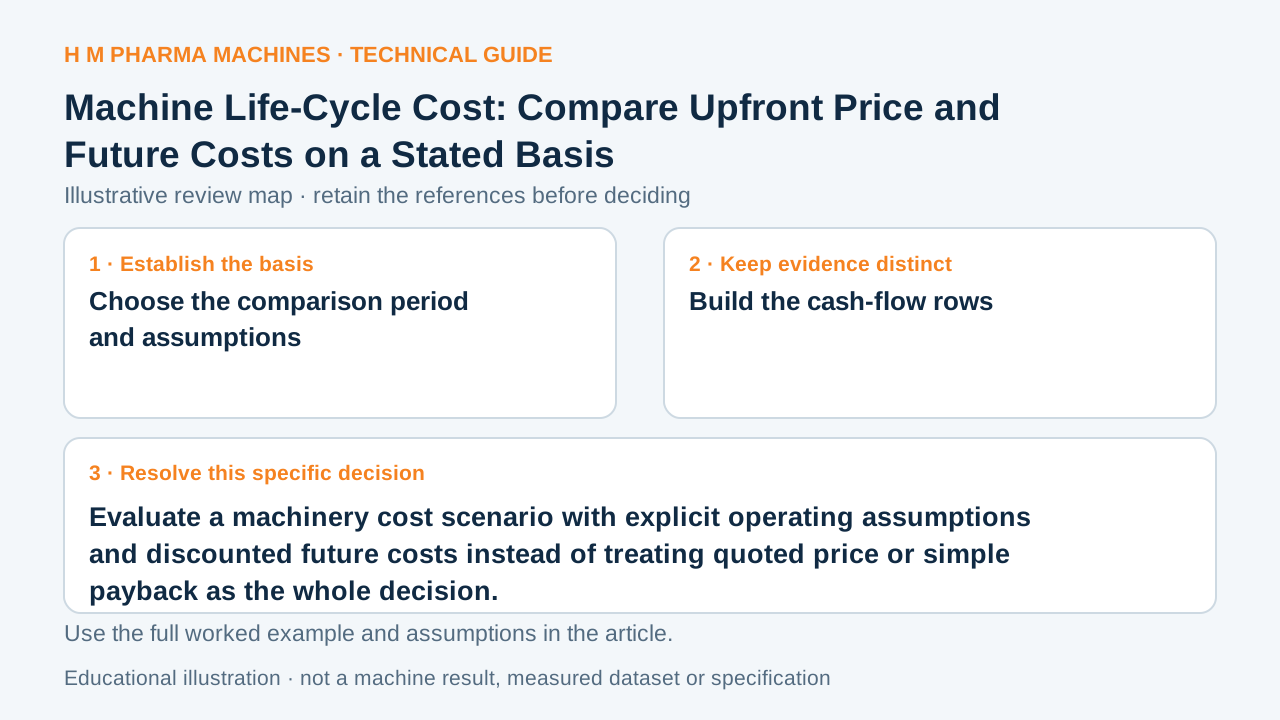
Evaluate a machinery cost scenario with explicit operating assumptions and discounted future costs instead of treating quoted price or simple payback as the whole decision.
Choose the comparison period and assumptions
Life-cycle costing compares relevant costs across a defined period and uses a stated discount basis for future amounts. NIST Handbook 135 explains this general framework. Its federal context is not a source of Indian machinery prices, tariffs or recommended business discount rates. For a machine RFQ, the useful principle is to make the time horizon and cost assumptions explicit so readers can distinguish a modeled scenario from measured savings or a price guarantee.
NIST Handbook 135-2020: life-cycle costing manual supports the technical principle above.
Build the cash-flow rows
Create rows for initial cost, installation differences, energy, maintenance, consumables, downtime assumptions and residual value where relevant. Include only costs supported by the comparison's defined scope; mark unknowns rather than silently setting them to zero. Keep the currency and base-year assumptions consistent. If inflation and discounting are used, state the chosen convention so nominal and real amounts are not mixed without explanation.
Record operating hours, duty and production equivalence behind recurring costs. A lower-power proposal is not automatically cheaper per useful output if it supplies a different process or capacity. Separate supplier commitments from buyer assumptions and from hypothetical sensitivity cases.
Hypothetical five-year comparison
Imagine an educational scenario with a ₹120,000 higher upfront cost and an assumed annual cost reduction of ₹48,000 for five years. With a deliberately assumed 8% annual discount rate and year-end savings, present value is the sum of ₹48,000/(1.08)^t for t = 1 through 5, approximately ₹191,650. Subtracting the upfront difference gives approximately ₹71,650 before any other cost differences. The annual reduction might arise from an invented 3 kW difference × 2,000 hours × ₹8/kWh; every number is a teaching assumption, not a current tariff, HM offer or verified saving. Add maintenance, useful output and residual-value differences if the actual comparison requires them.
Make uncertainty visible in the purchasing decision
Repeat the worksheet with a justified lower operating-hours case and other relevant assumptions to see which inputs drive the conclusion. Preserve those scenarios beside the original rather than presenting one favorable result as certainty. The final buying comparison should identify unresolved cost and performance evidence as well as the calculated amounts. When discussing machinery, share real duty and scope requirements to make proposals comparable. This guide provides a financial-model worksheet; it recommends no financing terms, promises no return and substitutes for neither an actual quotation nor professional appraisal of a major investment.
Customer Questions
Is simple payback the same as discounted life-cycle cost?
No. Discounted comparison considers the timing and defined scope of future costs; simple payback answers a narrower question.
Are the tariff and discount rate recommended values?
No. They are explicitly hypothetical teaching assumptions.
What if annual operating hours are uncertain?
Keep the uncertainty visible and compare justified scenarios rather than presenting one modeled result as a guaranteed saving.
Related Equipment References
Review the actual offered equipment and application separately from this educational example.
Primary References
These references support the technical principles discussed in this guide. The worked examples and review questions are educational.
Discuss Your Machine Requirement
Share your product, container, required output and the evidence needed for your technical review.
Request a Technical Review