
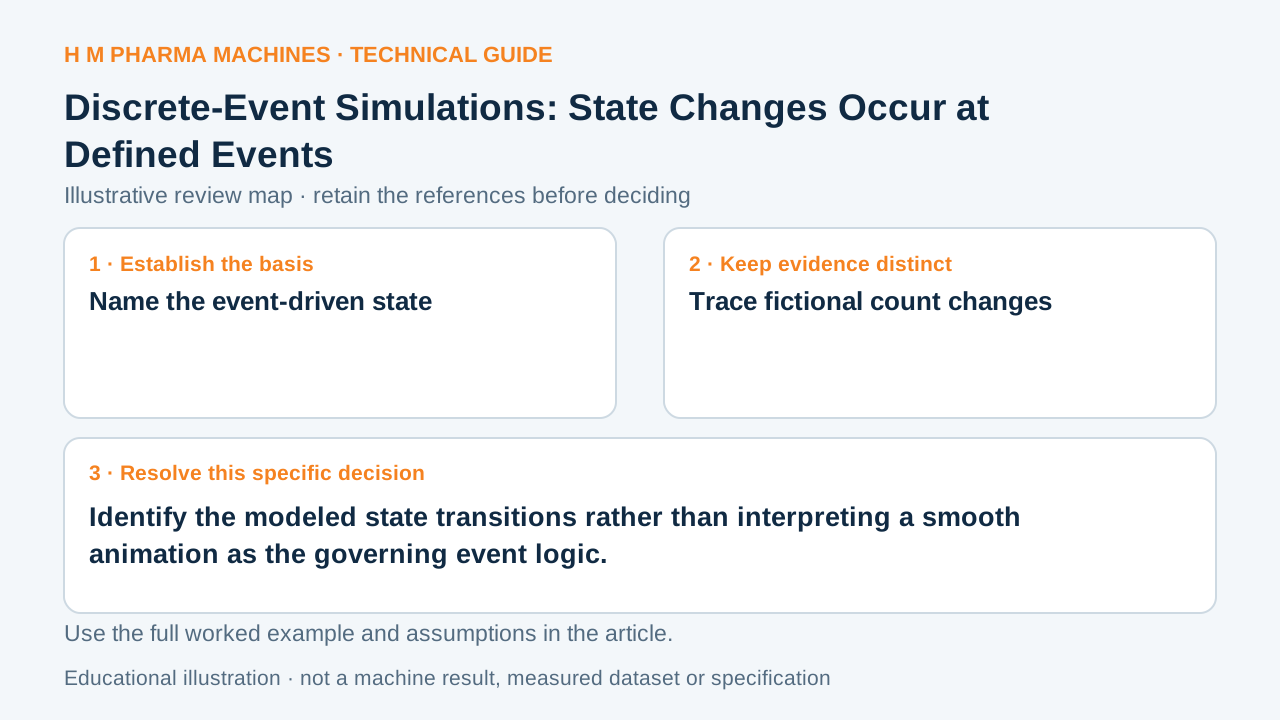
An animated item can appear to move continuously while the modeled queue changes only at specific events. Read the governing state updates separately from the display.
Name the event-driven state
An event framework schedules events for processing and invokes defined callbacks when an event is processed. A discrete-state process model can use arrivals, service starts and departures to update its counts. A screen animation is a representation of that process, not the rule that determines every state transition. Primary reference: SimPy core event types: scheduled events and callbacks.
For an original model worksheet, list the state variables and the event that changes each one. Distinguish logical queue count, busy status and completed-job count from a drawn item’s coordinates. This example concerns a discrete-state model; it does not exclude continuous or hybrid simulation methods.
Trace fictional count changes
Suppose a hypothetical one-job model starts with queue count zero and server idle. At minute 1, Arrival adds a ready job. Start then removes it from the queue and marks the server busy. At minute 3, Finish marks the server idle and adds one to completed output.
Between these defined transitions the logical counts remain unchanged in this model, even if an icon is drawn moving toward the station. A second display frame is not a second arrival. Counting animation frames instead of event identities would therefore manufacture fictitious work.
Review the ledger and display together
Prepare a trial log containing event identity, time and before-and-after state. Check that each completion increment corresponds to a defined Finish event and that an icon removal is not silently treated as departure. Replaying the same state history should preserve logical counts independently of display refresh speed.
This review does not establish actual controller timing, real conveyor motion or machine performance. The purpose is to ask which modeled event changes the reported state. Any physical interpretation needs the appropriate process definitions and observations rather than a convincing animation alone.
Customer Questions
Does a new animation frame mean a new process event?
No. Display refresh and modeled state transitions are separate.
What increments output in the fictional example?
One defined Finish event at minute 3.
Does this rule describe every simulation method?
No. The example explicitly uses discrete-state event logic.
Primary References
These references support the technical principles discussed in this guide. The worked examples and review questions are educational.
Discuss Your Machine Requirement
Share your product, container, required output and the evidence needed for your technical review.
Request a Technical Review