
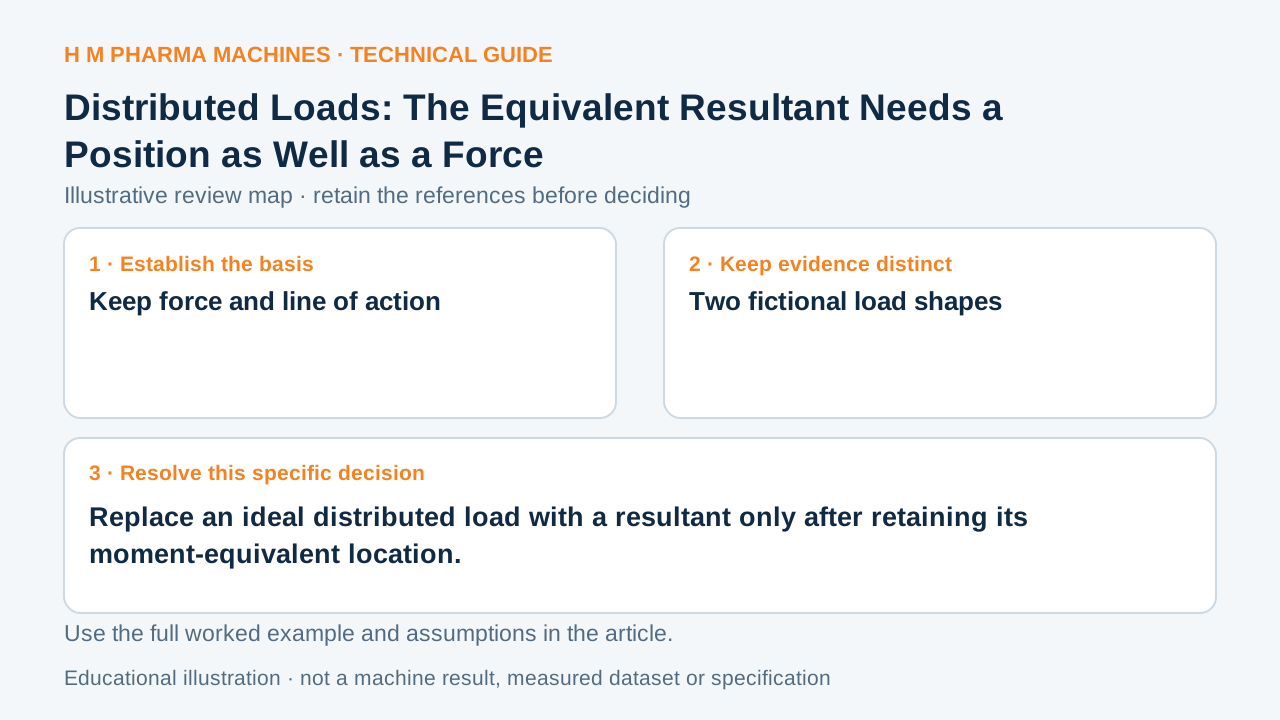
Retain a distributed load’s moment-equivalent location when replacing it with one resultant.
Keep force and line of action
An equivalent resultant has the area under a load-intensity curve as its magnitude and acts through that area’s centroid. Both are needed for equilibrium. Primary reference: distributed loads.
A total force without a position is incomplete when moments matter. Equivalent external force and moment do not mean the distributed and concentrated loads produce identical local internal forces or deflection throughout a member.
Two fictional load shapes
Imagine a 2 m span carries a uniform 100 N/m load. The resultant is 200 N at 1 m from the left end. A triangular load increasing from zero to 100 N/m over the same span instead gives 100 N at approximately 1.333 m from the zero-intensity end.
The triangular resultant is not located at midspan despite a simple total-force calculation. Its moment about the left end is approximately 133.33 N·m. These invented shapes illustrate centroid reasoning, without modeling an actual support, pipe, frame or machine load.
Draw a consistent load record
Keep the intensity function, coordinate origin, resultant magnitude and resultant position in separate fields. If several load regions are combined, preserve each force and centroid before computing their moment sum. Use consistent units for force per length and the integration length.
Place either the original distribution or its equivalent in the external equilibrium calculation; counting both would double the load. Ask whether a subsequent local-stress or deflection analysis must retain the original distribution. This worksheet establishes the replacement’s meaning rather than any installed load allowance.
Customer Questions
Is magnitude alone sufficient?
Moments also require the line of action.
Is every resultant at midspan?
Its location follows the intensity distribution.
Does external equivalence preserve local bending everywhere?
Local response can require the original loading.
Primary References
These references support the technical principles discussed in this guide. The worked examples and review questions are educational.
Discuss Your Machine Requirement
Share your product, container, required output and the evidence needed for your technical review.
Request a Technical Review