
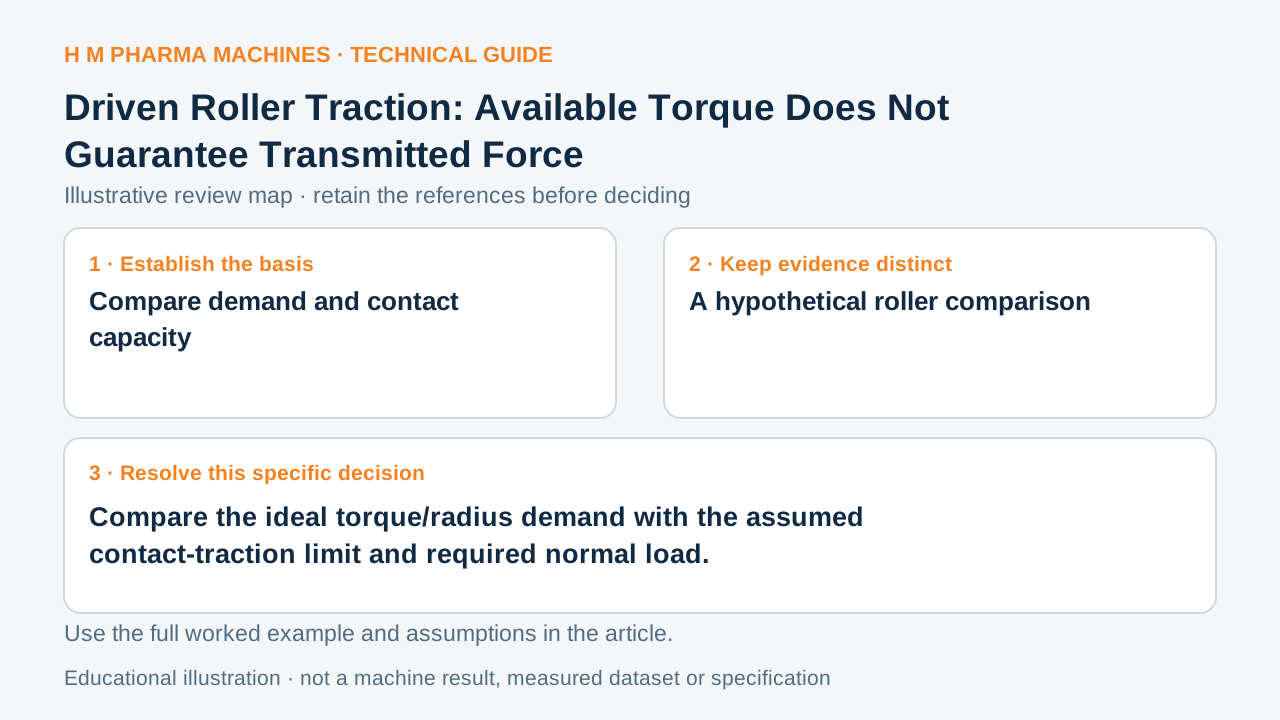
Compare a roller’s torque demand with the assumed available tangential contact force.
Compare demand and contact capacity
A simple static-friction model limits tangential contact force by μₛN. For a driven roller, compare that limit with the required contact force derived from torque and radius. Primary reference: friction limit.
A larger motor torque does not itself increase normal load or the applicable friction coefficient. Identify the effective contact radius and the load actually transmitted through that interface. Bearing and other losses must remain separate from useful traction demand.
A hypothetical roller comparison
Assume 5 N·m of torque must be transmitted at a 0.05 m radius. Ideal tangential demand is 100 N. If the explicitly assumed coefficient is 0.4 and normal contact load is 200 N, the modeled limit is 80 N. The demand therefore exceeds that assumed limit.
The algebra gives 250 N as the normal load associated with 100 N at μ = 0.4, before any margin or other assessment. This is not an instruction to apply that load: product compression, supports, geometry and the actual contact behavior still require review. The example describes no HM roller or sample.
Write a traction worksheet
Record required torque, contact radius, normal-load path and coefficient evidence. Check whether the motor-side torque must first be transformed through a transmission. If several contacts share the demand, document the assumed distribution rather than dividing equally by habit.
Ask what real observations distinguish sliding, deformation and drive limitations. Preserve the conditions used for a proposed assessment. A friction-limit calculation cannot establish surface life, product damage or reliable transport alone; those are separate requirements and evidence.
Customer Questions
Does more torque guarantee more transmitted force?
The contact can impose a smaller limit.
Is 250 N a recommended pressure setting?
It is only an illustrative algebraic result.
Which radius belongs in T/r?
Use the effective radius of the assessed contact.
Primary References
These references support the technical principles discussed in this guide. The worked examples and review questions are educational.
Discuss Your Machine Requirement
Share your product, container, required output and the evidence needed for your technical review.
Request a Technical Review