
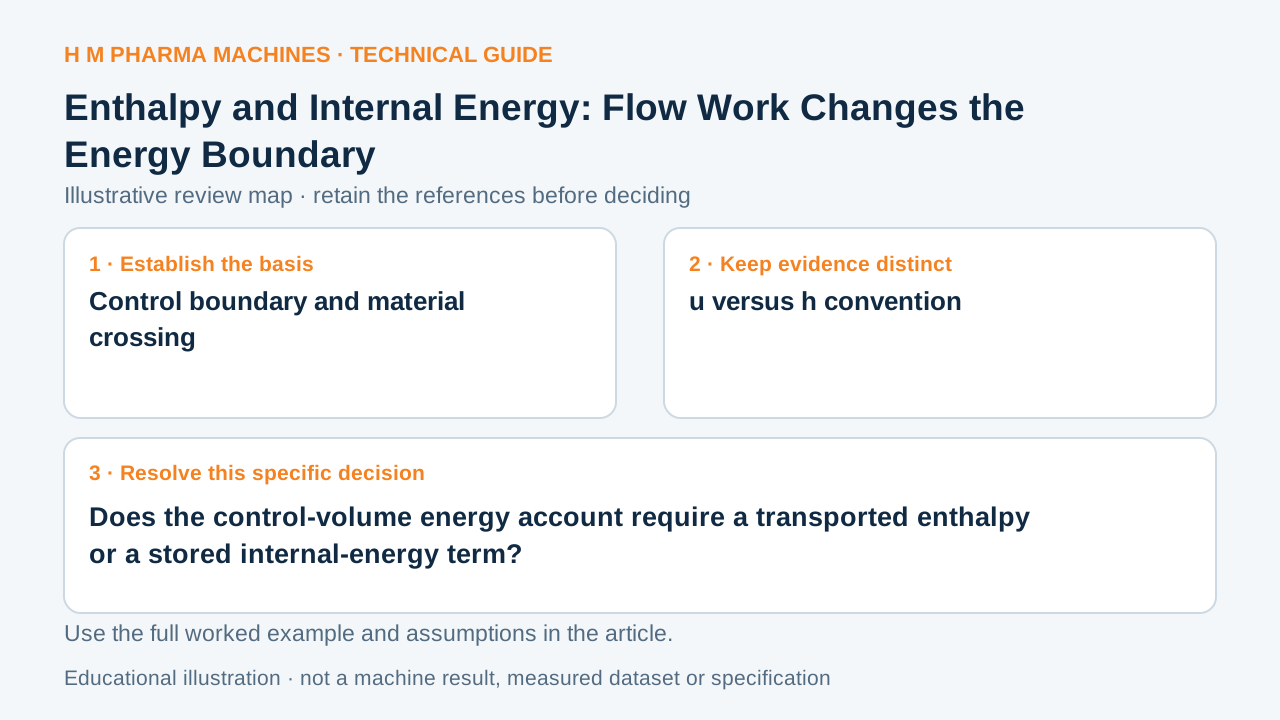
Use the appropriate stored or transported energy term when drawing a control boundary.
Define the Material or Thermodynamic Model
NASA’s enthalpy discussion defines enthalpy through internal energy plus pressure-volume contribution. Per unit mass, h = u + Pv. The Pv term accounts for pressure-related flow work when material enters or leaves a control volume; it is not a second independent internal-energy inventory.
Review a Hypothetical Comparison
For a fictional state assign u = 200 kJ/kg, absolute P = 200 kPa and specific volume v = 0.40 m³/kg. Since 1 kPa·m³ = 1 kJ, Pv = 80 kJ/kg and h = 280 kJ/kg. A flowing-stream term of 280 must not have the same 80 added again as flow work in an account that already uses h.
Keep the Evidence with the Decision
Draw the material-crossing boundary and mark whether each term is stored energy, transported enthalpy or separately supplied work. Keep reference states consistent when comparing inlet and outlet values.
The assigned state is not a physical property dataset. The definition does not eliminate kinetic, potential, heat or shaft-work terms when those are relevant; it prevents counting the same pressure-flow contribution twice.
Does the control-volume energy account require a transported enthalpy or a stored internal-energy term?
This blank worksheet is for your own project. It contains no H M machine trial result.
| Review field | Reference or result | Responsible person |
|---|---|---|
| Control boundary and material crossing | To complete | To complete |
| u versus h convention | To complete | To complete |
| P and specific-volume units | To complete | To complete |
| Other energy terms and reference state | To complete | To complete |
Customer Questions
What enthalpy is assigned?
280 kJ/kg.
What is the pressure-volume contribution?
80 kJ/kg.
Should that 80 be added again to h?
No, on the stated enthalpy convention.
Primary References
These references support the technical principles discussed in this guide. The worked examples and review questions are educational.
Discuss Your Machine Requirement
Share your product, container, required output and the evidence needed for your technical review.
Request a Technical Review