
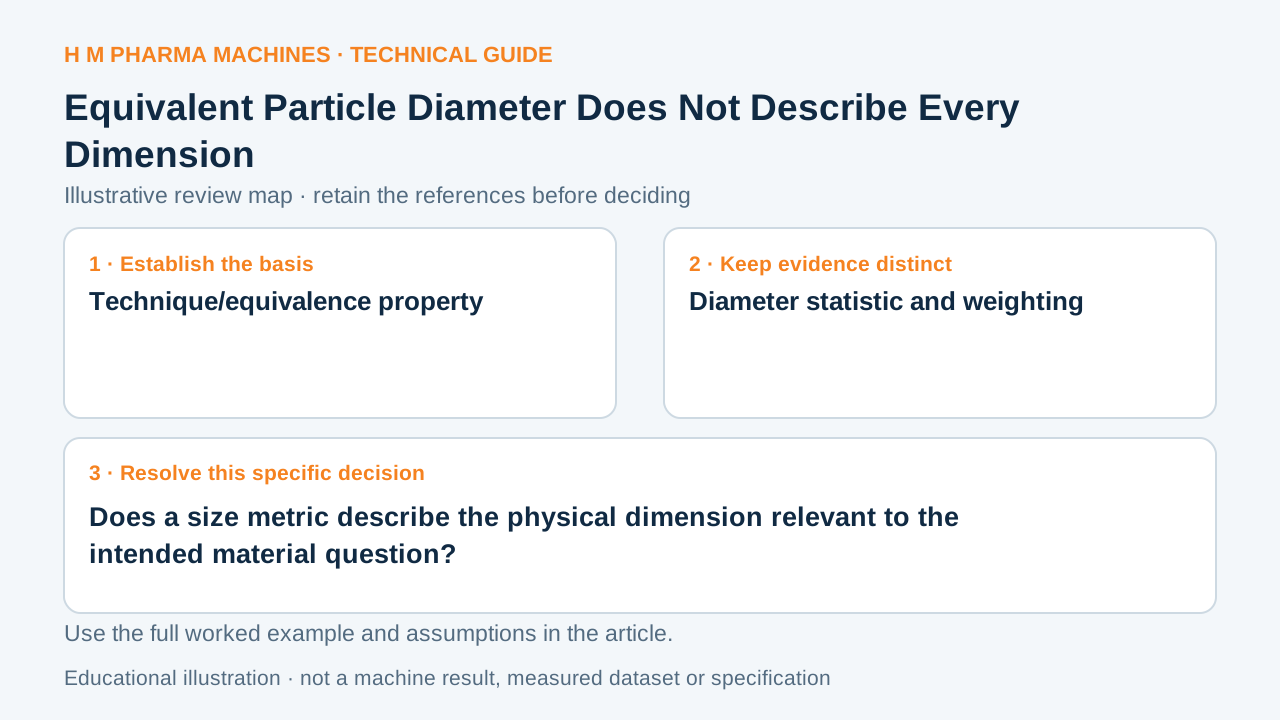
A single equivalent diameter can summarize a measurement while leaving the particle’s length, width or shape unresolved.
Identify the Equivalence Model
Malvern Panalytical explains equivalent-sphere descriptions: a diameter can represent a sphere with a selected property equivalent to that of a real particle. Different techniques can use different models, so their reported diameters need not match precisely.
Irregular particles such as needles or plates cannot be fully described by one diameter. Keep the technique and equivalence property in the report. Do not treat an equivalent-volume diameter as the largest physical dimension without another assessment. Primary characterization reference.
Illustrative Geometry
An invented box-shaped particle is 50 × 5 × 4 µm, giving a volume of 1,000 µm³. A sphere with that volume has a diameter of about 12.4 µm, while the box’s longest dimension is 50 µm. The two numbers describe different properties.
The example is abstract geometry, not an actual powder shape or HM passage specification. It shows why a small equivalent diameter can coexist with a longer physical dimension. It does not establish how a particle or agglomerate will orient in equipment.
Ask Which Dimension Matters
If the material question concerns elongated particles, request an appropriate shape or dimensional assessment from the characterization owner. Keep imaging and size-distribution results recognizable as different records. Avoid adding shape conclusions that the selected technique did not measure.
Complete the worksheet with the size model, relevant physical question and additional evidence needed. A powder-filling enquiry can then use the reported metric accurately while preserving the separate tooling, flow and representative-machine-trial assessment. HM equipment context: Servo Powder Filling Machine.
Equivalent Particle Diameter Does Not Describe Every Dimension — blank comparison record
This blank worksheet is for your own project. It contains no H M machine trial result.
| Quantity/question | Method or result | Reviewer/status |
|---|---|---|
| Technique/equivalence property | To complete | To complete |
| Diameter statistic and weighting | To complete | To complete |
| Relevant physical dimension or shape | To complete | To complete |
| Additional assessment required | To complete | To complete |
Customer Questions
Is equivalent diameter always longest dimension?
No. Its meaning depends on the selected equivalence model.
Can different techniques give different diameters?
Yes. They may represent different equivalent properties.
Does the example approve a particle passage?
No. Actual geometry, orientation and application criteria remain separate.
Related Equipment References
Review the actual offered equipment and application separately from this educational example.
Primary References
These references support the technical principles discussed in this guide. The worked examples and review questions are educational.
Discuss Your Machine Requirement
Share your product, container, required output and the evidence needed for your technical review.
Request a Technical Review