
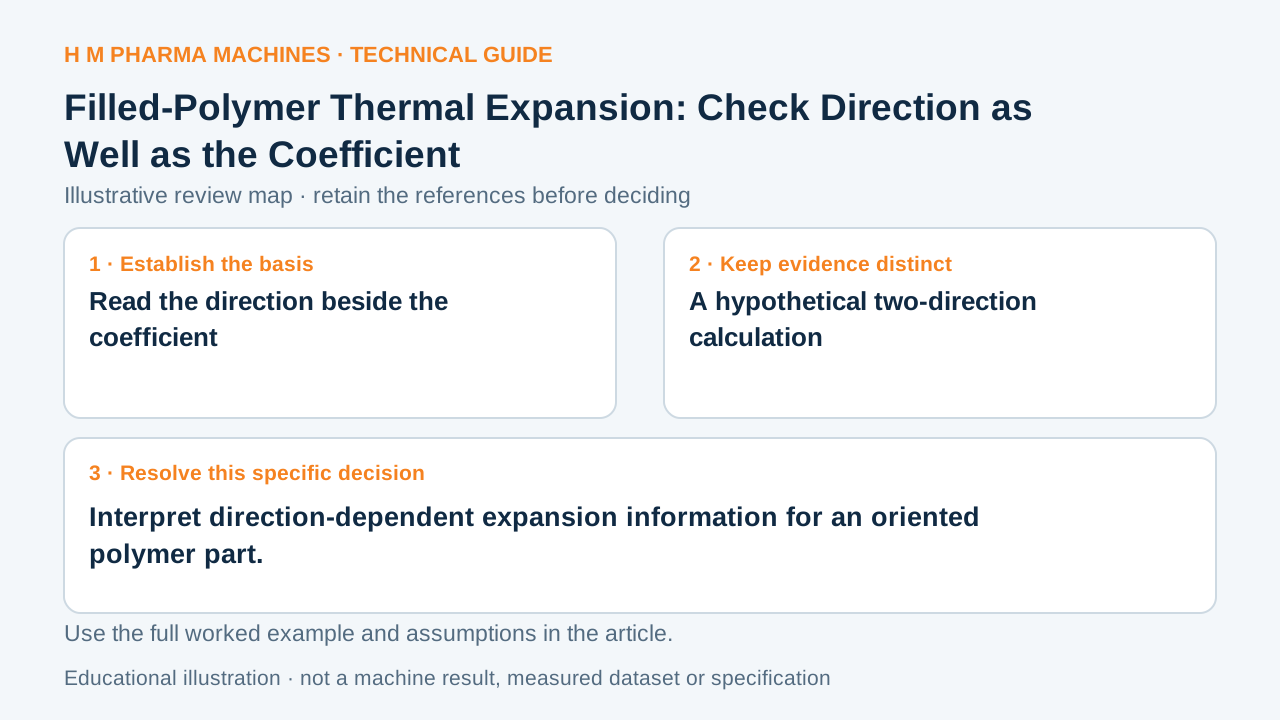
A reinforced material's expansion information may need more than one direction label.
Read the direction beside the coefficient
BASF's simulation discussion explicitly considers anisotropic thermal expansion and fiber orientation. A single scalar copied without its direction can hide the modeled material behavior. Primary reference: BASF thermomechanical modeling.
Identify the material grade, processing context, direction and relevant temperature basis. The intended part dimension should have a documented relationship to the direction of the available property information. A family name or reinforcement percentage does not supply that relationship by itself.
A hypothetical two-direction calculation
Assume fictional constant coefficients of 20 and60×10⁻⁶/K in two identified directions, each over a 200 mm dimension and a 30 K change. The simple linear model gives0.12 and0.36 mm respectively. The arithmetic demonstrates why the direction matters; the coefficients are not taken from a supplier grade or used by HM.
Put coefficient, direction, initial dimension, temperature change and modeled movement in separate columns. State that the calculation assumes the coefficient applies over the stated interval and does not represent the complete constrained assembly. An actual part requires its own material and manufacturing basis.
Relate movement to the actual interface
Ask which part dimension and mating relationship the application controls. If the supplied property direction is unclear, retain that gap instead of selecting the smaller coefficient because it produces a convenient result.
For a later manufacturing-route or orientation change, revisit the applicable dimensional model. Keep expansion distinct from conduction, heat removal and moisture effects. This guide helps define a directional size-change question without prescribing an installation clearance, proving an actual part's movement or treating a hypothetical free-expansion calculation as a finished-assembly tolerance assessment.
Customer Questions
Can the smallest coefficient be used in every direction?
No. Preserve its actual directional applicability.
Does reinforcement percentage define orientation?
No. The part's manufacturing and orientation evidence matters.
Is free-expansion arithmetic a complete assembly result?
No. Constraints and interfaces need their own model.
Primary References
These references support the technical principles discussed in this guide. The worked examples and review questions are educational.
Discuss Your Machine Requirement
Share your product, container, required output and the evidence needed for your technical review.
Request a Technical Review