
Two bonded substrates can seek different dimensional changes as temperature changes.
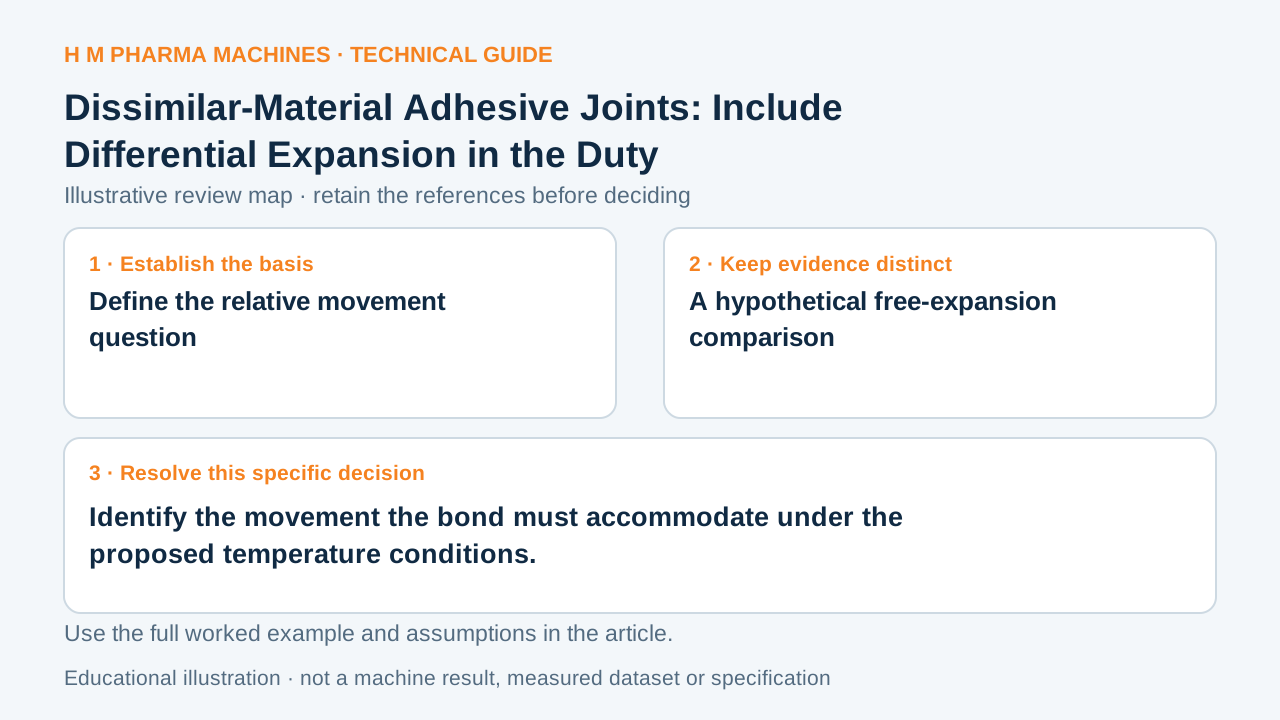
Define the relative movement question
The cited 3M data sheet discusses allowing for differential thermal expansion. Its product-specific capabilities do not define every adhesive joint. Primary reference: 3M expansion-aware bond context.
Record both substrate identities, relevant lengths, temperature range and constraint arrangement. An adhesive compatibility statement at one temperature can leave the movement requirement open. The actual joint assessment should explain how the bond and surrounding structure respond to the defined conditions.
A hypothetical free-expansion comparison
Assume fictional constant coefficients of 10 and50×10⁻⁶/K, a 200 mm reference length and40 K change. Separate free-expansion estimates are0.08 and0.40 mm, with0.32 mm difference. The arithmetic identifies a potential mismatch quantity under the simple model; it does not predict actual bond shear strain or stress in the constrained assembly.
List coefficient sources, length, temperature change, free movements, constraints and the requested joint assessment. The coefficients are invented, not real material recommendations or HM dimensions. No allowable movement, adhesive thickness or bond-capacity value is inferred from the difference.
Retain the geometry and constraints
Ask which model or evidence evaluates the complete proposed bond rather than assuming that a flexible-sounding adhesive name closes the movement question. Actual load duration and repeated temperature changes may belong in that application review.
If substrate, bond geometry or temperature range changes, preserve the changed condition with the design record. This guide supports a mismatch-movement worksheet without selecting an adhesive, reproducing a supplier's permitted-strain rule or promising that the simplified free-expansion difference is the movement the assembled joint will actually experience.
Customer Questions
Is free-expansion difference the actual constrained bond strain?
No. The assembly constraints and geometry require their own model.
Does a flexible adhesive label settle compatibility?
No. Identify the complete joint and duty basis.
Does the0.32 mm example prescribe bond thickness?
No. It is only a hypothetical movement estimate.
Primary References
These references support the technical principles discussed in this guide. The worked examples and review questions are educational.
Discuss Your Machine Requirement
Share your product, container, required output and the evidence needed for your technical review.
Request a Technical Review