
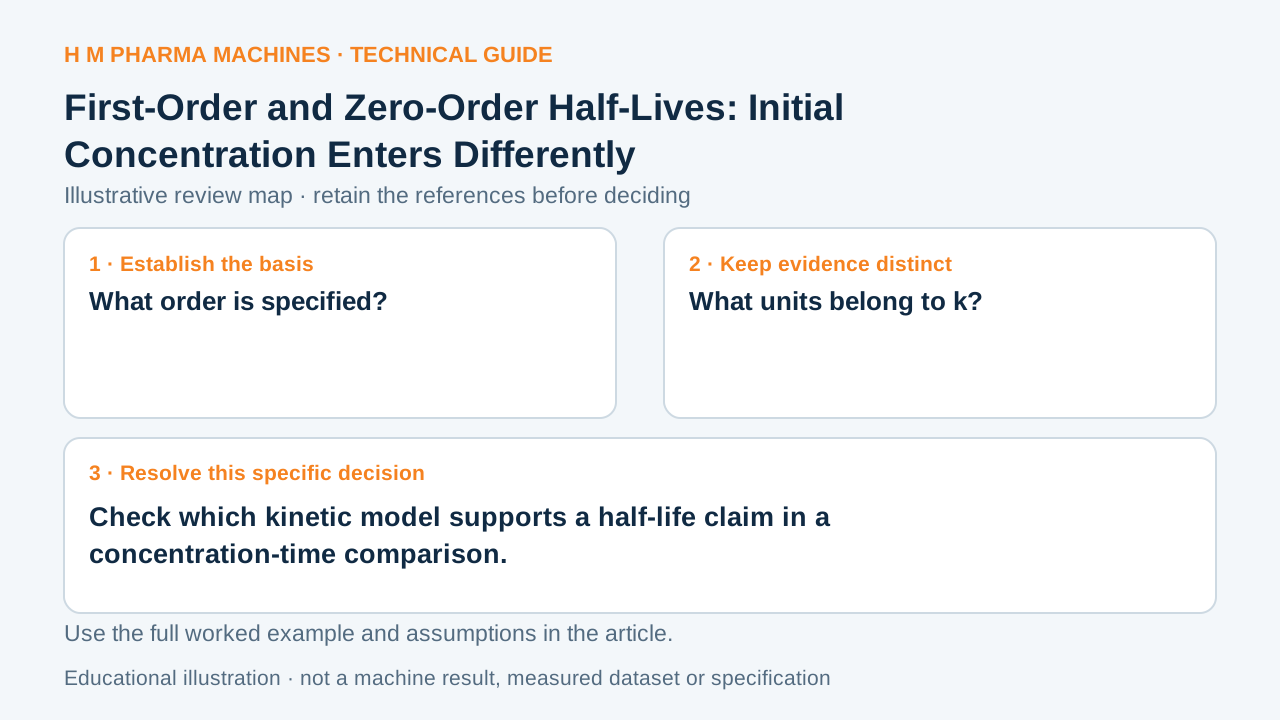
A half-life formula depends on the stated kinetic order. Its relationship to starting concentration changes when the model changes from first order to zero order.
Retain the specified kinetic law
Under a first-order disappearance model, half-life is ln(2)/k and is independent of initial concentration at fixed k. Under a zero-order model, half-life is c₀/(2k). The rate constants have different dimensions, so their bare numeric values cannot be compared as the same quantity. Primary reference.
Compare two invented half-life models
Assign an invented first-order constant k₁ = 0.100 min⁻¹. Its half-life is approximately 6.931 min for either c₀ = 0.200 or 0.400 mol/L. Separately assign a zero-order constant k₀ = 0.0100 mol/(L min). Its half-lives are 10.0 and 20.0 min for those respective starting concentrations.
The zero-order times follow a constant modeled disappearance rate over the interval to half the initial concentration. Extrapolating that model beyond depletion would produce an inadmissible negative concentration. Neither constructed law was identified from an actual HM process or stability study.
Keep the model identification separate
Prepare an original prediction sheet with the chosen rate law, dimensional rate constant, initial concentration and interval of applicability. Keep model identification tied to a suitable time-resolved dataset. Two listed half-life values alone do not establish every mechanism or exclude competing processes.
This article supplies no shelf life, sterilization duration or chemical operating instruction. Its decision is whether the half-life interpretation follows the already specified kinetic order. First establish the model and its conditions, then retain the concentration dependence that belongs to that model.
Solution review worksheet
This blank worksheet is for your own project. It contains no H M machine trial result.
| Question | Record to retain |
|---|---|
| What order is specified? | First-order or zero-order model |
| What units belong to k? | Inverse time or concentration per time |
| What concentration interval applies? | Initial state through the modeled observation range |
Customer Questions
What is the fictional first-order half-life?
Approximately 6.931 min.
What are the fictional zero-order half-lives?
10.0 and 20.0 min for the stated starting concentrations.
Can bare k values from different orders be compared directly?
No. Their dimensions differ.
Primary References
These references support the technical principles discussed in this guide. The worked examples and review questions are educational.
Discuss Your Machine Requirement
Share your product, container, required output and the evidence needed for your technical review.
Request a Technical Review