
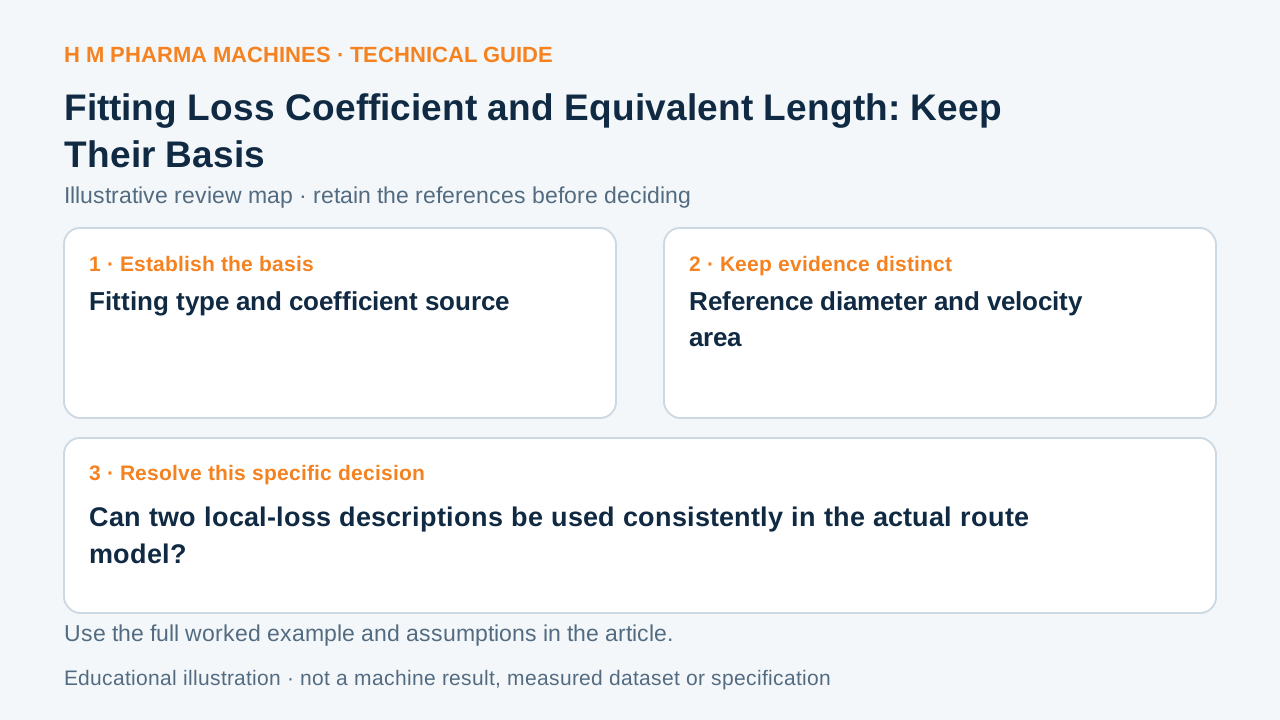
A fitting represented by a loss coefficient and the same fitting represented by equivalent length need the same hydraulic basis.
Identify the Physical Basis
With compatible definitions, K = f_D L_eq/D relates a fitting’s loss coefficient to an equivalent straight-pipe length. AFT’s equivalent-length explanation also shows why converting high-Reynolds-number fitting data into a laminar application needs care. K and L_eq are ways to represent a loss model; neither is simply the fitting’s measured physical length.
Work Through an Example
In a hypothetical calculation, K = 0.60, D = 0.025 m and the selected Darcy factor is 0.020. The matching equivalent length is K D/f_D = 0.75 m. If an analyst changes f_D to 0.040 but leaves K fixed, the corresponding L_eq is 0.375 m. This arithmetic comparison explains the dependency; it does not prove which fitting correlation is suitable for the new regime.
Use the Result in the Review
Record the coefficient’s source, Reynolds-number scope and reference velocity area. Choose one representation in the route model so that the same elbow is not included as both K and equivalent length. For a reducer or valve, confirm which diameter the source uses. A compact spreadsheet should retain the fitting inventory even when the calculation reports only one combined loss figure.
For transfer connections to a storage tank, submit the fitting types and positions with the line drawing. Ask for the correlation appropriate to the product and flow range. An equivalent-length conversion is an accounting identity within a model; applying it beyond that model’s evidence can hide the very component being reviewed.
Can two local-loss descriptions be used consistently in the actual route model?
This blank worksheet is for your own project. It contains no H M machine trial result.
| Review field | Reference or result | Responsible person |
|---|---|---|
| Fitting type and coefficient source | To complete | To complete |
| Reference diameter and velocity area | To complete | To complete |
| Friction-factor convention and regime | To complete | To complete |
| Single representation with double-count check | To complete | To complete |
Customer Questions
Is equivalent length the elbow’s centreline length?
No. It represents the same modeled pressure loss as a length of pipe.
Can K remain constant for every Reynolds number?
Check the source; some fitting models vary with regime.
Should I enter both K and L_eq?
Avoid counting the same modeled loss twice.
Related Equipment References
Review the actual offered equipment and application separately from this educational example.
Primary References
These references support the technical principles discussed in this guide. The worked examples and review questions are educational.
Discuss Your Machine Requirement
Share your product, container, required output and the evidence needed for your technical review.
Request a Technical Review