
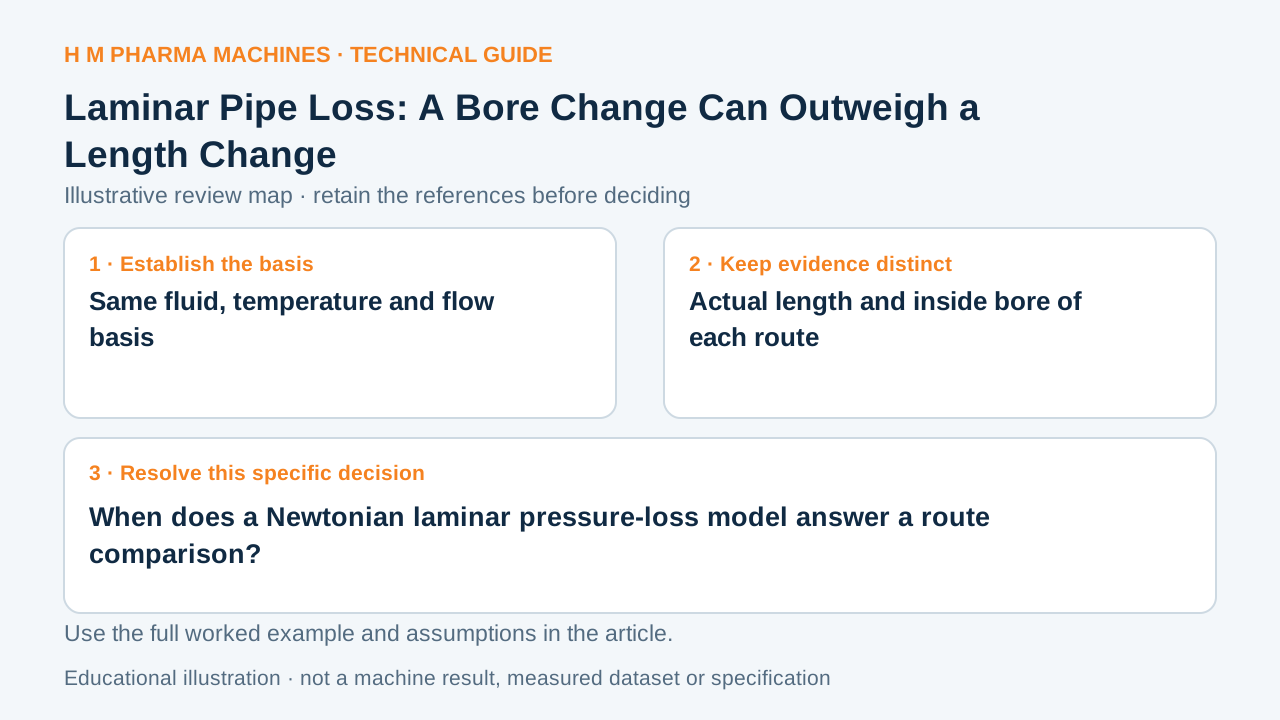
Use the laminar model to separate the effects of length and bore before treating a longer transfer route as the main source of loss.
Identify the Physical Basis
Combining the circular-pipe Darcy loss equation with its Newtonian laminar friction factor gives Δp = 128μLQ/(πD⁴). KSB’s pipe-loss reference provides the pipe-loss and laminar-factor basis. This expression assumes steady, fully developed laminar flow in a round passage; entry regions, local fittings and non-Newtonian behaviour are separate questions.
Work Through an Example
Consider hypothetical routes carrying the same liquid at the same flow: route A is 4 m long with a 20 mm bore; route B is 8 m long with a 25 mm bore. The straight-pipe loss ratio B/A is 2 × (20/25)⁴ = 0.8192. In this restricted model the longer route has about 18% less straight-pipe pressure loss. The result says nothing yet about the elbows, valves or elevation in either layout.
Use the Result in the Review
Build the comparison from inside dimensions and the viscosity at the relevant temperature. Recheck the laminar assumption for both routes because velocity and Reynolds number change with bore at constant Q. Separate physical length from fittings rather than silently treating every component as an identical metre of tube. Keep the calculation sheet attached to the drawing revision used.
The storage-tank page is a starting point for a transfer-interface discussion. Ask the supplier to combine the applicable straight-line model with local losses and the complete system duty. A favourable fourth-power comparison alone does not select a pump or approve a hygienic piping layout.
When does a Newtonian laminar pressure-loss model answer a route comparison?
This blank worksheet is for your own project. It contains no H M machine trial result.
| Review field | Reference or result | Responsible person |
|---|---|---|
| Same fluid, temperature and flow basis | To complete | To complete |
| Actual length and inside bore of each route | To complete | To complete |
| Laminar applicability for both routes | To complete | To complete |
| Separate local and static contributions | To complete | To complete |
Customer Questions
Is D⁻⁴ universal?
No. It applies to the stated Newtonian laminar model at fixed flow.
Does physical elbow length define its loss?
No. Use an appropriate local-loss model.
Does lower loss select the route?
No. Review full duty, drainage and interfaces.
Related Equipment References
Review the actual offered equipment and application separately from this educational example.
Primary References
These references support the technical principles discussed in this guide. The worked examples and review questions are educational.
Discuss Your Machine Requirement
Share your product, container, required output and the evidence needed for your technical review.
Request a Technical Review