
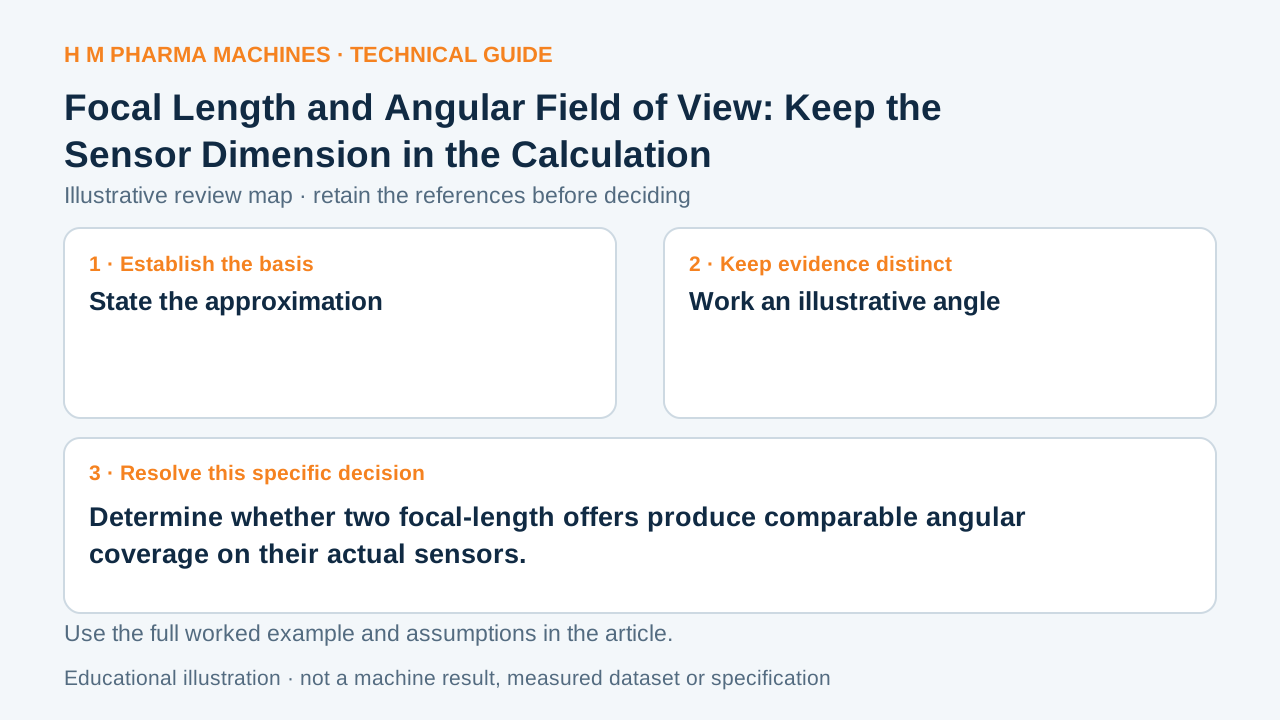
A focal-length number belongs to a camera-and-lens arrangement. Using it alone can make two different sensor formats look like equivalent views.
State the approximation
A first-order angular comparison uses AFOV = 2 arctan(H/(2f)), with sensor dimension H and focal length f in the same units. It is a selection aid; a real compound lens needs its own design data. Primary reference: Edmund Optics: focal length and field of view.
Choose the same image direction for both inputs. A horizontal sensor width cannot silently be compared with an angular value specified for the diagonal. Identify the active sensor dimension rather than substituting a format name that does not give the required geometry.
Work an illustrative angle
Take a fictional horizontal sensor width of 8 mm. With a 16 mm focal length, the approximation gives 2 arctan(8/32), about 28.1°. Using the same focal length with a 12 mm width gives about 41.1°. The unchanged lens label has not produced the same angular coverage on the two sensors.
The numbers are an educational calculation, not a predicted installed field. Distortion, actual lens design and the working geometry still need review. Do not use this approximate angle to set a bracket location without the lens-specific dimensional and optical information.
Compare like directions and conditions
Make a comparison row containing sensor direction, active dimension, focal length, approximation used and lens-specific confirmation. Retain the corresponding actual field-of-view evidence. If a lens's published angle refers to another sensor size, reconcile that condition before using the figure.
The useful outcome is an identified coverage difference and a request for the actual installed data. It is not a rule that every shorter lens is better, nor a promise that a wider angle preserves the required detail at the image edges.
Customer Questions
Does the same focal length mean the same angular view?
No. Keep the active sensor dimension with the comparison.
May horizontal and diagonal values be mixed?
No. Define the direction of each quantity.
Is the first-order equation an installation drawing?
No. Use the real lens's geometry and specification for the layout.
Primary References
These references support the technical principles discussed in this guide. The worked examples and review questions are educational.
Discuss Your Machine Requirement
Share your product, container, required output and the evidence needed for your technical review.
Request a Technical Review