
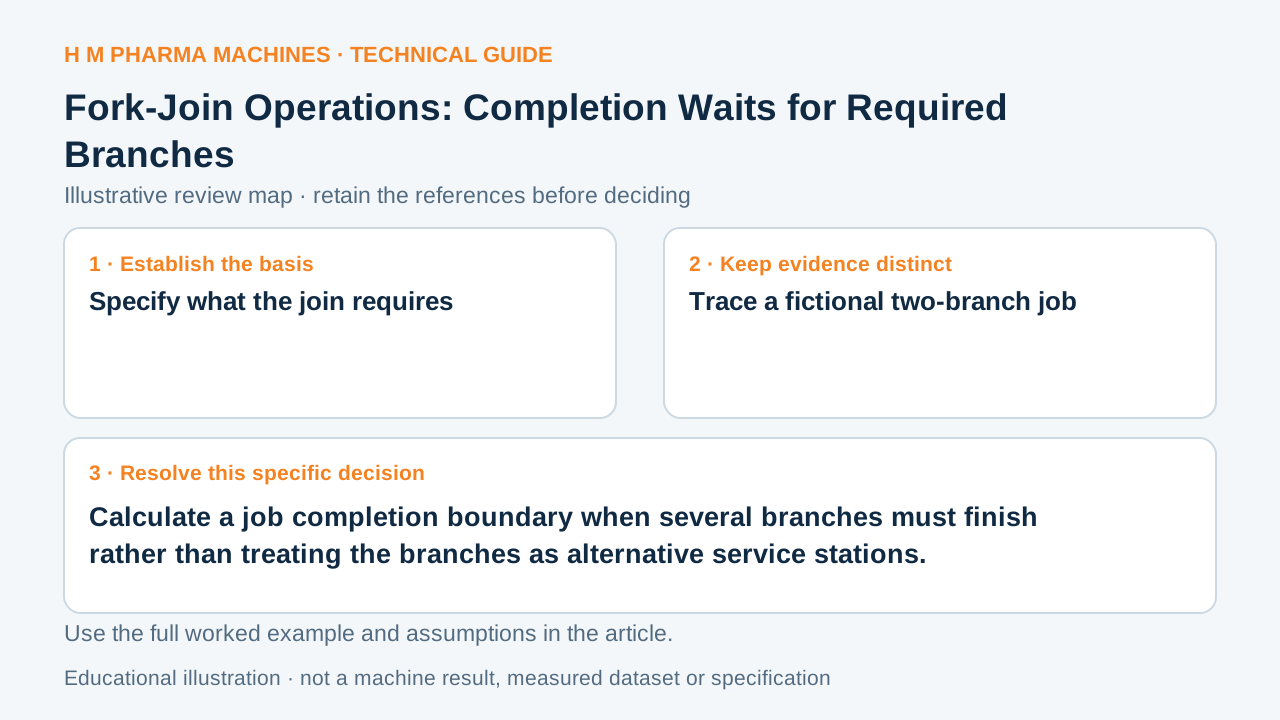
Parallel alternatives and parallel requirements represent different jobs. A join that needs every required branch must retain their individual completion events.
Specify what the join requires
An event condition can wait for all specified events, or for at least one of them. A fork-join operation uses the first meaning when each required branch must complete for the same job. This differs from selecting one alternative service route and accepting whichever route performs the job. Primary reference: SimPy events: AllOf and AnyOf conditions.
For the proposed job, list the required branch identifiers and the exact completion event from each. Do not substitute any-of logic merely because one branch finishes earlier. If failure or cancellation can satisfy the condition, state whether that represents successful job completion or a separate exception outcome.
Trace a fictional two-branch job
Assume two independent required branches start together at minute 0, with no contention or interruptions. Branch A takes 3 minutes and B takes 5 minutes. Both are complete at minute 5, so the job’s join can occur then. Adding 3 + 5 would describe serial service instead.
If B starts at minute 2 while A still starts at 0, their finish times are 3 and 7. The join is minute 7. Thus the result depends on completion timestamps, not merely the longer listed duration. These original scenarios concern one job, not a claim about repeated-job throughput.
Review the completion evidence
Create a trial ledger with each branch’s start, end and required status, then derive the join from the latest required successful completion. Keep optional branch work outside that required set unless the design explicitly changes the release rule. Record any synchronization or transfer interval separately.
A repeated production process also needs its resource-sharing and admission logic before capacity can be discussed. No arithmetic here establishes an HM assembly time or proves that all branches can run independently on actual equipment. The purpose is to verify the logical boundary used to call an individual modeled job complete.
Customer Questions
Does a required join finish after the first branch?
No. It waits for every required successful branch completion.
What is the simultaneous 3- and 5-minute example’s join time?
Minute 5 under the stated independence assumptions.
Can the longer duration alone determine the join?
Only when relevant start times coincide; otherwise compare completion timestamps.
Primary References
These references support the technical principles discussed in this guide. The worked examples and review questions are educational.
Discuss Your Machine Requirement
Share your product, container, required output and the evidence needed for your technical review.
Request a Technical Review