
Count rectified waveform repetitions before interpreting the ripple frequency of an AC-to-DC circuit.
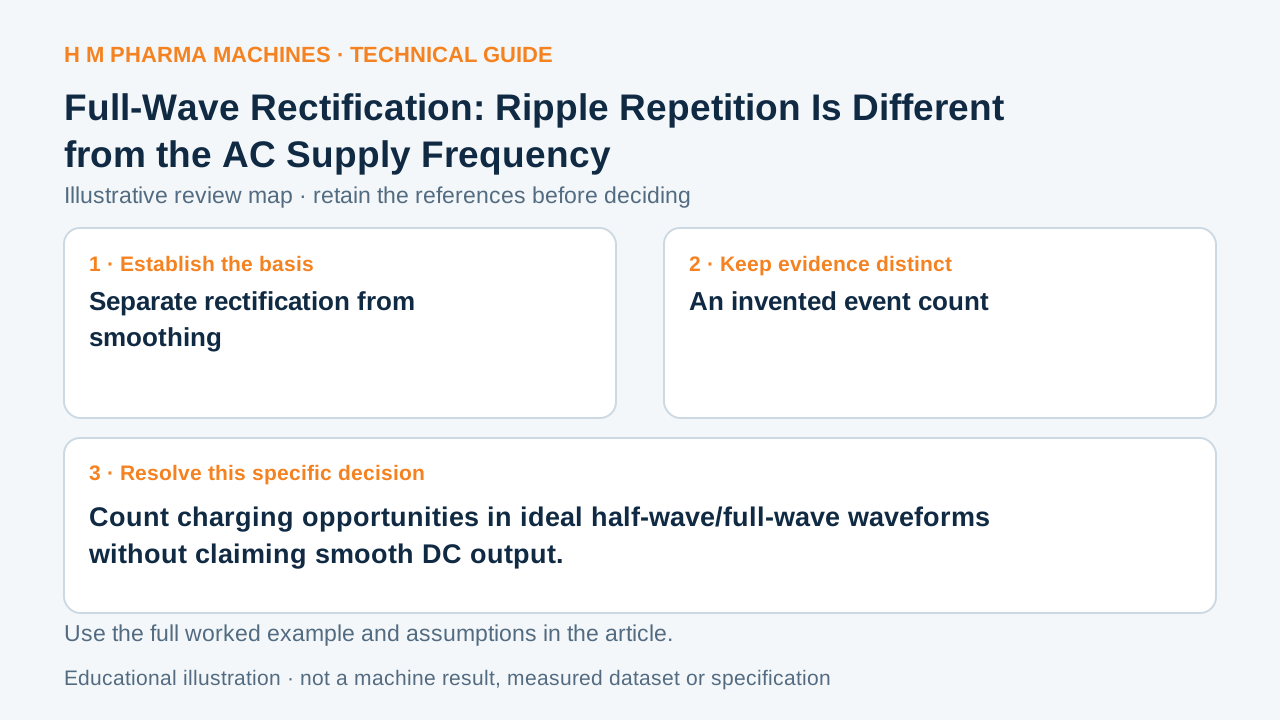
Separate rectification from smoothing
ROHM illustrates full-wave rectification as a unidirectional waveform and shows a capacitor used for smoothing. Rectification alone does not make a constant output voltage. Primary reference: rectifier waveforms, figure 4.
The waveform repetition rate and the size of the remaining variation are different questions. First identify whether one or both source half-cycles contribute to the modeled output. Then retain the actual load and storage arrangement for a ripple-magnitude assessment.
An invented event count
Assume a fictional 50 Hz sinusoidal supply. A simple ideal half-wave output repeats its conducting lobe 50 times per second, with a 20 ms repetition interval. A full-wave output has 100 lobes per second, giving a 10 ms repetition interval.
These intervals describe the ideal waveforms. A smoothing capacitor does not necessarily charge for the entire lobe or hold a perfectly flat voltage between lobes. Its actual charging and discharge intervals depend on the circuit. The example is not a mains wiring instruction or a measured HM supply waveform.
Make the frequency label meaningful
Record source frequency, rectifier arrangement, the waveform point being discussed and whether storage or regulation follows it. Distinguish AC supply frequency from the observed repetition of an output ripple.
A component proposal should retain actual waveforms and relevant operating conditions. This simple event-count worksheet helps explain why a quoted ripple frequency can differ from the incoming source frequency without implying that the source changed.
Customer Questions
Does rectification guarantee constant DC?
A rectified output can still vary with time.
Does ideal full-wave output repeat at source frequency?
It contains two lobes per source cycle.
Does 10 ms establish actual discharge time?
The circuit’s charging intervals must also be considered.
Primary References
These references support the technical principles discussed in this guide. The worked examples and review questions are educational.
Discuss Your Machine Requirement
Share your product, container, required output and the evidence needed for your technical review.
Request a Technical Review