
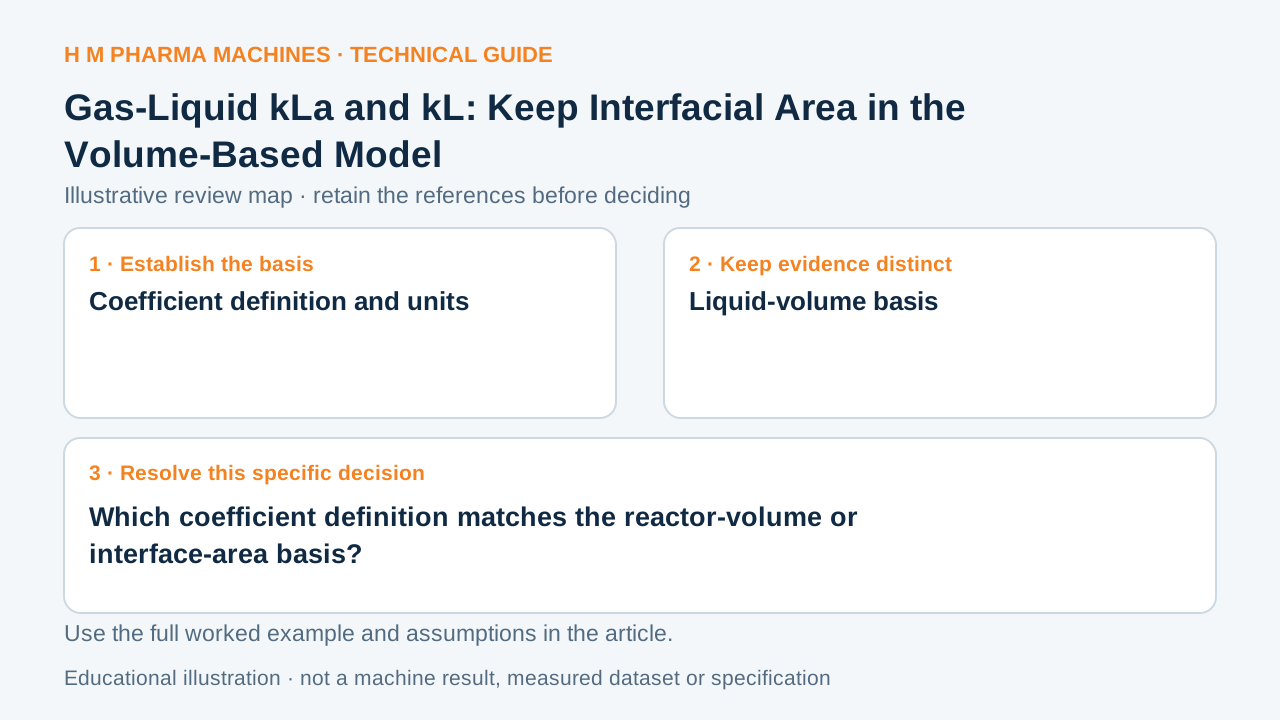
A coefficient per liquid volume includes the interfacial area available for transfer, while an area-based coefficient does not.
Define the Interface or Transport Basis
Al-Ahmady's primary oxygen-transfer study, equations 1–2 defines a as interfacial area divided by water volume and the volumetric coefficient as kL multiplied by a. Their units differ: kL has length per time, while kLa has inverse time under a consistent volume basis.
Review a Hypothetical Comparison
Assign hypothetical values kL=0.00008 m/s and interfacial area per liquid volume a=250 m²/m³. Their product is kLa=0.020 s⁻¹. If a second state has a=125 m²/m³ while the assigned kL stays the same, its product is 0.010 s⁻¹. The lower volumetric result could therefore arise from less area without a change in the assumed area-based coefficient. This is arithmetic for invented states, not a bubble-area estimate from an HM tank.
Keep the Evidence with the Decision
Write the liquid volume and total transfer area beside any inferred a value. If only kLa is measured, do not claim that kL changed without separate area evidence. Preserve the operating state and medium because a quoted volumetric coefficient belongs to that state. Check whether a report uses liquid volume, total vessel volume or another basis before comparison.
The useful outcome is a coefficient with a clear area and volume convention. This guide does not choose aeration hardware, extrapolate a source correlation or equate a higher kLa with better overall product performance.
Which coefficient definition matches the reactor-volume or interface-area basis?
This blank worksheet is for your own project. It contains no H M machine trial result.
| Review field | Reference or result | Responsible person |
|---|---|---|
| Coefficient definition and units | To complete | To complete |
| Liquid-volume basis | To complete | To complete |
| Independent interface-area evidence | To complete | To complete |
| State and medium associated with the result | To complete | To complete |
Customer Questions
Can measured kLa alone determine kL?
Not without the interfacial area per stated volume or another justified model.
What are the units of a?
Area divided by volume, such as m²/m³, which reduces to inverse length.
Does a larger vessel necessarily lower kLa?
No. The product depends on the transfer coefficient and interface area per volume in the actual state.
Primary References
These references support the technical principles discussed in this guide. The worked examples and review questions are educational.
Discuss Your Machine Requirement
Share your product, container, required output and the evidence needed for your technical review.
Request a Technical Review