
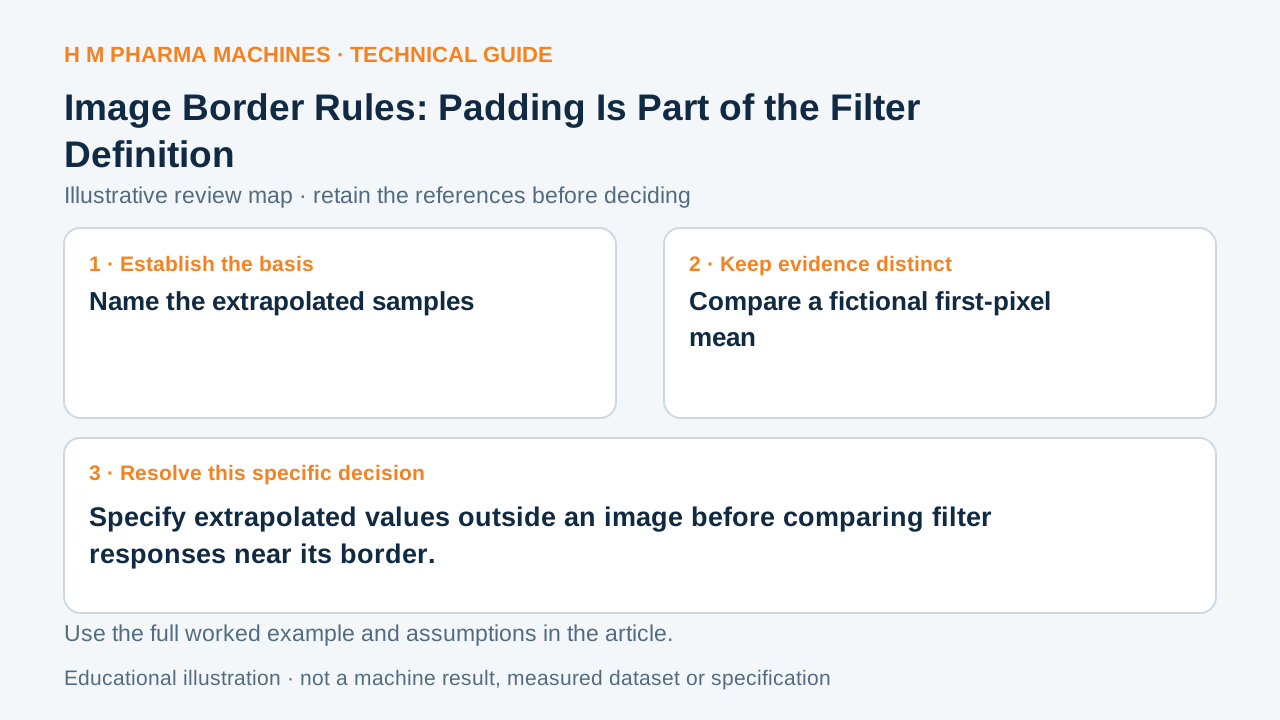
A neighborhood near an image edge can request samples that were never acquired. Their assigned values belong to the computation’s definition.
Name the extrapolated samples
Padding can extend an array using a specified constant or a rule such as replicating its boundary values. These assigned samples are not new sensor observations. A neighborhood operation touching the image boundary can produce different results according to the selected extension. Primary reference: MathWorks array padding values and replication.
For an original worksheet, distinguish acquired pixel indices from extrapolated indices. Record the padding method, amount and direction before calculating a border response. Do not infer the chosen rule from a displayed result without checking the operation definition.
Compare a fictional first-pixel mean
Take an invented row beginning [10,20,30] and a centered three-sample mean at its first pixel. Zero padding supplies [0,10,20], giving 10. Replicating the boundary supplies [10,10,20], giving 40/3 ≈13.33. Both calculations use the same acquired row.
Only the missing left sample differs. These are floating teaching values before any integer conversion. The example compares two explicit extensions; it does not imply that every filter function chooses either one by default or that a reflected extension has an identical convention.
Review edge measurements separately
Prepare a trial containing an interior location and a boundary location with all sampled indices shown. Identify outputs that depend on extrapolation so they are not described as using a complete acquired neighborhood. Preserve that boundary convention when comparing image-processing revisions.
Padding can make a computation possible, but it cannot restore scene evidence outside the sensor’s acquired area. The guide recommends no HM border treatment or inspection margin. Its decision is whether assigned outside-image values were retained in the definition behind a reported edge response.
Customer Questions
Are padded values acquired pixels?
No. They are values assigned by the extension rule.
What do the two fictional means give?
10 with zero padding and approximately 13.33 with replication.
Does the example establish a software default?
No. It compares explicitly selected rules.
Primary References
These references support the technical principles discussed in this guide. The worked examples and review questions are educational.
Discuss Your Machine Requirement
Share your product, container, required output and the evidence needed for your technical review.
Request a Technical Review