
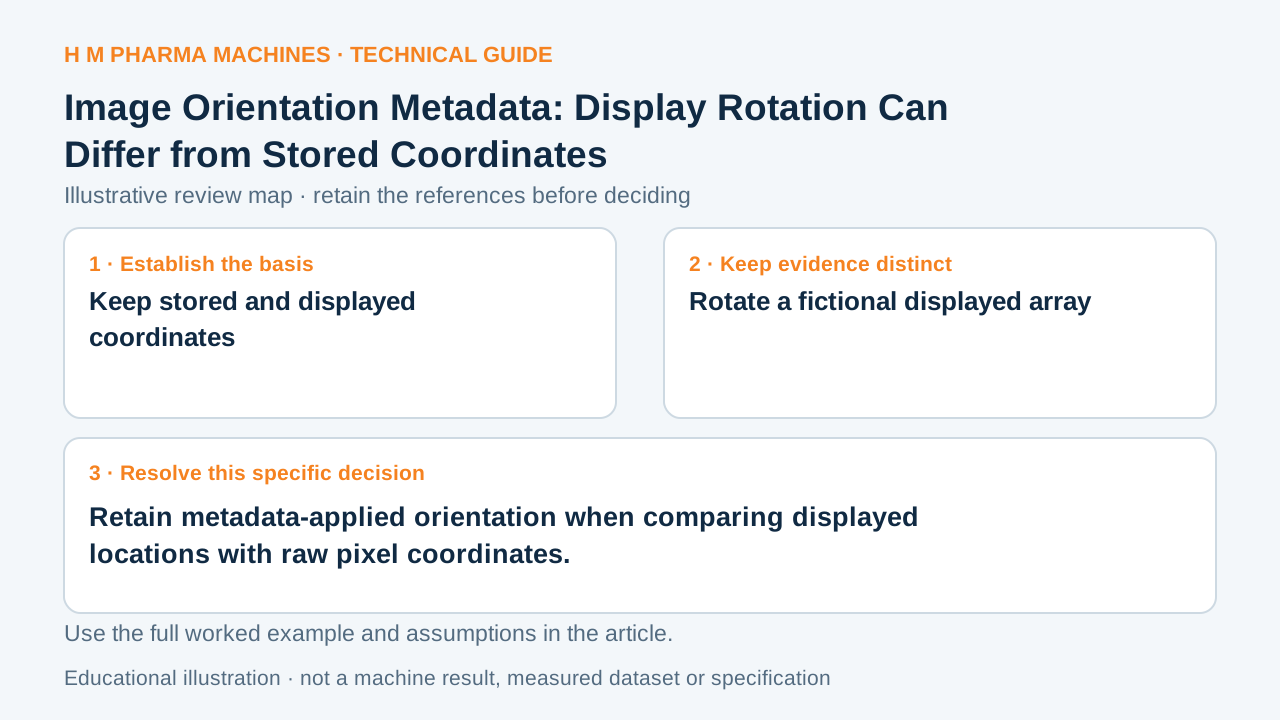
A viewer can rotate the displayed image according to metadata while leaving the underlying sample arrangement unchanged.
Keep stored and displayed coordinates
Image orientation metadata describes how stored rows and columns relate to the visual image. A viewer that honors the metadata can present another orientation without rewriting the stored sample array. Display coordinates therefore need the applied transform before they are compared with raw-array coordinates. Primary reference: Microsoft orientation metadata row and column definitions.
For an original worksheet, retain raw dimensions, orientation tag and the viewing route. Do not assume every receiver applies that tag identically. This metadata-driven presentation is distinct from a buffer's bottom-up row storage or a physical change in camera pose.
Rotate a fictional displayed array
Use stored rows [1,2,3] and [4,5,6], with width three and height two. In a teaching viewer explicitly applying orientation 6 as a ninety-degree clockwise presentation, displayed rows become [4,1], [5,2] and [6,3]. Display width is two and height three.
The stored sample at (x = 0,y = 0), value 1, appears at displayed (1,0). No sample value changed in this constructed presentation. The exercise does not promise an application's actual metadata handling or prove the photographed object rotated between records.
Retain the applied viewing rule
Prepare an original mapping table for a marked pixel and preserve the orientation transform with any displayed annotation. If an export physically rotates samples and clears the tag, document that new representation. Avoid applying the same transform twice when copying coordinates between such routes.
This guide claims no HM image-viewer behavior. Its reader decision is whether a displayed coordinate has been interpreted under the actual metadata application. Sample coordinates and viewing coordinates should remain distinguishable when screenshots and raw arrays support the same technical comparison.
Customer Questions
What are the fictional displayed dimensions?
Width two and height three.
Where does stored value one appear?
At displayed coordinate (1,0).
Did the stored values change in the example?
No. The defined presentation changed.
Primary References
These references support the technical principles discussed in this guide. The worked examples and review questions are educational.
Discuss Your Machine Requirement
Share your product, container, required output and the evidence needed for your technical review.
Request a Technical Review