
Adding cylindrical insulation changes both conduction resistance and exposed area. Check the model before assuming every added layer reduces heat loss.
Define the Thermal Model
For a fixed inner temperature and constant outer h, a cylindrical layer has R_total = ln(r_o/r_i)/(2πkL) + 1/(2πr_oLh). NPTEL’s critical-insulation lesson examines the competing terms. Differentiating this stated model gives minimum resistance, hence maximum heat loss, at r_o = k/h.
Compare a Hypothetical Case
Use invented k = 0.04 W/(m·K), h = 10 W/(m²K), L = 1 m and r_i = 0.002 m. The critical outer radius is 0.004 m. Bare convection resistance is about 7.958 K/W; at that outer radius the added-layer total is about 6.737 K/W. With the same temperature boundary, heat loss increases by approximately 18.1% in this restricted model.
Complete the Engineering Review
State which temperatures are held fixed and whether h can reasonably stay constant as geometry changes. Compare the actual starting radius with k/h, and calculate the complete before-and-after resistance rather than using the critical radius as a universal material rule. Include radiation or changing boundary conditions if the application needs them.
For a processing-tank connected-component review, obtain the actual geometry and insulation design. This tiny-cylinder example is not a pipe-insulation recommendation. It demonstrates model assumptions; material suitability, protective coverage and real heat-loss targets require a separate equipment assessment.
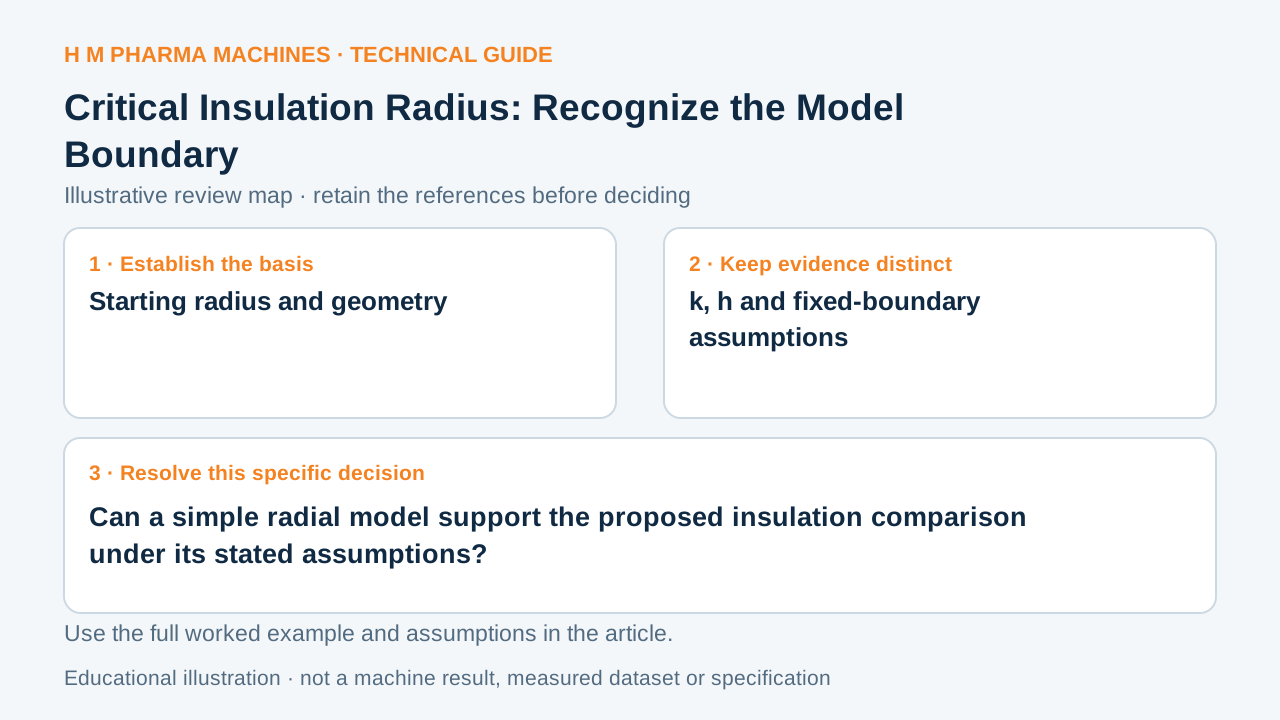
Can a simple radial model support the proposed insulation comparison under its stated assumptions?
This blank worksheet is for your own project. It contains no H M machine trial result.
| Review field | Reference or result | Responsible person |
|---|---|---|
| Starting radius and geometry | To complete | To complete |
| k, h and fixed-boundary assumptions | To complete | To complete |
| Complete before/after resistance | To complete | To complete |
| Additional heat paths and design purpose | To complete | To complete |
Customer Questions
Is k/h a universal insulation thickness?
It is a model-specific outer radius.
Does heat loss peak where resistance is lowest?
For a fixed temperature difference, yes.
Does the tiny-cylinder example specify a steam pipe?
No. Use the actual pipe and boundary conditions.
Related Equipment References
Review the actual offered equipment and application separately from this educational example.
Primary References
These references support the technical principles discussed in this guide. The worked examples and review questions are educational.
Discuss Your Machine Requirement
Share your product, container, required output and the evidence needed for your technical review.
Request a Technical Review